

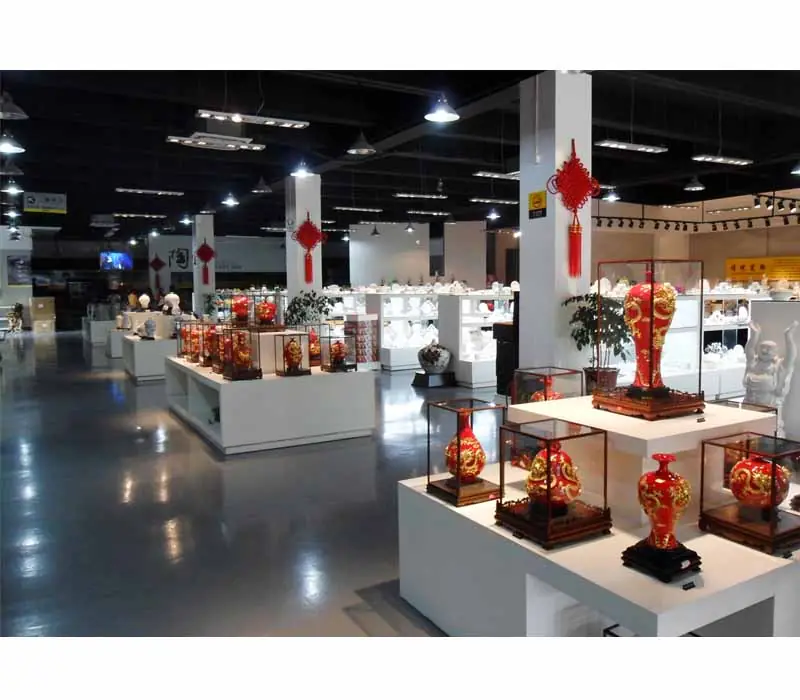
Explore the region
Why visit
Dehua is the inland, mountain side of Quanzhou’s maritime story. Its clay, water and long-running kiln communities produced both practical vessels and the fine white porcelain for which the county became known abroad. The museum makes that connection visible: a local material becomes a softly coloured glaze, a carefully modelled figure or a bowl that travelled far from Fujian.
This is a useful stop before treating “Dehua porcelain” as a single style. The displays move between archaeology, religious sculpture, household objects and export wares. They also keep the county’s working tradition in view: Dehua porcelain making is a national intangible cultural heritage, with forming, mould work, glazing and high-temperature firing all part of the craft rather than a single decorative finish.
What to see
Start with the fixed display Dehua Ceramic History. Its seven sections follow the local sequence from suitable soil and early kiln smoke through Song–Yuan wares, Ming white porcelain, Qing blue-and-white ceramics, overseas trade, the Republican period and modern production. The museum’s large white-porcelain relief in the entrance hall sets up the subject before the cases become more detailed.
The most distinctive objects are the Ming-period white-glazed figures attributed to He Chaozong. Look for Xiangyun Guanyin—the Guanyin standing on curling clouds—and Wenchang Dijun. Their calm faces and controlled, flowing robes show why Dehua sculpture is best understood by looking closely at modelling and surface, not only at the colour white. The museum’s own account identifies both as important works in its collection.
Then change scale. Jugs, bottles, bowls, jars and other vessels show how the same kiln tradition served daily life as well as devotional sculpture. The labels place these forms across the Tang, Song, Yuan, Ming and Qing periods, so compare rims, handles, feet and glaze colour rather than rushing from one famous figure to the next.
The Maritime Silk Road section adds a different kind of evidence. It includes blue-and-white plates, jars and bowls recovered from the Taixing, a nineteenth-century trading ship found in 1999. The county government describes 72 recovered pieces in this display, dated to 1822. They are a reminder that Dehua’s international history was built not only from rare masterpieces but also from wares made in quantity for long-distance trade.
If you want to understand the making behind the cases, read the craft notes alongside the objects. The national heritage record describes both direct forming of high-quality kaolin and mould-based forming, followed by glazing where required and firing at temperatures above 1,000°C. Dehua’s white porcelain can therefore be read through body, glaze, modelling and firing together. The National Museum’s overview also explains the warm ivory tones often associated with Ming Dehua ware and the later range of white bodies and firing effects.
The Song–Yuan Dehua Kiln Exhibition Hall is a separate venue beside the Qudougong kiln site. It interprets kiln archaeology and production through its own displays; do not assume it is another gallery or entrance of this county museum.
Plan your visit
The Quanzhou government’s museum directory records the museum as free to enter. It also gives the long-published seasonal hours as 08:00–12:00 and 15:00–18:00 in summer, and 08:00–12:00 and 14:30–17:30 in winter. Those hours should not be treated as current without checking: a Dehua government consultation that ended on 30 September 2026 proposed replacing the lunch closure with 09:00–17:00, or 09:00–17:30 in summer, with the first Monday of each month closed except public holidays. The page shows the consultation had ended but does not publish a final operating notice. Call 0595-23518883 before travelling, especially if you need to confirm a temporary exhibition, a foreign-passport entry arrangement or a guided visit.
Location and getting there
The current county notice gives the address as No. 17 Xuefu Road, Xunzhong Town, Dehua County, Quanzhou, Fujian (福建省泉州市德化县浔中镇学府路17号). An earlier official museum directory places it opposite the ceramics college, which remains a useful Chinese landmark when asking locally.
The county’s tourism guide records Bus Route 3 (德化3路) to Dehua Ceramic College (德化陶瓷学院) for the museum visit. Because Dehua has continued to publish route-adjustment notices, confirm the current bus, stop-side and operating direction locally. For the return, check the opposite-direction sign at the same stop rather than relying on an old timetable.
For an overland arrival, the county transport directory lists Dehua Longhu Coach Station (德化龙湖汽车站) at No. 160 Cidu Avenue, Dehua County (德化县瓷都大道160号). Arrange the final local bus or road transfer from there; no reliable journey time or current connection to the museum is established in the sources above.
For a taxi or ride-hailing car, show the driver 德化陶瓷博物馆,福建省泉州市德化县浔中镇学府路17号 and ask to be left at the public museum entrance. Keep the Chinese name for the return journey, and confirm the vehicle’s direction before leaving the museum.
Find Dehua Ceramics Museum
德化陶瓷博物馆 · 德化县
The pin marks the area, not the entrance.
Sources & visit information
Sources checked on 24 October 2026. Hours, tickets, reservations and transport can change; confirm with the operator before you go.
Image credits & notes (1)
- Dehua Ceramics Museum · 德化陶瓷博物馆Photo: 059517u.comResized for the web; the photo itself has not been edited.