

Explore the region
Tap any red Chinese text to hear it in Mandarin.
A village shaped by the sea
Xunpu lies southeast of central Quanzhou, on the north bank of the Jinjiang estuary beside the old Citong Port. It is still a community rather than a single monument: lanes lead between homes, small shops, shrines and the waterfront, while fishing, shellfish work and seafood businesses remain part of the local economy. Its interest is the way a maritime settlement is experienced at walking pace, not a checklist of enclosed sights.
The village’s most recognisable image is the zanhuawei: a ring of seasonal flowers arranged around a coiled bun. The headdress belongs with the traditional dajushan top and wide trousers associated with women’s coastal work. The style is now widely offered as a visitor experience, but its meaning is easier to understand when you also notice the shore, market life and the women’s everyday clothing rather than treating it as a costume prop. Xunpu women’s customs are listed as a national-level representative intangible cultural heritage project, with the practice recorded across several communities in Fengze District.
What to look for
Look closely at the keke cuo, or oyster-shell houses. Rows of overlapping shells form a scale-like outer wall, often combined with granite bases and red-brick openings. The material is a visible reminder of Xunpu’s relationship with the sea and with the trading world of historic Quanzhou; do not assume every shell-faced wall is an intact historic house, and do not enter a residence without permission.
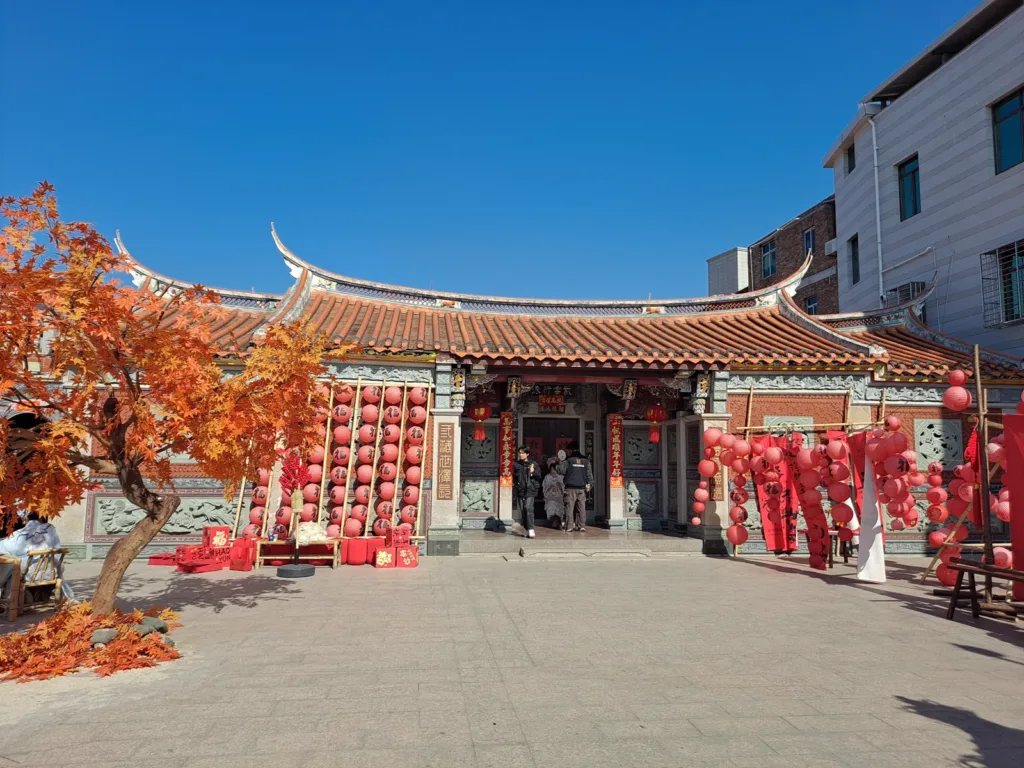
A useful first walk starts at the Xunpu Village Visitor Service Station and follows the village route to Shunji Palace, the local centre of Mazu worship, then past Siyuan Water Tower and through the older lanes. Continue along Xunpu Middle Road to the Landmark Triangle area. This locally published route links a shrine, a former water facility, residential streets, shops and shell houses, so it gives a better sense of the village than a quick photo stop.
Xunpu is a living neighbourhood. Ask before photographing residents, flower arrangers, seafood workers or the inside of a courtyard. Let people working at the water’s edge carry on, and keep the visit to public lanes and clearly open businesses.
Getting there and planning the visit
The village is in Donghai Subdistrict, Fengze District. There is no confirmed metro stop serving Xunpu in the route information reviewed; the practical final leg is a bus, taxi or a walk from the local stop. The village streets do not have one published opening schedule or a general attraction ticket in the sources reviewed. Flower styling, parking, cafés, markets and any separately managed venue may have their own hours or charges, so confirm those on arrival rather than assuming they are included.
For public transport, use the Chinese stop name 蟳埔菜市 (Xunpu Food Market). Local visitor information lists routes 39, 44, K301 and Tourist Route 1 for this stop, followed by a walk toward the visitor station. A Fengze District transport notice independently records K301 serving 蟳埔菜市 in both directions; check the live direction and last departure before boarding.
If you arrive by high-speed rail, the practical arrival stations named in local guidance are Quanzhou Railway Station (泉州站) and Quanzhou East Railway Station (泉州东站). Continue from either station by a current bus connection or taxi; neither station is at the village. For a taxi, show 蟳埔民俗文化村游客服务驿站 (Xunpu Folk Culture Village Visitor Service Station). If the driver needs a parking reference, use 丰海路396号,蟳埔民俗文化村新东停车场 (396 Fenghai Road, Xunpu Folk Culture Village Xindong Parking Lot), then walk to the service station. For the return, walk back to 蟳埔菜市 Xúnpǔ càishì and check the current city-bus direction.
A free night shuttle reported in 2025 connected Zhenwu Temple and Xunpu during a time-limited summer-to-autumn programme. It is not treated here as a current 2026 service. No current seasonal water shuttle or verified boat return is included; plan a road journey back.
Find Xunpu Village
蟳埔村 · 丰泽区
The pin marks the area, not the entrance.
Sources & visit information
Sources checked on 24 October 2026. Hours, tickets, reservations and transport can change; confirm with the operator before you go.
Image credits & notes (1)
- Shunji Palace (Shunji Gong), a Mazu shrine in Xunpu Village, Quanzhou Photo: H2v5o68zPhoto: CC0 1.0