

Explore the region
Tap any red Chinese text to hear it in Mandarin.
Why this pagoda matters
Liusheng Pagoda stands in Hanjiang Town, Shishi, on the southern side of Quanzhou Bay rather than in Quanzhou’s old urban centre. The official heritage record places it at the northern end of Shihu Peninsula, on Jinchai Mountain, where ships leaving the bay for inland ports could use the tower as a landmark.
Its first construction is dated to 1111–1113, during the Northern Song’s Zhenghe era. The tower seen today was rebuilt between 1336 and 1339, with funding from the local maritime merchant Ling Huifu after wartime damage. That sequence gives the monument a more precise story than the label “ancient pagoda”: it grew out of the working port, religious life and merchant economy of medieval Quanzhou.
Liusheng Pagoda is one component of the serial World Heritage property Quanzhou: Emporium of the World in Song–Yuan China. The UNESCO listing treats Quanzhou as a connected maritime system of religious buildings, production sites, bridges, docks and pagodas; it does not turn those separate places into one ticketed attraction or one entrance. Shihu Dock and nearby religious sites therefore remain distinct places even when they are part of the same historical landscape.
What to look for
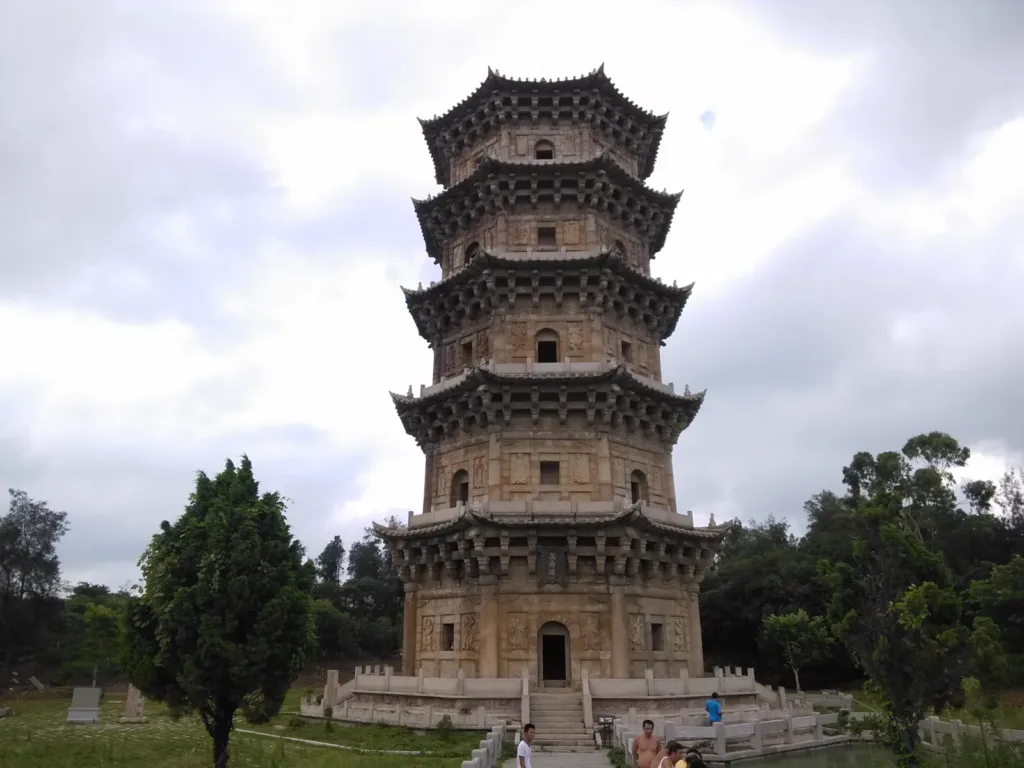
The tower is a five-storey, eight-sided granite structure in the form of a wooden pavilion pagoda. It rises about 36.06 metres from a two-level Sumeru base. Each storey has four arched doorways and four niches, set in alternating positions, with reliefs of vajra guardians, protective figures, arhats and bodhisattvas. Look from the base upward: the changing rhythm of doors, niches, projecting eaves and carved figures is easier to understand in sequence than in a single photograph.
The stonework also records its own history. Local government descriptions identify the “Wanshou Pagoda” inscription above the southern doorway and construction inscriptions on the beams. If the base is open when you visit, these details are worth looking for before you turn toward the bay.
The setting is part of the experience. The tower’s original role was navigational: it faced the maritime approach around Daiyu Gate and helped vessels find the route between Quanzhou Bay and the inland waterways. From the hill, read the pagoda together with the working port and the separate Shihu Dock rather than treating the tower as an isolated inland monument.
Planning your visit
Use the Chinese name 六胜塔 Liùshèng Tǎ when searching and keep 六胜塔公园(石湖港) for the local transport destination. The official pages read for this guide establish the heritage location but do not publish a current ticket price, opening hours, reservation procedure or passport-specific admission rule. They also do not confirm whether visitors may enter the tower interior. Check the current local notice before setting out, especially if your plan depends on climbing or an early or late visit.
This is a separate outing in Shishi, not a stop inside Quanzhou’s old-town pedestrian area. Allow time to view the tower from its base, read the stonework and look across the bay. Do not assume that a nearby dock, temple or other Quanzhou World Heritage component shares the same gate or ticket.
Getting there
- Bus: Shishi Bus 7 (石狮7路) is recorded as running between 服装城公交站 and 石湖港(六胜塔公园). Ride toward the Shihu Port terminal; the same terminal is the return direction toward 服装城公交站. A 2025 transport notice also recorded a temporary route adjustment, so check the live stop position and return service before boarding.
- Rail: There is no railway station at the pagoda. For high-speed rail arrivals, Quanzhou South Railway Station(泉州南站) is a named Shishi transfer hub in the city’s public-transport notices. From the station, use a current bus interchange or take a taxi or ride-hailing car to 六胜塔公园(石湖港); do not treat the station as the visitor entrance.
- Taxi or ride-hailing: Show the driver “六胜塔公园(石湖港),石狮市蚶江镇石湖村金钗山”. Confirm that the drop-off is at the public park or pagoda visitor approach, not simply a map result for the wider port area. The site’s older guide warns that its map pin is not reliable, so keep the Chinese name visible and confirm the return pickup point locally.
- Metro and water transport: No metro leg or current tourist water service is established for this site in the sources used here. A Shishi government notice described a special coastal bus shuttle stopping at 六胜塔 only during 1–5 May 2025; that seasonal event service should not be treated as a year-round timetable.
Find Liusheng Pagoda
六胜塔 · 石狮市
The pin marks the area, not the entrance.
Sources & visit information
Sources checked on 24 October 2026. Hours, tickets, reservations and transport can change; confirm with the operator before you go.
- Liusheng Pagoda — Quanzhou Municipal Government heritage register ↗
- Quanzhou: Emporium of the World in Song–Yuan China — UNESCO World Heritage Centre ↗
- Liusheng Pagoda — Shishi Municipal Government ↗
- Liusheng Pagoda: the navigation pagoda for ships entering and leaving Quanzhou Port — Quanzhou Evening News ↗
- Fujian Shishi: Liusheng Pagoda lights the Maritime Silk Road — Xinhua ↗
- Four Shishi bus routes temporarily adjusted from today — Quanzhou Evening News / Quanzhou Bus ↗
- Shishi buses add services for the May Day holiday — Shishi Municipal Government ↗
Image credits & notes (1)
- Liusheng Pagoda at the tip of Shihu Peninsula, Shishi, viewed from its base Photo: 董辰兴 (Dong Chenxing)Photo: CC BY-SA 4.0