

Photo adjustments
Wikimedia thumbnail; fitted to the ranking-card frame.
Explore the region
About South Putuo Temple
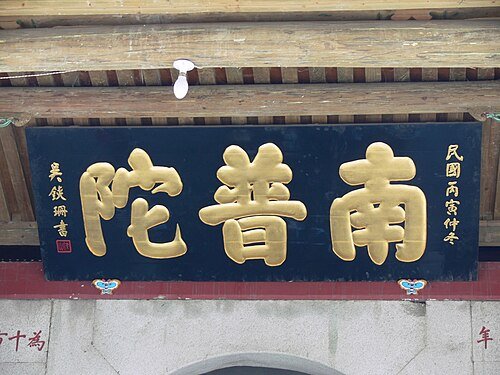
The temple’s dedication to Guanyin is expressed most clearly in the Great Compassion Hall, while the Heavenly Kings Hall introduces the sequence of worship spaces. Bright Minnan roof decoration adds detail to the buildings’ silhouette. Treat the temple as an active religious place, taking time around the halls before deciding whether the separately accessed hillside paths suit the day.
South Putuo Temple was founded in the late Tang dynasty as Sizhou Temple (泗洲寺). The Northern Song monk Wencui (文翠) rebuilt it as Wujin Yan (无尽岩); it was abandoned in the Yuan dynasty, then rebuilt on its present site in the Ming as Puzhao Temple (普照寺). Abandoned again after warfare in the early Qing, it was restored and expanded in 1684 with funding from Shi Lang (施琅), the Marquis who Pacified the Seas (靖海侯), who added a Great Compassion Hall for Guanyin in imitation of Mount Putuo in Zhejiang, giving the temple its present name. It was damaged during the Cultural Revolution and restored after 1976.
The temple covers more than 30,000 square meters, laid out as three halls and seven courtyard buildings facing south with hills behind and the sea in front, in a Minnan architectural style. Flanking structures include bell and drum towers, an arhat hall, the Taixu Library and classrooms of a Buddhist college. A square fangsheng (release) pond about 30 meters on each side and a lotus pond roughly 100 meters long lie in front of the Heavenly Kings Hall; the lotus pond is enclosed by a glazed-tile-roofed wall with a double-eaved gateway on each side, inscribed with the phrase Ludao Mingshan (鹭岛名山), written by Zhao Puchu (赵朴初), head of the Buddhist Association of China.
What to look for
- The Heavenly Kings Hall’s roof decoration and Buddhist figures.
- The Great Compassion Hall associated with Guanyin worship.
Location & getting there
Getting to South Putuo Temple
Use the temple entrance at No 515 Siming South Road, beside Xiamen University’s Siming campus. Check the temple’s current visitor arrangements independently of any university booking.
Combine your visit
A suggested sequence linking the specific features of this visit.
-
Heavenly Kings Hall
Begin with the entrance hall and its roof decoration.
-
Main Buddha hall
Continue along the principal worship axis.
-
Great Compassion Hall
Focus on the temple’s Guanyin tradition.
This order is editorial. Confirm access and any transfers between stops; it does not establish a walking route, same-day connection or common admission ticket.

Find South Putuo Temple
南普陀寺 · 厦门市
The pin marks the area, not the entrance.
More places nearby
Approximate straight-line distances between map pins, not travel distances.
Xiamen University 厦门大学
Less than 1 km awayXiamen University’s Siming campus combines a coastal setting with architecture shaped by founder Tan Kah Kee’s support. The early Qunxian buildings and later Furong group mix southern Fujian materials and roof forms with…
View guide →Xiamen Botanical Garden 厦门园林植物园
1 km awayXiamen Botanical Garden uses a rocky hillside setting for a series of specialised plant collections. Rainforest World contrasts dense tropical planting with the open shapes of the succulent collection, while the palm area…
View guide →Hulishan Fortress 胡里山炮台
2 km awayHulishan Fortress occupies a coastal position at the southeastern end of Xiamen Island. The battery was built in 1894 during the late Qing period.
View guide →Sources & visit information
The sources below support the place-specific description and arrival information. Suggested combinations are editorial planning ideas; confirm current opening, entry arrangements and transport services for your date.
- South Putuo Temple ↗
- you.ctrip.com ↗
- www.amap.com ↗
- Chinese Wikipedia: 南普陀寺 (revision 88641870, 2025-08-08) ↗
Visitor information adapted and edited from Wikipedia contributors, “South Putuo Temple” · CC BY-SA 4.0. Source revision 1366926327.
Background paragraphs translated and condensed from Wikipedia contributors, "南普陀寺", Chinese Wikipedia · CC BY-SA 4.0. Source revision 88641870.