


Explore the region
About Bafang Thirteen Lanes
Bafang Thirteen Lanes (八坊十三巷) is a historic Hui Muslim quarter in the main urban area of Linxia City (临夏市), capital of the Linxia Hui Autonomous Prefecture (临夏回族自治州) in Gansu, bounded by Beidajie (北大街) to the north, Qianheyan (前河沿) to the south, Jiefang Road (解放路) to the east and Xinxi Road (新西路) to the west.
Linxia was known in the past as Hezhou (河州). It sits where the Loess Plateau meets the Qinghai-Tibet Plateau, and the Silk Road, the Tang-Tibet road and the Gansu-Sichuan road all crossed here. 'Hezhou Bafang' (河州八坊), the 'eight quarters', was the old name for the Hui district outside the city's south gate. From the Tang dynasty, merchants and preachers from Arabia and Persia came to trade and teach, and some stayed. As their numbers grew from the Song dynasty through to the Republic, the Hui community built mosques and founded congregations, and the quarter grew up with homes around the mosques and trade around the congregations. The eight quarters are grouped around eight mosques, among them the Nanguan Great Mosque (南关大寺), the North Mosque (清真北寺) and the Old and New Wangsi mosques (老王寺, 新王寺).
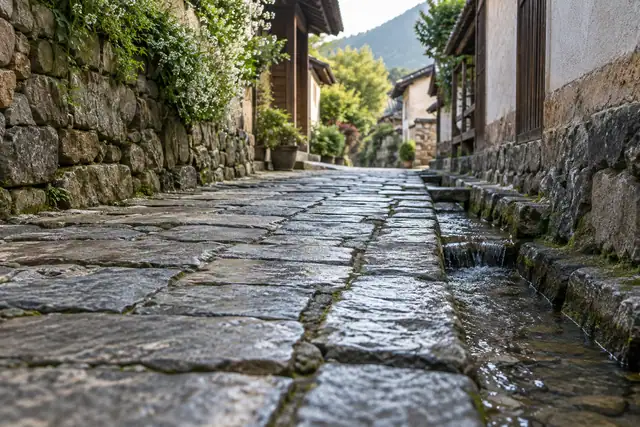
The present look of the houses dates from the Republican era. The city government began restoring the tile-roofed area in 2015 and in 2017 extended the work to about 3.3 km of lanes, including Zhuanyuan Lane (专员巷), Wangsi Lane (王寺巷), Shiqiao Lane (石桥巷), Bei Lane (北巷) and both banks of the Hongshui River (红水河). The district became a national 4A tourist attraction on 6 January 2018. Its lanes keep 41 courtyard compounds and 109 houses in fairly complete condition.
Da Gongguan (大公馆), the mansion at No. 80 Dagaxiang (大旮巷), was once the home of a prominent family. Built on the plan of a Beijing courtyard house, it had four main courtyards plus rear, south and carriage yards, a garden and storerooms, ringed by tall enclosing buildings and sentry towers. Its decoration joins Hui brick carving with Han woodwork and Tibetan-style painting. Less than a tenth of the original buildings survive, and the house is now used as the Bafang Folk Custom Museum (八坊民俗馆). In Bei Lane, the brick screen wall in front of the North Mosque dates from 1741, according to a stele in the mosque, and the Gansu Daily describes it as the oldest surviving large free-standing brick-carved screen wall. Its three panels show a dragon teaching its young in the centre and phoenixes on wutong trees at the sides. Brick carvings in the quarter's mosques also show pines, peonies and Hui household objects such as the washing ewer, abacus, tea bowl and brush rack.
What to look for
- Da Gongguan (大公馆), the multi-courtyard mansion at No. 80 Dagaxiang, now the Bafang Folk Custom Museum
- The 1741 brick screen wall of the North Mosque (清真北寺) in Bei Lane, with its central dragon panel and phoenix side panels
- The eight mosques around which the quarters grew, including the Nanguan Great Mosque (南关大寺)
- Brick carvings of peonies, pines and Hui household objects on mosque walls and screens
- The restored lanes, such as Zhuanyuan Lane (专员巷) and Shiqiao Lane (石桥巷), and the banks of the Hongshui River
Location & getting there
Getting to Bafang Thirteen Lanes
- Search for 八坊十三巷 with 临夏回族自治州 and 临夏市.
Find Bafang Thirteen Lanes
八坊十三巷 · 临夏市
No reliable map pin yet: search by the Chinese name.
Sources & visit information
Written from the linked sources and fact-checked against them on 2026-09-23. Opening hours, admission and access arrangements are not covered; confirm current visitor information with the site.
Some facts checked against Wikipedia contributors, "八坊十三巷" · CC BY-SA 4.0.