

Explore the region
Tap any red Chinese text to hear it in Mandarin.
Sertri Monastery, also called 达仓郎木赛赤寺 Dácāng Lángmù Sàichì Sì, is the Gansu-side monastery of Langmusi in Luqu County, Gannan Tibetan Autonomous Prefecture. It is a working Gelug Tibetan Buddhist institution, not a museum arranged only for sightseeing. The provincial government describes the monastery as one of the larger and more influential Tibetan Buddhist institutions in the Gansu–Qinghai–Sichuan border region.
The name Langmusi refers to the town as well as to the religious landscape. The Bailong River runs out of Namo Gorge and divides the settlement: the north bank, in Gansu, contains Sertri Monastery, while the south bank, in Sichuan, contains Kirti Monastery, also known as Geerdeng Monastery. A visit to Sertri is therefore a visit to one specific side of a cross-provincial town; do not use “Langmusi” alone when asking for a taxi or checking a map.
The county’s cultural-history page and its tourism overview do not give the same founding date. One places Sertri’s beginnings between 1564 and 1643; the other says that the temple was founded in 1748. This guide does not force those accounts into one date. What is clear is that the monastery has a long institutional history, was rebuilt after its closure in the twentieth century, and remains a living religious site.
What to notice
Read the complex as a monastery, not a single shrine
The county account describes five traditional colleges—dialectics, tantra, Kalachakra, medicine and woodblock printing—and records assembly halls, Maitreya, reliquary, Hayagriva and protector chapels among the site’s religious buildings. It also records a historic collection of more than 800 thangkas and gold-written Kangyur and Tengyur scriptures. These figures belong to the county’s historical account and should not be read as a promise that every object or interior is visible on a particular day.
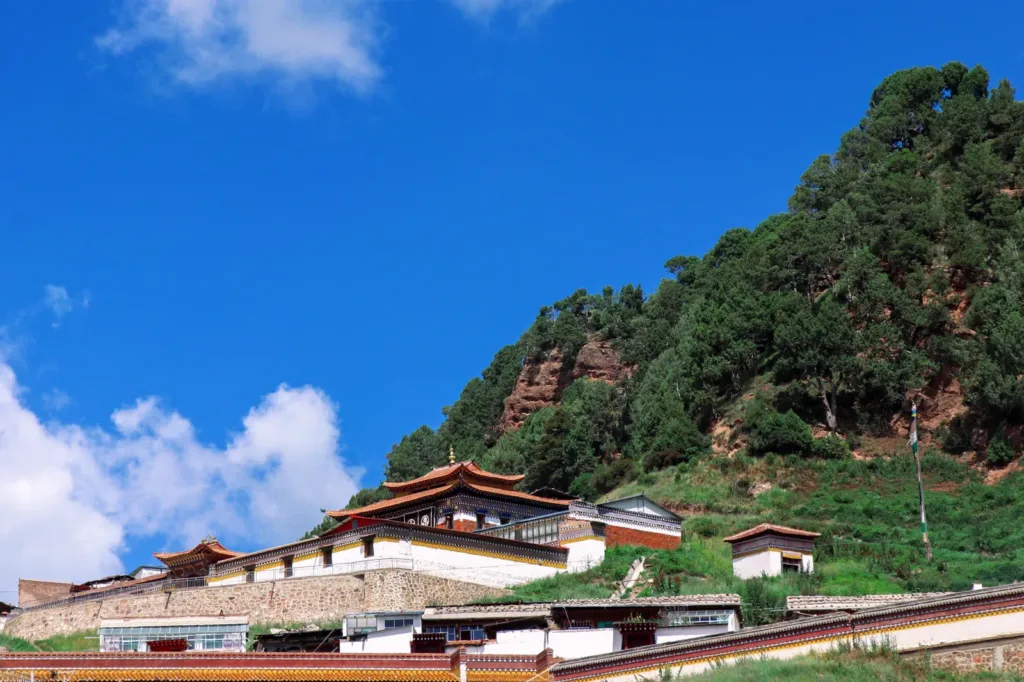
From outside, pay attention to the way halls, monastic residences and religious structures climb the Gansu-side slope above the river. The river valley is part of the experience: look back toward the town to understand how the two monastery communities occupy different banks, then keep the rest of your visit within the public routes of Sertri Monastery.
Understand the New Year rituals as living religion
The county page documents a two-day New Year observance combining a large Buddha display, qiangmu (羌姆) religious dance and the burning of ritual torma. Its detailed account is a 2007 field record, not a current annual timetable. If your trip is intended to coincide with a ceremony, ask the monastery or the current local tourism authority for that year’s notice rather than relying on a remembered festival date.
A ritual courtyard, a display terrace and a sky-burial site are not ordinary photo stops. Keep clear of ceremonies and funerary activity, never photograph a ritual or mourners without explicit permission, and follow signs or instructions from monks and local staff. In prayer areas, walk quietly, dress modestly and do not enter a hall simply because its door is open.
Visiting and access
A current named gate, ticket counter, opening time and passport-specific admission procedure are not established by the reliable public pages used for this guide. Check the same day which courtyards and interiors are open, whether a ticket is required, and whether the entry arrangement accepts a foreign passport. A domestic-ID procedure should not be assumed to apply to an international visitor. Langmusi is in Gansu and Sichuan, not the Tibet Autonomous Region; do not import Tibet Travel Permit rules into this visit, and do not assume from that distinction that every current admission question is settled.
For a map or taxi, use 郎木寺甘肃侧赛赤寺 Lángmùsì Gānsù Cè Sàichì Sì and add 甘南藏族自治州碌曲县郎木寺镇 Gānnán Zàngzú Zìzhìzhōu Lùqū Xiàn Lángmùsì Zhèn. The county government places Langmusi in southern Luqu County, about 90 kilometres from the county seat, with National Highway G213 running through the town; its tourism overview also describes the town as the end of the Lan–Lang highway.
The most specific public final-approach clue located for the monastery is a recent local travel guide’s description of an uphill, stone-paved lane from Langmusi town centre to the Sertri entrance. Treat that as orientation, not as a current official gate notice: confirm the active public entrance or ticket point locally, and make sure a driver is taking you to the Gansu-side monastery rather than the Sichuan-side complex.
There is no verified metro or railway connection to the monastery. An undated local Langmusi operator page lists a coach from 合作汽车南站 Hézuò Qìchē Nánzhàn to Langmusi and describes an inbound Lanzhou–Diebu coach as a possible drop at 郎木寺桥头 Lángmùsì Qiáotóu; because the page does not show a publication date, its times, fares and current operation must be checked at the station. It also lists a Langmusi–Hezuo return coach, but does not provide a current last-departure guarantee.
Plan the return before entering the monastery. Ask your driver, accommodation or the current coach station where the reverse service leaves that day, or arrange a car back to 合作市 Hézuò Shì or 碌曲县城 Lùqū Xiànchéng in advance. Do not build a same-day connection around the old operator timetable. The county describes Langmusi as a high, cold settlement above 3,480 metres; weather and road conditions can change the practical return plan, especially outside the warmer travel season.
Find Langmusi Sertri Monastery, Gansu Side
郎木寺甘肃侧赛赤寺 · 碌曲县
The pin marks the area, not the entrance.
Sources & visit information
Sources checked on 1 November 2026. Hours, tickets, reservations and transport can change; confirm with the operator before you go.
Image credits & notes (1)
- Exterior view of Taktsang Lhamo (Sertri) Monastery on the wooded Gansu-side hillside at Langmusi, Luqu County, Gansu, China. Photo: 明雨卿晨Photo: CC BY-SA 2.5