

Photo adjustments
Full frame retained; proportionally resized and converted to WebP. No retouching or changes to the photographed subject. Card displays may crop the view.
Explore the region
About Kongtong Mountain
The Zhongtai temples and the higher Huangcheng precinct give the ascent a sequence of religious spaces, while gates and steep stairs connect them through the terrain. The mountain is also associated with the legend of the Yellow Emperor seeking instruction from Guangchengzi. Plan around a named entry route and your ability on steps rather than aiming vaguely for the summit pin.
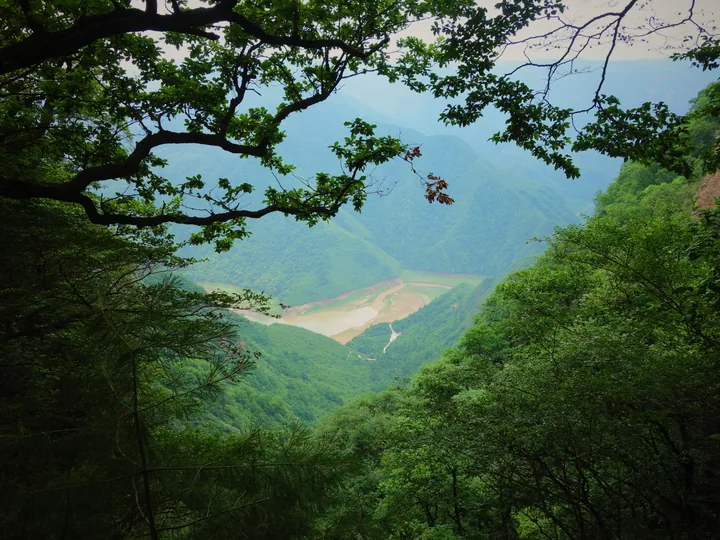
Religious objects were damaged in 1958 and during the Cultural Revolution (1966-1976), and the mountain's religious sites were later restored. In 1980, Kongtongxia Reservoir (崆峒峡水库) was built in the gorge south of the mountain, with a hydroelectric station of 1,890 kilowatts installed capacity. The mountain forms part of a spur of the Liupan Mountains (六盘山), running north to south for about 100 kilometres with an average width of 15 kilometres. Its main peak, Cuiping Peak (翠屏峰), reaches 2,123 metres. Buddhist and Daoist compounds are concentrated in the Five Terraces (五台) area. The mountain is a National Key Scenic Area (国家重点风景名胜区) and the birthplace of the Kongtong martial-arts school (崆峒派).
What to look for
- The Buddhist temple precinct around Zhongtai.
- Huangcheng and the steep connecting route through Chaotian Gate and Sanjiao Cave.
Location & getting there
Getting to Kongtong Mountain
For a Zhongtai or Xiangshan visit using scenic transport, go to the ticketing centre at Kongtong Ancient Town. Separate walking entries use the mountain’s south or east gates; match the entrance to your booked route and confirm the return transport.
Combine your visit
A suggested order for the documented features and stops.
-
Zhongtai temples
Begin with the central Buddhist precinct after the arranged ascent.
-
Sanjiao Cave route
Follow the permitted connection through the mountain’s religious landscape.
-
Huangcheng
Complete the higher compound before returning by the route and transport you selected.
This is an editorial sequence. Check access and any road or boat transfers; it does not establish a walking route, common ticket or guaranteed same-day connection.
Find Kongtong Mountain
崆峒山 · 平凉
The pin marks the area, not the entrance.
More places nearby
Approximate straight-line distances between map pins, not travel distances.
Wangmu Palace Grottoes 王母宫石窟
79 km awayThe Wangmu Palace grotto at the foot of Huishan is a Buddhist cave beneath a hill associated with the Queen Mother of the West. A central pillar creates a passage around its core, with carved figures covering the pillar and…
View guide →Dadiwan Site 大地湾遗址
82 km awayDadiwan’s excavations reveal successive generations of settlement, with houses, hearths, pottery and traces of cultivation. The large F901 building stands out through its organised rooms, substantial supports and central hearth…
View guide →Northern Grotto Temple 北石窟寺
92 km awayNorthern Grotto Temple is carved into yellow sandstone beside the Pu River. The figures are cut from the rock itself, giving the site a different character from cave complexes dominated by modelled clay. Cave 165 is particularly…
View guide →Sources & visit information
The sources below support the place-specific description and arrival information. Suggested combinations are editorial planning ideas; confirm current opening, entry arrangements and transport services for your date.
Visitor information adapted and edited from Wikipedia contributors, “崆峒山” · CC BY-SA 4.0. Source revision 91271937.
Background paragraphs translated and condensed from Wikipedia contributors, "崆峒山", Chinese Wikipedia · CC BY-SA 4.0. Source revision 91271937.