

Explore the region
Tap any red Chinese text to hear it in Mandarin.
What it is
Lychee Bay is the historic waterway landscape around Pantang (泮塘) in Xiguan (西关), Liwan District. It is not simply another name for Liwan Lake Park: the park is a neighboring, purpose-built lakeside green space within the wider Lychee Bay–Pantang area. The city describes the park as excavated in 1958 and formally named in 1960; its published boundary runs between Longjin West Road, Xiguan Kou, Huangsha Avenue and Zhongshan 8th Road.
The creek landscape grew out of Pantang’s low-lying ponds and waterways. A Guangzhou government cultural feature traces the area’s garden history to the Southern Han royal Hualin Garden, and describes how the western Xiguan waterways later became known as Lychee Bay amid lychee groves and gardens. The historic gardens themselves should not be expected as surviving attractions; the present visit is about the restored water edge, the park and the older neighborhood around it.
How to explore
Use Liwan Lake Park (荔湾湖公园) as an easy landmark, then follow the open creek edges and cross the bridges at a relaxed pace. The park’s four connected lakes—Xiaocui, Yucui, Ruyi and Wuxiu—make a greener, more spacious contrast to the narrow channel-side streets. The creek was uncovered and restored in 2010. A later municipal report describes a series of bridges along the channel, including Longjin (龙津), Dexing (德兴), Daguan (大观), Rouji (柔济) and Duobao (多宝); use their names as details to notice rather than as a guaranteed turn-by-turn route.
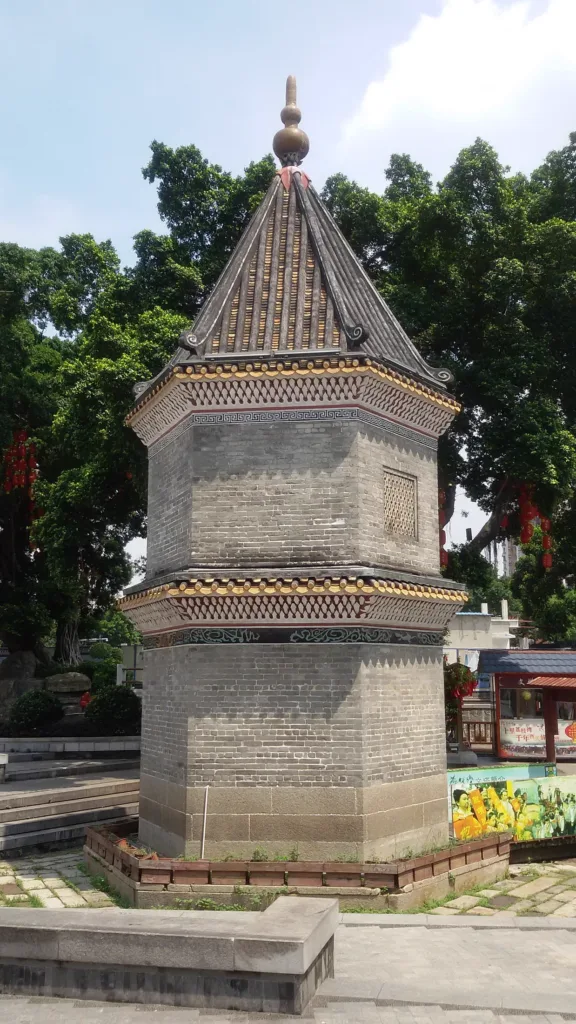
Allow time to look from both sides of the water: the bridges frame short views down the channel, while the surrounding Pantang lanes and historic buildings show that Lychee Bay is a neighborhood landscape, not a single fenced attraction. Liang Ancestral Hall (梁家祠) and Guangzhou Wenta (广州文塔) are among the creek-side cultural landmarks identified in the municipal account. The nearby Pantang Five Yue (泮塘五约) retains a historic village layout, but is a separate place to explore rather than part of the lake park.
Practical access
For the Liwan Lake Park end, the municipal park guide identifies Zhongshanba Station (中山八) and exit B. A current station list places Zhongshanba on Metro Line 5 and Line 11. The creek has several access points, so treat Zhongshanba as a practical approach to the park and nearby Pantang, not as a single entrance for the whole waterway. The same station is a straightforward reference point for the return journey; check the station and exit signage on arrival rather than relying on an assumed walking time.
For a taxi or ride-hail, give the destination as 荔湾湖公园 Lìwān Hú Gōngyuán. The municipal guide lists the park’s adjoining streets as Zhongshan 8th Road, Nan’an Road and Lizhiwan Road, but does not identify one universal drop-off for the creek. Confirm the actual meeting point with the driver.
No current official source reviewed here establishes opening hours, an admission policy for every section, or whether sightseeing boats are operating on a particular day. Do not plan around a boat ride without checking locally. The park and creek are distinct from any ticketed cultural venue nearby.
Find Lychee Bay
荔枝湾 · 荔湾区
The pin marks the area, not the entrance.
Sources & visit information
Sources checked on 22 October 2026. Hours, tickets, reservations and transport can change; confirm with the operator before you go.
Image credits & notes (1)
- Guangzhou Wenta (广州文塔), a historic landmark in the Lychee Bay area of Guangzhou. Photo: CRCHFPhoto: CC BY-SA 3.0