


Get to know Chengqu

Photo adjustments
Full frame retained; proportionally resized and converted to WebP. No retouching or changes to the photographed subject. Card displays may crop the view.
- Administrative area
- District · 市辖区
- Part of
- Shanwei
- Chinese name
- 城区
- Local areas
- District guide
Area & population
- Area in the source
- 421.00 km²
Source: cited geographic source, as of the dates shown.
Setting and landscape
The district has 97 kilometres of coastline and a sea area of 8,949 square kilometres with 376 islands. The district government sums up its scenery as "one lake, two hills, two bays, three islands": Pinqing Lake (品清湖), the Fengshan (凤山) and Tongding (铜鼎山) hills, Yinlong Bay (银龙湾) and Jinding Bay (金町湾), and the islands of Yuzai (屿仔岛), Guiling (龟龄岛) and Jiangmu (江牡岛). Shanwei Port is a national first-class fishing port; Magong (马宫) is a second-class and Jiesheng (捷胜) an ordinary fishing port.
History and culture
When Shanwei city was created from Haifeng and Lufeng counties in January 1988, seven coastal towns of Haifeng became Chengqu. In 1989 Shanwei town was replaced by the Fengshan (凤山), Xiangzhou (香洲) and Xingang (新港) sub-districts, and in 1992 Tianqian (田墘) and Zhelang (遮浪) were split off to form the Honghaiwan Economic Development Experimental Zone (红海湾经济开发试验区). The district government points to the Shakeng culture (沙坑文化), which it dates back 6,000 years, and to Ming-dynasty coastal defences such as the Changsha fort (长沙古炮台) and Kanxia (坎下城).
Three rare opera forms, Baizi opera (白字戏), Zhengzi opera (正字戏) and Xiqin opera (西秦戏), are national intangible heritage, as are the Shanwei fishing songs (汕尾渔歌), listed in 2014 with the district's cultural centre as their safeguarding body. The songs are improvised narrative and lyric pieces of the Ou-boat fishing families (瓯船渔民), who moved south in the Song and Yuan periods, and are sung in the Hoklo dialect of Southern Min. The folklorist Zhong Jingwen (钟敬文) collected them in the 1920s and published them in 1927.
What to see
The Fengshan Mazu Temple (凤山祖庙) has what the district government calls the tallest stone statue of Mazu (妈祖) in China, together with a 60,000-square-metre cultural plaza. Other A-level scenic areas are the Tongding Hill tourist area (铜鼎山旅游区), the Chenzhou oyster village (晨洲蚝乡旅游景区), the Laodetou marine culture park (老德头海洋文化园) and the Zhonghong ecological park (中宏生态园); Jinding Bay has a provincial-level resort.
Food and local products
Chenzhou oysters (晨洲蚝), purple sea urchin (紫海胆) and haili fish (海鲡鱼) are promoted as the "three delicacies of Shanwei". Local cooking draws on Cantonese, southern Fujian and Hakka traditions, and the district's own snacks include caicha (菜茶), sweet and savoury thin pancakes (咸甜薄饼), xiaomi (小米) and caibao guo (菜包粿). Er Malu (二马路) food street and the Pinqing beef brisket street (品清牛腩一条街) are presented by the district as its food calling cards.
Getting oriented
The Shenzhen–Shantou Expressway (深汕高速公路) and the Xiamen–Shenzhen Railway (厦深铁路) both cross the district, and Shanwei Station on that railway lies within it.
Highlights
- Fengshan Mazu Temple 凤山祖庙: A-level scenic area with a Mazu stone statue described by the district government as the tallest in China.
- Pinqing Lake 品清湖: The lake in the district's "one lake, two hills, two bays, three islands" landscape.
- Shanwei fishing songs 汕尾渔歌: National intangible heritage since 2014, sung in the Hoklo dialect by the Ou-boat fishing families.
- Chenzhou oysters 晨洲蚝: One of the "three delicacies of Shanwei"; the oyster village is an A-level scenic area.
Sources for this guide
汕尾市城区概况_今日城区_汕尾市城区人民政府 · Chengqu District People's Government, Shanwei
城区 (汕尾市) - 维基百科,自由的百科全书 · Wikipedia (Chinese) · CC BY-SA 4.0
渔歌(汕尾渔歌) - 中国非物质文化遗产网·中国非物质文化遗产数字博物馆 · China Intangible Cultural Heritage Network (Chinese National Academy of Arts)
Original English written from the listed sources and checked sentence by sentence against quoted extracts by a separate reviewer. Updated 2026-09-23.
Explore Chengqu
Core places to explore, with English and Chinese names.
Places to explore around Chengqu
 AI illustration · AI 示意图(仅供参考,非该地点实拍)
Honghai Bay Zhelang Peninsula红海湾遮浪
Honghaiwan Zhelang (红海湾遮浪) is the Zhelang (Nan'ao) peninsula projecting into the sea where Honghai Bay meets Jieshi Bay, in the Red Bay Economic Development Zone at Shanwei, Guangdong.
Read the place guide →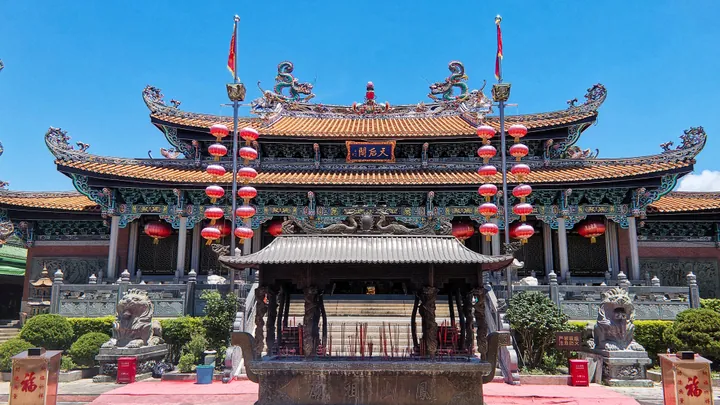 The Mazu Pavilion of Fengshan Ancestral Temple, Shanwei · 汕尾凤山祖庙妈祖阁 Source-recorded photograph date: 2022-08-14 12:49:33.
Fengshan Mazu Temple凤山祖庙
Mazu temple founded in 1636 by Fujian fishermen on Fengshan hill in Shanwei, with a 16.83 m granite Mazu statue and a yearly birthday temple fair.
Read the place guide →Plan your visit
Getting there
Chengqu covers the centre of Shanwei. Search for 城区 in a map app to find stations and your accommodation.
Where to stay →Build your route
Honghai Bay Zhelang Peninsula and Fengshan Mazu Temple are both listed here. The linked place guides have entrance and visit details.
Continue with Shanwei →More in Shanwei
Sources & geographic information
Administrative names and parent areas: Official geographic directory · Reference date 2026-09-06.
Some facts checked against 城区 (汕尾市) — Wikipedia contributors, CC BY-SA 4.0.
Photo: Fengshan Mazu Temple · HMGiovanniV · CC BY-SA 4.0. Full frame retained; proportionally resized and converted to WebP. No retouching or changes to the photographed subject. Card displays may crop the view.

Map data © OpenStreetMap contributors. Pins mark approximate centres, not entrances or boundaries.