

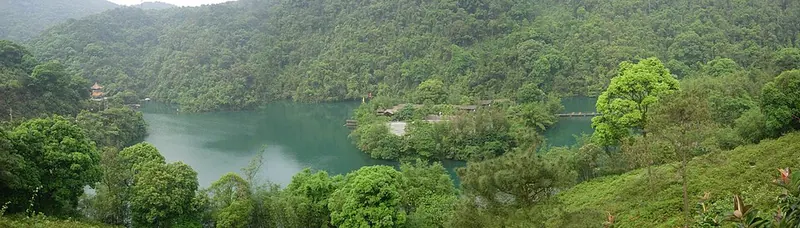
Photo adjustments
Full frame retained; proportionally resized and converted to WebP. No retouching or changes to the photographed subject. Card displays may crop the view.
Explore the region
About Dinghu Mountain
Visitor paths pass dense trees and stream valleys, with Feishuitan providing a waterfall-and-pool focus and Qingyun Temple introducing a sequence of religious buildings. Baoding Garden adds a contrasting designed space. Keep to the designated scenic routes: the reserve’s ecological importance does not mean all its forest is open for recreation. Choose the waterfall and temple circuit before deciding whether to add another mountain area.
Dinghu Mountain was originally named Ding Hu (顶湖) after a lake on its summit; according to legend, the Yellow Emperor defeated Chiyou and cast a cauldron (鼎) here, giving the mountain its present name. It ranks first among the Four Great Mountains of Lingnan (岭南四大名山), a group that also includes Luofu, Danxia and Xiqiao. In 1956 it became the first nature reserve in China.
The reserve's highest peak, Jilong Shan (鸡笼山), reaches 1000.3 meters. Forest cover reaches 78.8 percent, ranging from gully rainforest near the foot to subtropical monsoon evergreen broadleaf forest higher up, with coniferous-broadleaf mixed forest as the dominant type. Located on the Tropic of Cancer, the mountain has a subtropical monsoon humid climate; unlike most places at this latitude, which are desert, it stays evergreen year-round.
The reserve holds over 500 plant species, including 23 rare species under state protection, and is home to 178 bird and 38 mammal species; it has been called a gene bank of South China's biological species and a living natural museum. In 1979 it became one of the first UNESCO Man and Biosphere research stations, and in 1982 it joined Seven Star Crags to form part of the first group of 44 national key scenic areas; in 2020 it was rated a national 5A tourist attraction.
What to look for
- Feishuitan concentrates the mountain stream into a waterfall and pool setting.
- Qingyun Temple provides a built religious focus within the forest.
Location & getting there
Getting to Dinghu Mountain
Use the main scenic entrance on Shangshan Road in Dinghu District’s Kengkou area. Follow visitor signs for Dinghu Mountain, then choose the official pedestrian or internal-transport route to Feishuitan and Qingyun Temple.
Combine your visit
Suggested order for the visit:
-
Main entrance and route information
Check forest and transport notices.
-
Feishuitan
Look at the waterfall from the designated path.
-
Qingyun Temple
Continue with the forest-set religious complex.
This is an editorial sequence of named spaces or places. It does not imply a verified walking connection or promise opening, ticket availability or a journey time.

Find Dinghu Mountain
鼎湖山 · 肇庆市
The pin marks the area, not the entrance.
More places nearby
Approximate straight-line distances between map pins, not travel distances.
Seven Star Crags 七星岩
13 km awaySeven Star Crags brings limestone towers into the middle of Zhaoqing’s Star Lake. Paths and narrow land strips divide the water into connected sections, changing the view as each crag overlaps the next. The rock faces also carry…
View guide →Piyun House 披云楼
16 km awayPiyun Tower rises above the northern section of Zhaoqing’s old city wall. The present three-storey building is a modern reconstruction in a historical architectural style, rather than an untouched Song tower. Its projecting…
View guide →Mount Xiqiao 西樵山
50 km awayMount Xiqiao rises above the flat Pearl River Delta with wooded peaks, rock cavities and spring-fed scenery. Baiyun Caves occupy the northwestern foothills, while higher visitor areas include Baofeng Temple and the large seated…
View guide →Sources & visit information
The sources below support the place-specific description and arrival information. Suggested combinations are editorial planning ideas; confirm current opening, entry arrangements and transport services for your date.
- Dinghu Mountain ↗
- Wikivoyage: Zhaoqing ↗
- Guangdong Foreign Affairs Office: Dinghu Mountain ↗
- Amap: Dinghu Mountain main gate ↗
- Chinese Wikipedia: 鼎湖山 (revision 93885862, 2026-08-14) ↗
- English Wikipedia: Dinghu Mountain (revision 1311904184, 2025-09-17) ↗
Visitor information adapted and edited from Wikipedia contributors, “Dinghu Mountain” · CC BY-SA 4.0. Source revision 1311904184.
Visitor information adapted and edited from Wikivoyage contributors, Zhaoqing · CC BY-SA 4.0. Source revision 5261075.
Background paragraphs translated and condensed from Wikipedia contributors, "鼎湖山", Chinese Wikipedia · CC BY-SA 4.0. Source revision 93885862.
Background paragraphs condensed from Wikipedia contributors, "Dinghu Mountain", English Wikipedia · CC BY-SA 4.0. Source revision 1311904184.