

Photo adjustments
The exact downloaded source bytes are separately retained and hashed. Prepared JPEG is proportionally reduced to a maximum 720-pixel long edge; full frame retained, no subject alteration. Final website rendition: full frame retained, proportionally resized to at most 720 pixels and converted to WebP. No additional retouching or subject alteration. Card displays may crop the view.
Explore the region
About Piyun House
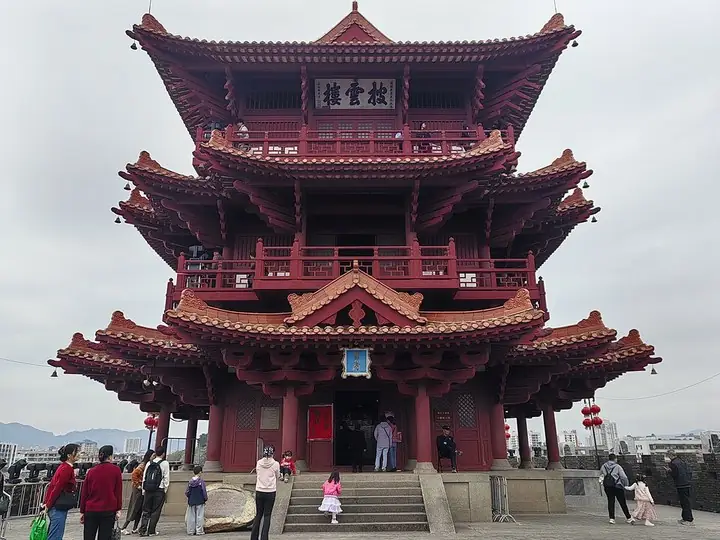
The present three-storey building is a modern reconstruction in a historical architectural style, rather than an untouched Song tower. Its projecting rooflines and bracketed structure are best considered together with the wall beneath it. Compare the elevated pavilion with the lower brick defences, then follow whichever nearby wall section is open to appreciate its relationship with the old streets.
Piyun Tower stands on the Zhaoqing Ancient City Wall (肇庆古城墙) in Duancheng District, Zhaoqing, which is a Major Historical and Cultural Site Protected at the National Level (全国重点文物保护单位); the tower was first built in the Zhenghe era (政和) of the Song dynasty. Because it rises from the highest point of the north wall, appearing to pierce the clouds, it was named Piyun, meaning cloud-piercing. The tower has been rebuilt or repaired eight times; the original three-storey timber structure was reduced to two storeys during the Republic of China period, and it was rebuilt again on the same site in 1986 after falling into disrepair.
The tower rebuilt in 1986 again rises three storeys, with a total height of 19.3 meters and a floor area of about 300 square meters. Its design drew on the Tengwang Pavilion (滕王阁) in Nanchang, the Yellow Crane Tower (黄鹤楼) in Wuhan and the Feiyun Tower (飞云楼) in Wanrong, Shanxi, and it was built with a reinforced-concrete structure imitating timber framing, using the bracket-set style of the Zhenwu Pavilion (真武阁) in Rongxian, Guangxi. It is roofed with orange-red glazed tiles and topped with a cross-shaped gable design.
What to look for
- The three-storey reconstructed tower has layered rooflines and traditional-style brackets.
- Its position on the old city wall reveals the relationship between a lookout and the surrounding defences.
Location & getting there
Getting to Piyun House
Approach the northern old-city wall west of Renmin Road in Duanzhou. Use the signed Piyun Tower access rather than Seven Star Crags; the tower belongs to the urban wall, not the lakeside scenic area.
Combine your visit
Suggested order for the visit:
-
Tower exterior
See the roofline above the wall.
-
Permitted tower or wall access
Examine the construction from the visitor route.
-
Nearby open wall section
Compare the defences with the streets below.
This is an editorial sequence of named spaces or places. It does not imply a verified walking connection or promise opening, ticket availability or a journey time.

Find Piyun House
披云楼 · 肇庆市
The pin marks the area, not the entrance.
More places nearby
Approximate straight-line distances between map pins, not travel distances.
Seven Star Crags 七星岩
3 km awaySeven Star Crags brings limestone towers into the middle of Zhaoqing’s Star Lake. Paths and narrow land strips divide the water into connected sections, changing the view as each crag overlaps the next. The rock faces also carry…
View guide →Dinghu Mountain 鼎湖山
16 km awayDinghu Mountain combines a forest reserve with a long-established Buddhist landscape. Visitor paths pass dense trees and stream valleys, with Feishuitan providing a waterfall-and-pool focus and Qingyun Temple introducing a…
View guide →Mount Xiqiao 西樵山
55 km awayMount Xiqiao rises above the flat Pearl River Delta with wooded peaks, rock cavities and spring-fed scenery. Baiyun Caves occupy the northwestern foothills, while higher visitor areas include Baofeng Temple and the large seated…
View guide →Sources & visit information
The sources below support the place-specific description and arrival information. Suggested combinations are editorial planning ideas; confirm current opening, entry arrangements and transport services for your date.
- Wikivoyage: Zhaoqing ↗
- Nanfang Daily: interview on rebuilding Piyun Tower ↗
- Guangdong culture portal: Zhaoqing city wall ↗
- Chinese Wikipedia: 披云楼 (revision 91620300, 2026-02-21) ↗
Visitor information adapted and edited from Wikivoyage contributors, Zhaoqing · CC BY-SA 4.0. Source revision 5261075.
Background paragraphs translated and condensed from Wikipedia contributors, "披云楼", Chinese Wikipedia · CC BY-SA 4.0. Source revision 91620300.