

Explore the region
Tap any red Chinese text to hear it in Mandarin.
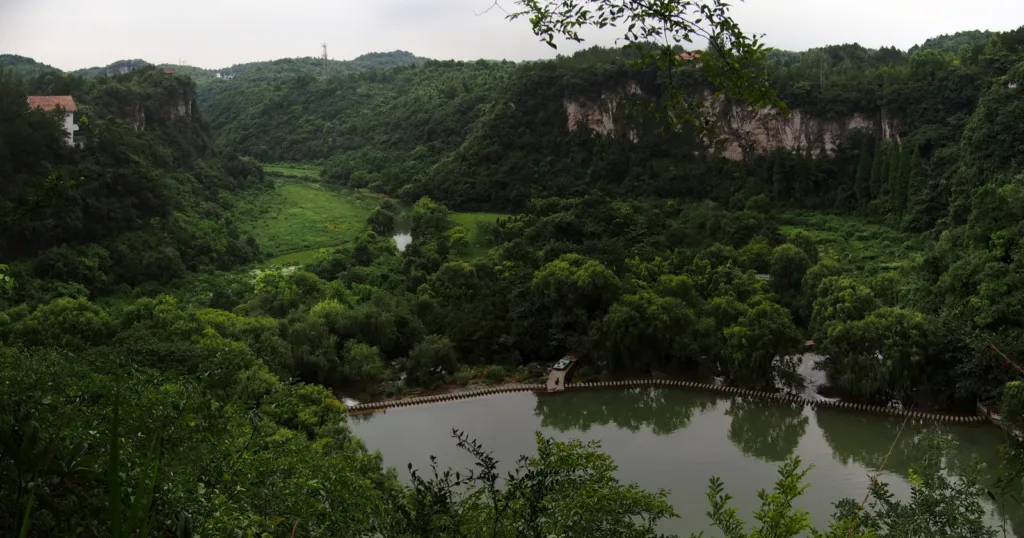
Tianhetan is a large, managed scenic area in Shiban Town, Huaxi District, on the Guiyang–Gui’an side of the city. The municipal government lists the visitor address as Tianhetan Tourist Resort in Shiban Town and describes the site as a 4A attraction built around karst mountains, water, caves and waterfalls. It is worth treating as a half-day outing from Guiyang, not as a quick roadside waterfall stop.
What to see
Start with the open landscape: water gathers among limestone cliffs, channels and falls, and the scenery makes the karst easier to read before you go underground. The scenic area’s cave section is divided into Kongling Cave (崆灵洞), a water cave visited by boat, and Yinhe Palace (银河宫), a dry cave with a different, more enclosed walking experience. Xinhua describes Kongling Cave as an underground water route of about 1,200 metres and Yinhe Palace as a three-level dry cave; these are useful descriptions of the attraction’s structure, not a promise that every route or boat is operating on every date.
Plan your visit around the contrast. Look at the waterfall and surface pools first, then follow the signed route for whichever cave services are open. In the water cave, the point is the changing ceiling, rock walls and reflected light from the boat rather than a single named formation. In the dry cave, expect steps, close rock surfaces and slower movement. Wear shoes with a secure sole, allow extra time after rain, and keep the cave and return arrangements together when buying or checking your admission.
Tickets and timing
A Guiyang municipal attraction page updated on 23 December 2024 lists a 50-yuan pass covering the landscape waterfall and karst-cave tour, alongside separate landscape, karst-cave, cableway and sightseeing-bus products. Those figures are a dated government listing, not a 2026 fare quote. Check the current ticket combinations, cave and boat inclusion, last admission, and any internal shuttle or cableway operation before setting out.
The accessible sources do not establish a current passport-specific booking or ticketing procedure. A domestic-ID reservation process should not be assumed to work for a foreign passport. Ask the operator which document and booking channel are accepted for your date; the municipal page lists +86 400 900 9995 as a contact number, but confirm that it remains current. Cave, boat and other outdoor services may also be altered by weather or operational notices.
Getting there
The most clearly documented public-transport option is Guiyang Metro S1 to Tianhetan Station (天河潭站). S1 opened to passengers on 28 December 2024; it runs between Zaohangba and Wangchengpo, with connections to Line 3 at Zhongcaosi and Line 1 at Wangchengpo. For central Guiyang, check the train direction toward Wangchengpo and verify same-day service in Amap/Gaode Maps.
A Guiyang Culture and Tourism Bureau traffic notice published on 3 April 2026 says that Tianhetan Station is about a five-minute walk from the scenic-area gate by the signed pedestrian route. The same notice lists bus routes 211, 701, 706 and 711 as serving Tianhetan or nearby stops, with a walk of roughly four to eight minutes. It does not provide a dependable all-day timetable, so check the departure direction and final stop in Amap before boarding and confirm the return service before entering the caves.
For a taxi or ride-hailing car, show the Chinese destination 贵阳市花溪区石板镇天河潭旅游度假区 Guì Yáng Shìhuā Xī Qū Shíbǎn Zhèn Tiān hé Tán Lǚ Yóu Dùjià Qū and ask for the visitor entrance (景区大门/游客入口), not only the broad map pin. The older China Revealed page also cautions that an area pin does not identify every entrance; use the entrance name shown by the operator or current map listing.
Combine your visit
Suggested order for the visit:
-
Waterfall area
See the surface-water landscape.
-
Karst depression approach
Read the connection with the cave system.
-
Managed cave route
Continue underground where service is operating.
This is an editorial sequence of named spaces or places. It does not imply a verified walking connection or promise opening, ticket availability or a journey time.
Find Tianhetan
天河潭 · 贵阳
The pin marks the area, not the entrance.
More places nearby
Approximate straight-line distances between map pins, not travel distances.
Huaxi Park 花溪公园
9 km awayHuaxi Park is organised around streams, pavilions and tea gardens south of central Guiyang. Its watercourses give the grounds a clear landscape structure, with resting places set among the planting. A short visit works well as a…
View guide →Qingyan 青岩古镇
16 km awayQingyan’s old-town visit can be organised around its gates and historic civic buildings. Dingguang Gate and the North Gate mark the fortified settlement, while Wenchang Pavilion and the former residence of Zhao Yijiong provide…
View guide →Jiaxiu Tower 甲秀楼
20 km awayJiaxiu Tower rises from a rock in the Nanming River, with Fuyu Bridge connecting its setting to the banks. The bridge’s Hanbi Pavilion and the nearby Cuiwei Garden turn the tower into a short sequence of waterside architecture…
View guide →Sources & visit information
Sources checked on 31 October 2026. Hours, tickets, reservations and transport can change; confirm with the operator before you go.
Image credits & notes (1)
- Tianhetan's karst valley, lake and managed waterside path viewed from above in Huaxi District, Guiyang. Photo: rheinsPhoto: CC BY 3.0