

Explore the region
Tap any red Chinese text to hear it in Mandarin.
In brief
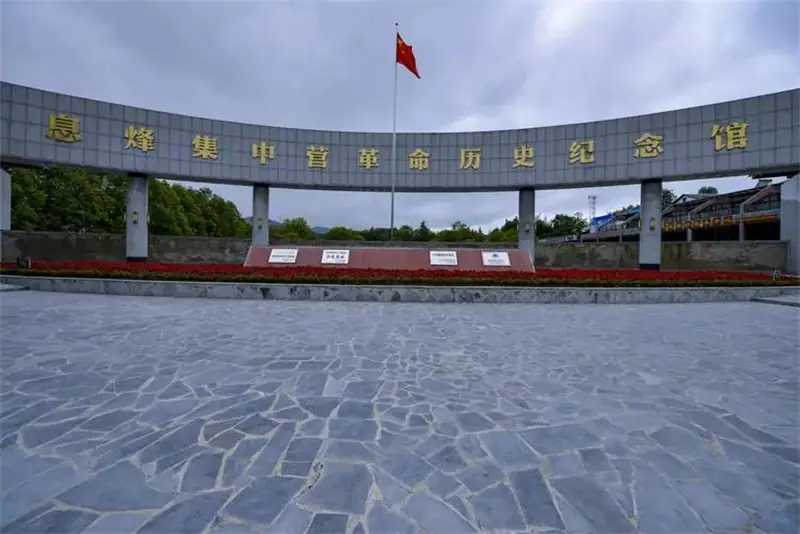
Xifeng Concentration Camp Memorial Hall preserves the Yanglangba headquarters of a wartime secret prison and pairs the surviving compound with the Fenghuo Buxi exhibition. It is a quiet, serious place to read the physical layout of a prison and the stories of the people held there, rather than a conventional sightseeing stop.
Why this site matters
The camp was established in November 1938 by the Nationalist military intelligence service during the War of Resistance against Japan. It was publicly labelled the Xifeng Office of the National Government Military Commission and was called the “university” inside the intelligence service. More than 1,200 people were held here between its establishment and its closure in July 1946, including Communist activists, patriotic officers and other political prisoners.
The memorial is in Xifeng County (息烽县), north of central Guiyang, not in the city’s urban sightseeing area. The wider camp also included the separate Xuantian Cave detention site, described by the Guizhou government as 14 km from the Yanglangba headquarters; do not assume that it is part of the same entrance or an adjacent gallery.
What to look for
Start at the preserved camp compound before moving through the modern museum. The old gate carries the four characters 抬起头来 Tái Qǐtóu Lái (“raise your head”), a deliberately harsh command to prisoners. Inside, the camp’s two contrasting zones—an administrative and recreation area with a lake, assembly hall and basketball court, and the cell area—make the institution’s carefully staged “heaven” and “hell” especially legible.
The cells were organised into named sections such as 忠斋, 孝斋, 仁斋, 爱斋, 信斋, 义斋, 和斋, 平斋 and 特斋; official descriptions identify 义斋 as the women’s prison. Behind the cells is a natural limestone cave where interrogation rooms and a water cell were installed. The Fenghuo Buxi exhibition then adds documents, photographs, objects and reconstructed scenes about the camp and the prisoners’ activities.
Published official descriptions do not use one consistent count for the preserved cell structures, so this guide avoids presenting a single number as settled fact. Read the room labels and the site interpretation on the day rather than treating a simplified online count as a complete plan of the compound.
Plan the visit
The listed visitor address is 贵阳市息烽县永阳街道猫洞村 Guì Yáng Shì Xī Fēng Xiàn Yǒng Yáng Jiē Dào Māo Dòng Cūn (Maodong Village, Yongyang Subdistrict, Xifeng County). Amap lists the same Chinese name and address and the venue phone as 0851-87700529; keep the Chinese destination text for ride-hailing or map searches.
Official listings give opening hours of 08:30–16:30. One Guizhou government listing notes an afternoon closure on the last Monday of each month, while a 2026 Xifeng County travel page says there are no closure days from May through October. Because those official notices do not fully agree, confirm the date with the venue before travelling.
Admission is listed as free with valid identification. An official listing from the Guizhou discipline-inspection authority says reservations can be made through Meituan or the WeChat mini-program 一码游贵州 Yī Mǎ Yóu Guì Zhōu, while the Guizhou government listing describes entry with valid identification without setting out a booking workflow. Neither page explains whether a foreign passport can be used in the same reservation channel. If you are travelling on a passport, call the venue before the trip and ask which document and booking process apply; do not assume that a domestic-ID reservation is transferable.
Getting there from Guiyang
The most clearly documented public-transport option is high-speed rail plus a local bus. Xifeng County’s 2026 visitor guidance gives the sequence 贵阳北站 (Guiyang North Railway Station) → 息烽站 (Xifeng Railway Station), with the rail journey described as about 23 minutes, followed by bus 501 to 阳朗风情小镇站 (Yanglang Style Town stop) and a walk of about 300 metres to the memorial hall. Check the train and bus departures on the day rather than relying on the article’s illustrative timing.
A 2019 English-language Xifeng government bus listing also places the memorial hall and Xifeng High-speed Railway Station on route 501, but its timetable and stop order are old. Treat it as route corroboration, not as a current schedule. For the return, check the live 501 direction back towards 息烽站 in Amap, or arrange a taxi from the exact Chinese venue name before leaving the site.
By road, the official description places the site beside China National Highway 210, between the Sichuan–Guizhou railway and the Guiyang–Zunyi expressway corridor. A taxi or ride-hailing car should be directed to 息烽集中营革命历史纪念馆, 贵阳市息烽县永阳街道猫洞村 rather than to “Guiyang” alone.
Set aside time to read the displays and walk the surviving compound slowly. This is a memorial to imprisonment and political violence: follow staff instructions on photography, keep voices low, and treat the cells, cave and personal objects as a historical site rather than a themed backdrop.
Find Xifeng Concentration Camp Memorial Hall
息烽集中营革命历史纪念馆 · 息烽县
No reliable map pin yet: search by the Chinese name.
Sources & visit information
Sources checked on 31 October 2026. Hours, tickets, reservations and transport can change; confirm with the operator before you go.
- 息烽集中营革命历史纪念馆|贵州省人民政府,2022-11-16 ↗
- 息烽集中营革命历史纪念馆|贵州省纪律检查委员会 ↗
- 探访息烽集中营旧址,追寻先烈们的热血与信仰|新华网,2024-04-04 ↗
- Xifeng Concentration Camp Revolutionary History Memorial Hall|Xifeng County English Government, 2019-10-18 ↗
- 爽爽贵阳·红色息烽|夏天就去这条宝藏线路,人少景美还全免费!|息烽县人民政府,2026-08-07 ↗
- 息烽集中营革命历史纪念馆|高德地图 ↗
- Bus Lines|Xifeng County English Government, 2019-10-21 ↗
Image credits & notes (1)
- Xifeng Concentration Camp Memorial Hall · 息烽集中营革命历史纪念馆Photo: m.krzzjn.comResized for the web; the photo itself has not been edited.