

Explore the region
Tap any red Chinese text to hear it in Mandarin.
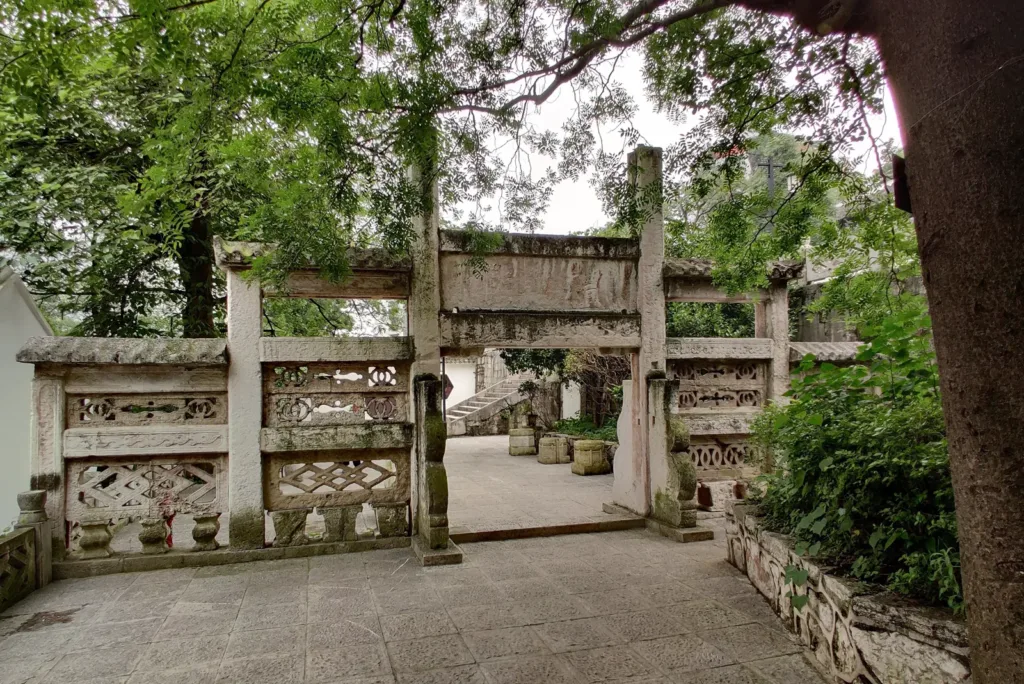
Yangming Shrine is a small historic complex rather than a single object to photograph from the road. It stands on the southern foot of Fufeng Hill in Yunyan District, beside the wider group of Yangming Shrine, Yin Daozhen Shrine and Fufeng Temple. The approach is worth taking slowly: the site’s character comes from the sloping courtyards, covered corridors, old trees and writing carved or displayed around the buildings.
The shrine commemorates Wang Shouren (1472–1528), better known as Wang Yangming, the Ming philosopher and teacher whose time in Guizhou remains important to the province’s intellectual history. His disciples established an earlier shrine in 1534; the shrine at the present Fufeng Hill site was built in 1814, the nineteenth year of the Jiaqing era. The complex is included in the national-level protected designation “Yangming Cave and Yangming Shrine,” announced in the sixth batch of Major Historical and Cultural Sites Protected at the National Level in 2006.
What to look for
- The main hall and courtyard sequence. The principal hall, or xiangtang (享堂), sits at the upper part of the sloping compound. The Zhengqi Pavilion and Guihua Hall connect with the two-sided corridors, so look at how the buildings make a compact, layered courtyard rather than expecting a large temple precinct.
- Wang Yangming’s image. The main hall contains a white-marble seated statue of Wang Yangming; the site’s inscriptions and explanatory displays connect the memorial space with his writing and teaching legacy.
- Stone inscriptions and calligraphy. The corridors and halls hold poetry, essays, plaques and carved writing. Much of the visible inscription programme was restored or re-carved from old rubbings after wartime damage and the Cultural Revolution; treat the labels as part of the visit, because they distinguish the historical material from later reconstruction.
- The wider Fufeng group. Yangming Shrine is next to Yin Daozhen Shrine and Fufeng Temple, but this guide does not assume that every neighbouring building shares the same entrance, opening status or visitor route. Follow the parts that are open on the day.
Allow time to read rather than rushing through for a roofline photograph. A short visit can focus on the main hall, statue and corridors; a longer one can pause in the planted courtyards and observe the hillside relationship between the shrine buildings. As this is a protected historic site, keep to signed visitor paths and do not touch inscriptions or enter closed rooms.
Visit and access
Address: Use 阳明祠, No. 15 Dongshan Road, Yunyan District, Guiyang (贵阳市云岩区东山路15号) in Amap or another current Chinese map. The city’s English government profile and the current China Revealed entry use No. 15; an older Yunyan government page gives No. 13, so confirm the live map marker and the actual visitor approach before leaving.
Opening, tickets and booking: The official pages I could open do not establish one current rule. The 2019 English government profile listed free entry and 09:00–17:00, while a 2017 Yunyan government page listed a ¥3 ticket and no current timetable. These are historical listings, not a reliable 2026 schedule. Check the venue or current map listing on the day. No current, directly readable passport-specific reservation procedure was verified here; a rule written for Chinese-ID visitors should not be assumed to work for a foreign passport.
The 2019 official profile listed the phone number +86-851-85621821, but it may have changed. If a same-day visit matters, use the Chinese name 阳明祠 Yáng Míng Cí when checking the current contact or booking channel and ask specifically about opening, entry, and foreign-passport registration.
Metro: Guiyang Metro Line 2 serves 阳明祠站 (Yangmingci Station). The station is useful for reaching this part of the city, but the reviewed sources do not verify a current exit number, step-free route or walking time from the station to the shrine gate. Search 阳明祠 Yáng Míng Cí and 贵阳市云岩区东山路15号 together in Amap, then follow the live pedestrian approach rather than assuming that the station pin is the entrance.
Bus: An older Yunyan District government listing names routes 6, 11, 32, 44 and 64 to 阳明祠站 Yáng Míng Cí Zhàn. Bus routes and stop arrangements can change, so confirm the route direction, service status and the return stop in Amap on the day.
Taxi or ride-hailing: Set the destination in Chinese as 阳明祠(贵阳市云岩区东山路15号). Ask for the current visitor approach, not simply the approximate map pin. No fixed fare or travel time is stated because both depend on the starting point and traffic. For the return, recheck the map after leaving; do not assume the same curb is the safest pick-up point on a sloping urban road.
Combine your visit
Suggested order for the visit:
-
Yangming Shrine courtyard
Begin with the principal memorial buildings.
-
Inscription corridor
Compare the carved portraits and calligraphy.
-
Neighbouring shrine and temple spaces
Continue to the open parts of the Fufeng group.
This is an editorial sequence of named spaces or places. It does not imply a verified walking connection or promise opening, ticket availability or a journey time.
Find Yangming Shrine
阳明祠 · 贵阳
The pin marks the area, not the entrance.
More places nearby
Approximate straight-line distances between map pins, not travel distances.
Guiyang Wenchang Pavilion 贵阳文昌阁
Less than 1 km awayGuiyang’s Wenchang Pavilion stands near the former East Gate, with a roofline that rewards a careful look from below. Its square lower storey changes to nine-sided upper levels, and the repeated roof corners give the building an…
View guide →Jiaxiu Tower 甲秀楼
1 km awayJiaxiu Tower rises from a rock in the Nanming River, with Fuyu Bridge connecting its setting to the banks. The bridge’s Hanbi Pavilion and the nearby Cuiwei Garden turn the tower into a short sequence of waterside architecture…
View guide →Qianling Park 黔灵山公园
4 km awayQianling Park rises through wooded hills within Guiyang. Hongfu Temple and the surrounding hilltop outlooks add architectural and scenic stops, while tea gardens provide a slower part of the visit. Wild monkeys also inhabit the…
View guide →Sources & visit information
Sources checked on 31 October 2026. Hours, tickets, reservations and transport can change; confirm with the operator before you go.
Image credits & notes (1)
- The stone 礼门 gate and a path inside Yangming Shrine's wooded hillside compound in Guiyang. Photo: AugustohaiPhoto: CC BY-SA 4.0