

Explore the region
Tap any red Chinese text to hear it in Mandarin.
A working wetland in the city
Fengxiang is best understood as a working urban wetland rather than a conventional flower garden. The park occupies a major middle reach of the Meishe River and was designed as a showcase for “sponge city” ideas: water is slowed, stored and filtered through wetlands, while the same landscape provides habitat and open space. The design uses raised fields, woodland, orchards and chains of wetland islands, with walking and cycling routes woven through the larger site.
That purpose gives the park a useful story to follow. The Meishe River runs through Meilan, Qiongshan and Longhua districts. In the 1990s and 2000s, pollution and untreated discharges turned parts of it into a dirty urban channel; Haikou’s 2016 programme combined pipe and pollution-control work with the removal of hard banks and ecological restoration. Fengxiang was one of the river’s demonstration sections, where the aim was to restore water, banks and habitat together rather than decorate a canal after the fact.
What to look for
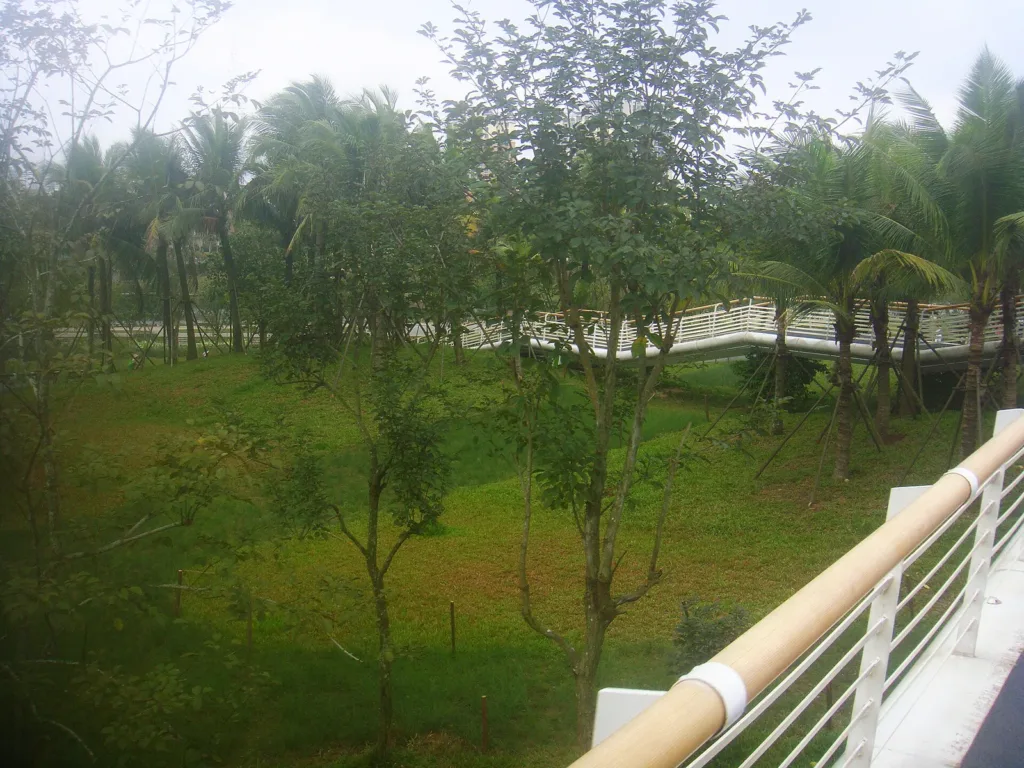
Start with the relationship between plants and water. The park’s large artificial terraced wetland was built as a water-treatment landscape, not simply as a flower display. A 2018 report describes a 14,000-square-metre, eight-level wetland planted with species including canna, calamus, Thalia dealbata and water lilies; it was designed to remove pollutants naturally and reuse treated water for green-space irrigation. Treat these figures as project information, not as a reason to touch or drink the water.
Continue toward the open water and islands. The design deliberately replaces rigid banks with shallows, islands and wetland edges that give fish, water plants and wading birds more room. Depending on season and maintenance, you may see water birds or simply the layered structure of the habitat; do not expect wildlife on demand.
The park also contains a small visitor and ecological-education centre. The building, completed in 2019, was planned as a base for exhibitions, training and public services, and its sloping paths, deep eaves, bamboo screens and volcanic-stone walls respond to Haikou’s sun, rain and tropical planting. Its current opening and exhibition programme were not independently confirmed here, so treat it as an optional stop rather than the basis of your visit.
Location and getting there
The park is in Qiongshan District at 美舍河凤翔湿地公园, 迈瀛路230-2号, Haikou, beside Yehai Avenue. The park section lies on both sides of Fengxiang Road, north of Yehai Avenue, so the name covers a broad north–south landscape rather than one compact gate.
A 2024 government report records a repaired section of the Yehai Avenue sidewalk and describes residents walking from the nearby 椰海家园 community toward the park. That is useful local context, but it does not establish a single continuous walking route from the city centre.
For a direct arrival, give a taxi or ride-hailing driver the Chinese name 美舍河凤翔湿地公园 Měishě Hé Fèngxiáng Shīdì Gōngyuán and the address above. Use the current public entrance shown by the map or on-site signs; the older visitor listing also points to an entrance along Yehai Avenue, but a broad park label is not a guarantee of a particular trailhead.
Public listings associate routes 68, 76, 79, 96 and Airport Line 1 with the “凤翔湿地公园” stop. Check the route, direction and stop position on the day because bus services can change. No metro stop or exit has been verified for the park, so do not build a metro itinerary around an assumed “nearest station.”
An encyclopedic listing describes the outdoor park as open around the clock, but current gate conditions, any ticket or reservation requirement, and the visitor-centre schedule were not confirmed by a current operator notice. Plan for weather, stay on open paths, and confirm your return route before walking away from the road.
Combine your visit
Suggested order for the visit:
-
Yehai Avenue entrance
Orient yourself in the river-restoration landscape.
-
Constructed wetland beds
Look at how planting meets the water.
-
Meishe River corridor
See the park in its wider urban setting.
This is an editorial sequence of named spaces or places. It does not imply a verified walking connection or promise opening, ticket availability or a journey time.
Find Fengxiang Wetlands Park
美舍河凤翔湿地公园 · 海口
The pin marks the area, not the entrance.
More places nearby
Approximate straight-line distances between map pins, not travel distances.
Qiongtai Academy 琼台书院
2 km awayQiongtai Academy is a historic educational site in Haikou’s Fucheng area, associated with the scholar Qiu Jun. Its principal two-storey building combines brick and timber, giving the academy a smaller and more intimate scale…
View guide →Temple of the Five Lords 五公祠
3 km awayThe Temple of the Five Lords is a memorial complex in Haikou dedicated to officials exiled to Hainan during the Tang and Song periods. Statues of the five men give the principal hall its focus, while the surrounding palms, lily…
View guide →Hainan Museum 海南省博物馆
5 km awayHainan Museum connects the island’s history with the South China Sea through archaeology, maritime displays and regional craft collections. Its history galleries include bronze objects and evidence of local settlement, while the…
View guide →Sources & visit information
Sources checked on 23 October 2026. Hours, tickets, reservations and transport can change; confirm with the operator before you go.
Image credits & notes (1)
- Elevated pedestrian bridge through tropical planting in the Meishe River wetland park, Haikou (2019). The file is catalogued as Meishe River National Wetland Park and is used here for the terraced wetland component of the broader Fengxiang Wetlands Park landscape. Photo: Anna FrodesiakPhoto: CC0 1.0