

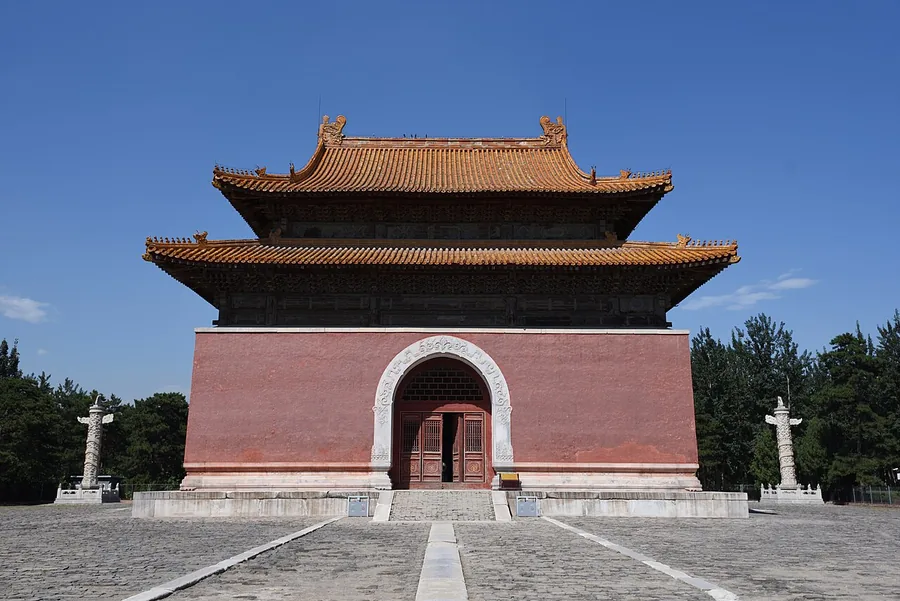
Photo adjustments
Proportionally resized and converted to WebP without cropping, retouching or changing the photographed subject.
Explore the region
About Western Qing tombs
Each follows the broad language of Qing imperial funerary architecture, but their scale and detailing differ. Tailing provides the main introduction to the ceremonial approach, while Chongling connects the site with the dynasty's final decades. The compounds are spread through a protected landscape, so select a focused route and distinguish the historic imperial tombs from later commercial cemeteries nearby.
Construction began in 1729, when the Yongzheng Emperor (雍正帝) abandoned an earlier plan to build near the Eastern Qing tombs and chose Taiping Valley on Yongning Mountain in Yi County instead. The Qianlong Emperor (乾隆帝) later instituted a zhaomu system (兆葬之制) under which a son's tomb alternated between the eastern and western sites depending on where his father was buried. The first tomb, Tailing (泰陵), was completed in 1737, and Guangxu Emperor was interred in Chongling (崇陵) in 1914.
The necropolis holds seventy-eight royal burials, including four Qing emperors with their empresses, consorts, princes and princesses. A staked and walled perimeter once enclosed the tombs, with an innermost geomantic wall (风水墙) 21 kilometres long and successive rings of red, white and blue markers barring ordinary people from entry. The Xuantong Emperor, Puyi, whose own tomb was left unfinished after the 1911 revolution, is buried separately in a commercial cemetery behind Guangxu's tomb.
The tombs were repeatedly looted before a dedicated conservation office was established in 1954, including damage from French troops occupying the site in 1900 and the robbing of Chongling's own burial chamber in 1938. After 1949 the site was properly protected; Chongling's underground palace was cleared and opened to the public in 1980, and the complex was inscribed on the World Heritage List in 2000.
What to look for
- Tailing's ceremonial approach and imperial tomb compound.
- Chongling, the tomb of Guangxu and Empress Dowager Longyu, with chamber access subject to current arrangements.
The surrounding area
A provincial city base for the former Zhili administrative quarter and substantial local food traditions.
Location & getting there
Getting to Western Qing tombs
Use 清西陵景区 in Xiling Town, Yi County. Begin at the visitor reception point serving the protected imperial tombs.
- Arrange transfers between the selected compounds and check which interiors are open before setting out.
Combine your visit
Suggested order within this visit:
-
Tailing
Begin with Yongzheng's tomb and the site's formal layout.
-
Chongling
Compare a later imperial burial complex on a separate internal transfer.
This sequence is an editorial suggestion based on the features described in the sources. Access to individual buildings or areas should be checked locally; no travel time or shared admission is implied.
Find Western Qing tombs
清西陵 · 保定市
The pin marks the area, not the entrance.
More places nearby
Approximate straight-line distances between map pins, not travel distances.
Langya Mountain 狼牙山
30 km awayLangya Mountain combines sharp, wooded ridges with the wartime story of the Five Warriors. The memorial museum at the foot introduces that history through photographs and objects, including images by wartime photographer Liu…
View guide →Mancheng Han Tombs 满城汉墓
47 km awayThe Mancheng Han Tombs occupy Lingshan in Baoding's Mancheng District. The two burials belonged to Liu Sheng, king of Zhongshan, and his wife Dou Wan, and their discovery in 1968 produced some of China's best-known Han objects…
View guide →Sources & visit information
The linked encyclopedia sources support background and place descriptions. Current opening hours, ticket prices, booking rules and transport schedules have not been independently verified for this guide. Confirm them with the venue or operator before travelling.
Visitor information adapted and edited from Wikipedia contributors · CC BY-SA 4.0. Source revision 86126780.
Background paragraphs translated and condensed from Wikipedia contributors, "清西陵", Chinese Wikipedia · CC BY-SA 4.0. Source revision 86126780.
Background paragraphs condensed from Wikipedia contributors, "Western Qing tombs", English Wikipedia · CC BY-SA 4.0. Source revision 1366157506.