

Explore the region
About Zhaozhou Bridge
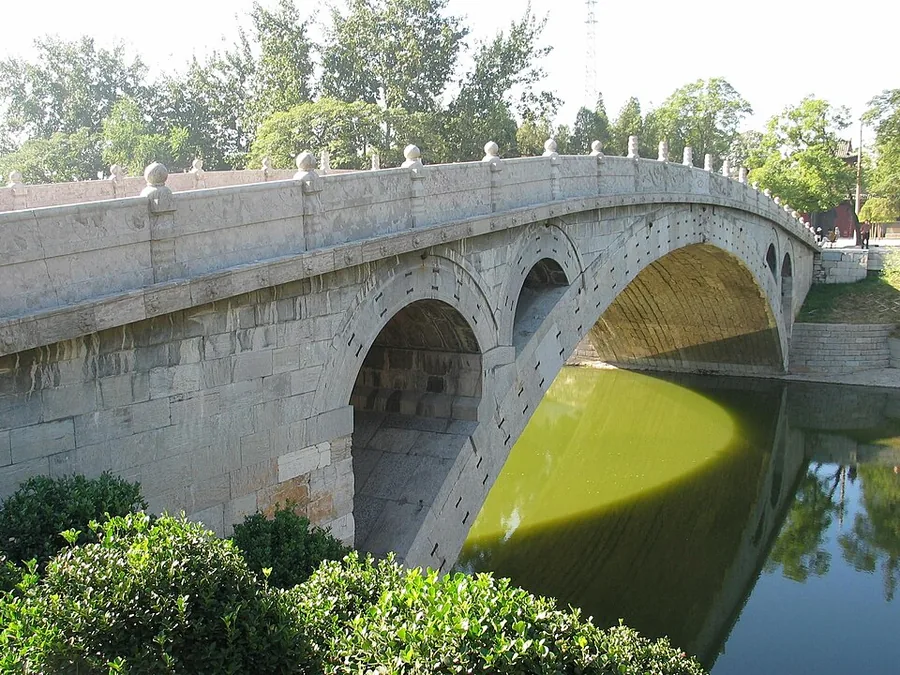
Its shallow stone arch was an important Sui-period engineering solution: four smaller openings above the main arch reduce masonry weight and allow additional floodwater through. The bridge has undergone later restoration, including replacement balustrades, so distinguish its structural design from newer surface details. A side-on view from the riverbank explains the bridge more clearly than simply walking across the deck.
The bridge is generally believed to have been designed by the Sui-dynasty craftsman Li Chun (李春) and built in 605, the sixth year of the Daye era (大业六年). It was repaired during the Tang, Song, Ming and Qing dynasties and was severely damaged by the late Qing. A controversial renovation between 1952 and 1956 significantly altered its appearance and structural technique, yet most in China still regard it as the world's oldest intact large-span single-arch open-spandrel flat-arc stone bridge.
The bridge is 50.82 meters long and 9 meters wide, crossing the Xiaohe River (洨河) with its deck split into three lanes, a central one for vehicles and two for pedestrians. The arch consists of four layers of 28 parallel stone arcs bound with iron clamps; each arc is slightly wider at the bridge's ends than at its center, a tapering design that draws the arcs inward under their own weight. The main arch spans 37.47 meters with a rise of 7.23 meters.
In the 1950s, more than 1,000 balustrade panels dating from the Sui to the Qing dynasties were excavated beneath the bridge and are displayed in its exhibition room. A restoration project completed in 2017 restored 30 such panels and components, including a Sui-dynasty double-dragon panel, the bridge's first completed heritage restoration project.
What to look for
- The low main arch and paired openings at either end of its shoulders.
- The stone bridge deck and restored balustrades, viewed alongside the larger structural form.
Location & getting there
Getting to Zhaozhou Bridge
Use 赵州桥景区 on the Xiaohe River south of Zhaoxian town, Zhao County. Specify the bridge attraction rather than the county centre.
- Begin at the visitor approach and use the public riverside paths for the side view; do not descend onto the riverbed.
Combine your visit
Suggested order within this visit:
-
Riverbank side view
Read the main arch and four smaller openings together.
-
Bridge deck
Compare the shallow rise with the perspective from below.
This sequence is an editorial suggestion based on the features described in the sources. Access to individual buildings or areas should be checked locally; no travel time or shared admission is implied.
Find Zhaozhou Bridge
赵州桥 · 石家庄市
The pin marks the area, not the entrance.
More places nearby
Approximate straight-line distances between map pins, not travel distances.
Kongshan White Cloud Cave 崆山白云洞
41 km awayKongshan White Cloud Cave is a developed limestone cave at Lincheng on the eastern side of the Taihang Mountains. Its interior is organised into five named halls, including Human World, Heaven, Maze, Underworld and Dragon…
View guide →Hebei Museum 河北博物院
41 km awayHebei Museum is especially valuable for the objects recovered from the Mancheng Han tombs and the earlier Zhongshan kingdom. The Changxin Palace lantern and jade burial suit associated with Liu Sheng reveal the technical…
View guide →Linji Temple 临济寺
50 km awayLinji Temple is a living Buddhist site in Zhengding associated with the Chan tradition that became Rinzai Zen in Japan. Its most distinctive monument is Chengling Stupa, an octagonal brick tower with closely spaced eaves and…
View guide →Sources & visit information
The linked encyclopedia sources support background and place descriptions. Current opening hours, ticket prices, booking rules and transport schedules have not been independently verified for this guide. Confirm them with the venue or operator before travelling.
Visitor information adapted and edited from Wikipedia contributors · CC BY-SA 4.0. Source revision 1352011534.
Background paragraphs translated and condensed from Wikipedia contributors, "赵州桥", Chinese Wikipedia · CC BY-SA 4.0. Source revision 93733858.
Image credits & notes (1)
- Zhaozhou Bridge (Anji Bridge), Hebei.Photo: Zhao 1974 (English Wikipedia) · Public domainResized for the web; the photo itself has not been edited.
