

Photo adjustments
Wikimedia thumbnail; fitted to the ranking-card frame.
Explore the region
About Unit 731 Museum
Its exhibition examines human experimentation, the development and use of biological weapons, the destruction of evidence and subsequent trials. Outside, surviving structures and ruined foundations connect that account to the original facility. The value of the visit lies in this relationship between documented evidence and place. Displays concern severe wartime atrocities, so allow time for the subject and consider children's readiness for the material.
The original site dates to 1933; most of its buildings were destroyed in August 1945, leaving the arrangement of remains seen today. The museum has a building area of 9,997 square metres and adopted its present name on 9 April 2003. A new museum building was completed on 15 August 2015, with 5,000 square metres of exhibition space.
The site covers 248,000 square metres. It entered the sixth group of Major Historical and Cultural Sites Protected at the National Level (全国重点文物保护单位) in 2006. In 2012, the State Administration of Cultural Heritage (国家文物局) placed it on China's tentative list for World Cultural Heritage (中国世界文化遗产预备名单). A Harbin municipal regulation protecting the former site took effect on 1 November 2011, following approval by the provincial legislature.
What to look for
- The evidence exhibition's sections on biological warfare, human experimentation, destruction of evidence and trials.
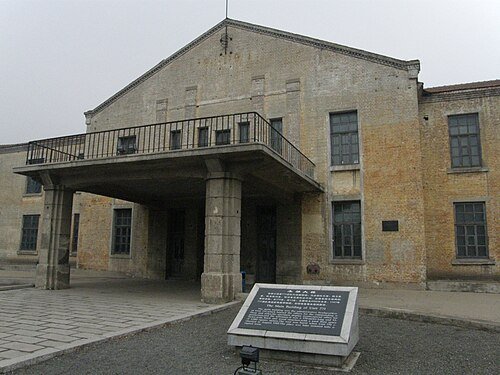
- The former administration building and the ruined prison-area remains on the protected site, where visitor access is permitted.
The surrounding area
Provincial capital base for Central Street, architectural history, music and seasonal ice displays.
Location & getting there
Getting to Unit 731 Museum
Use Xinjiang Dajie station on Harbin Metro Line 1 and continue along Xinjiang Street to the museum in Pingfang District.
- Check the museum's official admission arrangements before the journey, and follow its current route between the indoor exhibition and the historic site.
Combine your visit
Suggested order within this visit:
-
Evidence exhibition
Read the documentary account before viewing the remains.
-
Former administration-building area
Relate the museum narrative to the surviving complex.
-
Ruined prison-area remains
Finish with the physical evidence on the authorised outdoor route.
This sequence is an editorial suggestion based on the features described in the sources. Access to individual buildings or areas should be checked locally; no travel time or shared admission is implied.
Find Unit 731 Museum
侵华日军第七三一部队罪证陈列馆 · 哈尔滨市
The pin marks the area, not the entrance.
More places nearby
Approximate straight-line distances between map pins, not travel distances.
Dragon TV Tower 龙塔
16 km awayDragon Tower's 336-metre steel structure gives Harbin's Nangang district a very different landmark from its railway-era architecture. An open lattice shaft supports a broad disc-shaped upper section and a smaller sphere below…
View guide →Heilongjiang Provincial Museum 黑龙江省博物馆
17 km awayHeilongjiang Provincial Museum brings together the province's archaeology, historical objects and natural-history collections in the former Moscow Department Store building on Hongjun Street. Its holdings include the Jin-period…
View guide →The Liao & Jin History Museum of Heilongjiang 黑龙江辽金历史博物馆
17 km awayThis privately established museum focuses on objects associated with the Liao and Jin periods. Published collection descriptions emphasise decorated belt fittings, Buddhist objects and ceramics, bringing personal ornament and…
View guide →Sources & visit information
The sources below support the place-specific description and arrival information. Suggested combinations are editorial planning ideas; confirm current opening, entry arrangements and transport services for your date.
- Wikipedia: 侵華日軍第七三一部隊罪証陳列館 ↗
- Wikivoyage: Harbin ↗
- Heilongjiang Foreign Affairs Office: Unit 731 Museum visitor profile ↗
- Heilongjiang Culture and Tourism: Xinjiang Dajie station and Unit 731 Museum ↗
Visitor information adapted and edited from Wikipedia contributors · CC BY-SA 4.0. Source revision 94206311.
Visitor information adapted and edited from Wikivoyage contributors · CC BY-SA 4.0.
Background paragraphs translated and condensed from Wikipedia contributors, "侵華日軍第七三一部隊罪証陳列館", Chinese Wikipedia · CC BY-SA 4.0. Source revision 94206311.