

Explore the region
Tap any red Chinese text to hear it in Mandarin.
Read Harbin through one building
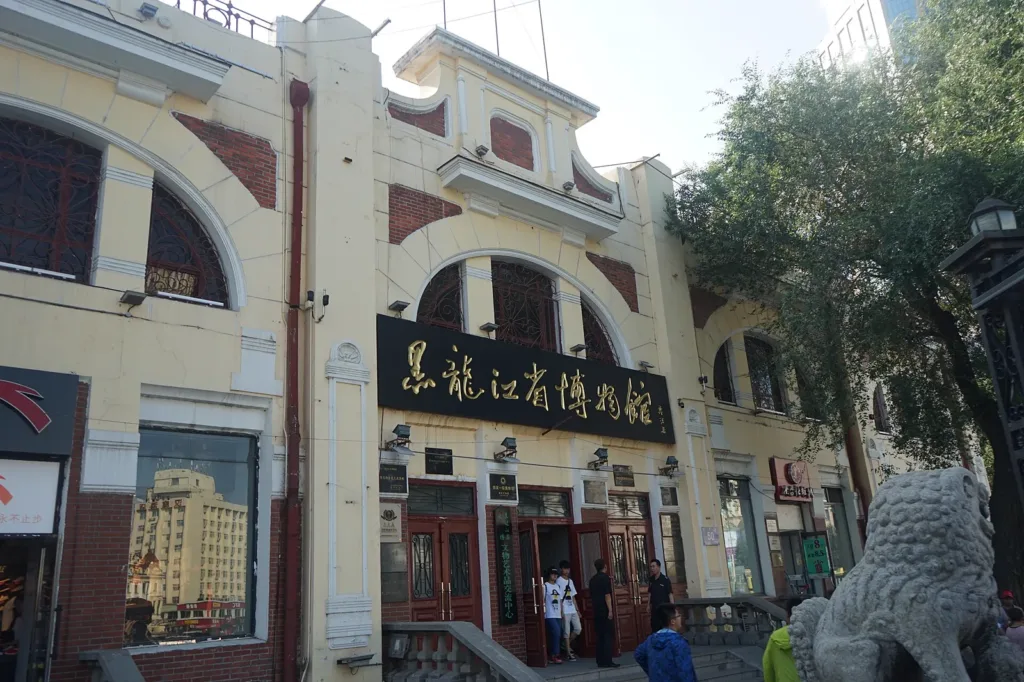
The museum’s main building was constructed in 1906–1908 as the Moscow Department Store, one of the early commercial buildings of Chinese Eastern Railway-era Harbin. Its exhibition hall opened to the public in 1923, and the building was later incorporated into the provincial museum’s institutional history. The former store is now a nationally protected historic site, so the visit begins before the galleries: pause outside to read the curved wall piers, arched openings, raised flattened domes and symmetrical, angled plan.
Inside, the museum is a broad provincial collection rather than a single-period gallery. Its institutional profile groups the holdings into history, nature, art and documents. That range is especially useful in Harbin: a display about the city’s early social life can sit alongside archaeological material from the Jin period and specimens that record the northern environment, including woolly-rhinoceros and mammoth remains.
The official homepage currently highlights Harbin’s Past: Social Life in Harbin at the Turn of the 20th Century. The exhibition follows three threads—Chinese residents’ lives, railway-era construction and industry, and Harbin as an international city—and presents 1,382 objects connected with the city’s local, immigrant and blended cultures. Treat named exhibitions as changeable rather than permanent promises.
What to look for
The object most closely identified with the museum is the Jin-period Bronze Seated Dragon. It is a 19.6-centimetre, 2.1-kilogram bronze object found at the Jin Shangjing Huiningfu site in present-day Acheng, Harbin. Its crouching form combines dragon, qilin, lion and dog-like features; the museum and provincial sources describe it as a national first-class cultural relic and a museum treasure. If it is displayed during your visit, look closely at the raised head, open mouth, lifted foreleg and curled mane rather than treating it as a generic dragon sculpture.
Allow time for the building as well as the collection. The historic address is in Nangang, near Hongbo Square, while the museum’s homepage separately labels a new Heilongjiang Provincial Museum building as under construction. For a visit now, use the operating Hongjun Street venue below, not a future construction-site address.
Plan your visit
The current visitor notice requires advance reservation through the museum’s official website or its WeChat Official Account. Individual reservations open up to seven days ahead, and one account can reserve for up to five people; the notice also says that each identity document can be used once per day. On the visit date, entry is by the reserved identity document or the order’s ticket QR code after security screening. The published instructions list Chinese identity documents and do not explain passport booking or passport-only inspection, so an international visitor should confirm that point with the museum before relying on an online reservation.
The visitor system lists Tuesday to Sunday, 09:00–16:30, with entry stopping at 16:00. It closes on Mondays except public holidays. The current official pages reviewed here do not state an admission price; check the booking system or museum directly rather than relying on an older listing.
Getting there and back
For a taxi or ride-hailing car, use 黑龙江省博物馆 (Hēilóngjiāng Shěng Bówùguǎn), 50 Hongjun Street, Nangang District, Harbin (哈尔滨市南岗区红军街50号). The museum is served by Museum Station (博物馆站) on Harbin Metro Line 1 or Line 2. No exit number is confirmed here, so follow the station signs toward the museum and check the approach locally rather than trusting an unverified walking time.
The museum’s visitor information lists buses to Museum stop (博物馆站), including routes 101, 103, 108, 109 and 115, and buses to Provincial Exhibition Centre stop (省博览中心站), including routes 104, 107, 110, 111 and 112. Route patterns can change, so confirm the stop and direction on the day. For the return, use the same Chinese museum name or station name and check the next metro or bus service before leaving.
Combine your visit
Suggested order within this visit:
-
Historic museum building
Read the commercial façade before entering.
-
Regional historical collections
Focus on Jin-period and earlier archaeological material.
-
Ancient-animal displays
Compare the cultural sequence with the province's natural history.
This sequence is an editorial suggestion based on the features described in the sources. Access to individual buildings or areas should be checked locally; no travel time or shared admission is implied.
Find Heilongjiang Provincial Museum
黑龙江省博物馆 · 哈尔滨市
The pin marks the area, not the entrance.
More places nearby
Approximate straight-line distances between map pins, not travel distances.
The Liao & Jin History Museum of Heilongjiang 黑龙江辽金历史博物馆
Less than 1 km awayThis privately established museum focuses on objects associated with the Liao and Jin periods. Published collection descriptions emphasise decorated belt fittings, Buddhist objects and ceramics, bringing personal ornament and…
View guide →Northeast China Revolutionary Martyrs’ Memorial Hall 东北烈士纪念馆
Less than 1 km awayThis memorial museum occupies a building originally intended as a library and later used by the police under Japanese occupation. Its white neoclassical façade, with six Corinthian columns, contrasts sharply with the history…
View guide →Saint Sophia 圣索菲亚教堂
2 km awaySaint Sophia is a former Russian Orthodox cathedral whose red-brick walls and large green dome give Harbin one of its most recognisable silhouettes. The present church was completed in 1932, replacing an earlier wooden building…
View guide →Sources & visit information
Sources checked on 23 October 2026. Hours, tickets, reservations and transport can change; confirm with the operator before you go.
- Heilongjiang Provincial Museum: Visitor Information ↗
- Heilongjiang Provincial Museum Visitor Management System ↗
- Heilongjiang Provincial Museum official website ↗
- 黑龙江省博物馆 — Heilongjiang Provincial Department of Culture and Tourism ↗
- Heilongjiang Provincial Museum: Former Moscow Department Store site ↗
- 人民日报:黑龙江省博物馆藏金代铜坐龙——金源文化的实物范本 ↗
- 金代铜坐龙遇上文创 — 新华网 ↗
- 黑龙江省博物馆信息与交通导航 ↗
- 博物馆站(哈尔滨市) ↗
Image credits & notes (1)
- Entrance of Heilongjiang Provincial Museum in Harbin’s former Moscow Department Store building, photographed in 2017. Photo: AmarespecoPhoto: CC BY-SA 4.0