


Explore the region
About Shangjing Longquanfu
Its plan followed the model of Tang Chang'an, organising an outer city, inner city and palace city around a north–south ceremonial axis. The surviving site is chiefly archaeological: earthworks, foundations and the layout carry more meaning than complete palace buildings. Nearby Xinglong Temple preserves Buddhist stonework associated with Bohai, offering a useful contrast between the scale of the ruined capital and individual surviving objects.
In 755, Da Qinmao (大钦茂), the Bohai kingdom's third king, moved the capital here from Zhongjing (中京城), after which the city served as the kingdom's capital and was foremost among Bohai's five capitals. In 926 Emperor Taizu of Liao (辽太祖) destroyed Bohai and established the Dongdan Kingdom (东丹国) on the site; in 929 Dongdan's capital was relocated south to Liaoyang and Longquanfu was destroyed.
The city covered sixteen square kilometers, divided into an outer city, an inner city and a palace city. The outer wall was built of packed earth, the inner wall of stone, and the palace-city wall of basalt. Five halls linked by corridors were arranged along the north-south axis. Around the ruins are further Bohai-era tombs, kilns and bridges.
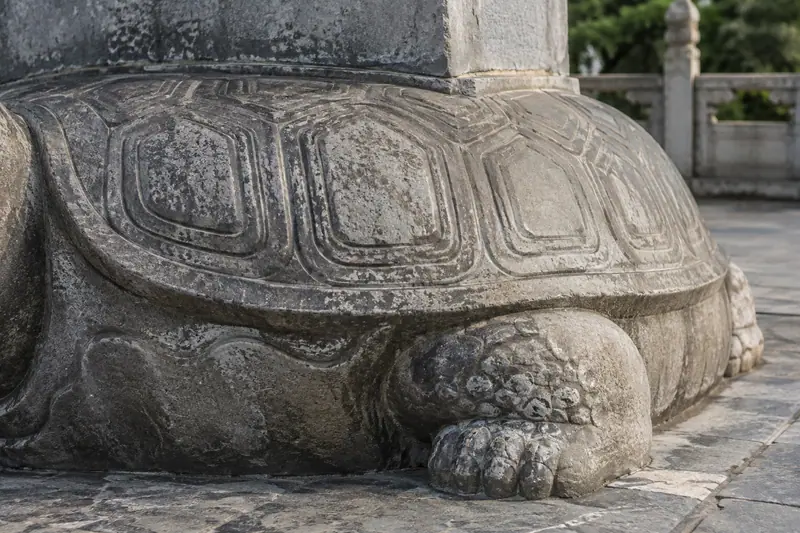
The site has been a Major Historical and Cultural Site Protected at the National Level (全国重点文物保护单位) since 1961. Within the old city stands Xinglong Temple (兴隆寺), built during the Qing dynasty on the grounds of an earlier Bohai temple; it preserves Buddhist stone carvings surviving from the Bohai period, including a stone lantern pillar, a stone tortoise stele base and a large stone Buddha.
What to look for
- The palace-city axis and the remains of successive halls and enclosing walls.
- Bohai stone Buddhist work at Xinglong Temple, including the stone lamp pillar and large stone Buddha where accessible.
Location & getting there
Getting to Shangjing Longquanfu
The archaeological site is in Bohai Town, Ning'an, near the town also known as Dongjingcheng. Arrange the road transfer to the archaeological park's public entrance.
- The capital ruins and Xinglong Temple are distinct parts of the visit; confirm their current access separately.
Combine your visit
Suggested order within this visit:
-
City and palace remains
Read the plan of the former capital on the authorised archaeological route.
-
Xinglong Temple
Compare the broad urban remains with surviving Buddhist stonework.
This sequence is an editorial suggestion based on the features described in the sources. Access to individual buildings or areas should be checked locally; no travel time or shared admission is implied.
Find Shangjing Longquanfu
渤海国上京龙泉府遗址 · 牡丹江市
The pin marks the area, not the entrance.
More places nearby
Approximate straight-line distances between map pins, not travel distances.
Jingpo Lake 镜泊湖
32 km awayJingpo Lake owes its long, winding shape to lava flows that blocked the Mudan River. The northern end gives a compact introduction to that volcanic landscape: Diaoshuilou Waterfall drops over dark rock, while the lakeside…
View guide →People's Park 牡丹江人民公园
64 km awayMudanjiang's People's Park combines a social gathering place with two different lake landscapes. Yixin Lake occupies the eastern part, while the smaller Lianxin Lake lies nearer the western entrance and includes a retained…
View guide →Xuexiang 雪乡
78 km awayXuexiang's visitor village developed from Shuangfeng Forest Farm, with wooden houses and yards that acquire rounded caps of deep snow in winter. Xueyun Street forms its main pedestrian spine. The raised sightseeing boardwalk…
View guide →Sources & visit information
The linked encyclopedia sources support background and place descriptions. Current opening hours, ticket prices, booking rules and transport schedules have not been independently verified for this guide. Confirm them with the venue or operator before travelling.
Visitor information adapted and edited from Wikipedia contributors · CC BY-SA 4.0. Source revision 92085716.
Background paragraphs translated and condensed from Wikipedia contributors, "渤海国上京龙泉府遗址", Chinese Wikipedia · CC BY-SA 4.0. Source revision 92085716.
Image credits & notes (1)
- An archival photograph of palace foundations at Dongjingcheng, the Shangjing Longquanfu site in Ning'an, Heilongjiang. Published in Asia Taikan, volume 16 (1939–1940); exact photograph date unknown.Photo: Black Dragon Society (Commons source attribution; individual photographer not stated) · Public domainResized for the web; the photo itself has not been edited.
