

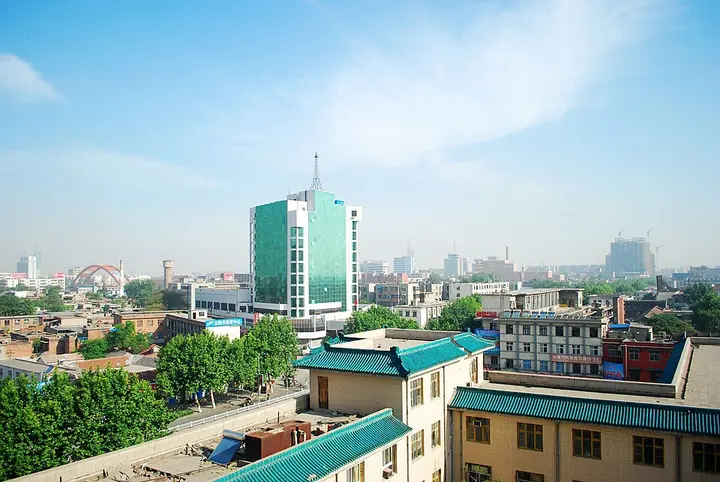
Photo adjustments
Full frame retained; proportionally resized and converted to WebP. No retouching or changes to the photographed subject. Card displays may crop the view.
Explore the region
About Anyang
At Yinxu, palace foundations, burials and oracle-bone evidence relate to the late Shang capital beside the Huan River. The National Museum of Chinese Writing broadens that story beyond one dynasty, while Wenfeng Pagoda provides a later landmark in the established city. These places work best as a sequence of focused visits, with transport between the archaeological zone and the urban museums.
The city's earliest name was Beimeng (北蒙); around 1300 BC the Shang king Pangeng moved his capital there from Yan (奄) and renamed it Yin (殷). The name 'Anyang' first appears in a Warring States account of 275 BC, when the state of Zhao took the town. Its walls, abandoned after the Shang capital fell in 1046 BC, were rebuilt in 236 BC, restored in 398, and rebuilt on a larger scale in 1368 with four gated towers, four corner towers and a moat; the Bell Tower, Drum Tower and the southwest corner tower at Sanjiao Lake survive from that Ming-era rebuilding.
Anyang lies in the north of Henan, bordering Puyang to the east, Xinxiang and Hebi to the south, and Shanxi and Hebei to the west and north, at the eastern foot of the Taihang Mountains, with hills in the west giving way to a piedmont and alluvial plain in the east. The Zhang River (漳河) runs along its northern edge and the Huan River (洹河) winds through the city's north. It covers 7,352 square kilometers and has a population of 5.417 million.
What to look for
- Yinxu’s archaeological landscape, linking early writing with the material remains of a capital.
- The National Museum of Chinese Writing and its wider account of written forms.
Background & history
Anyang (simplified Chinese: 安阳; traditional Chinese: 安陽; pinyin: Ānyáng; [án.jǎŋ]) is a prefecture-level city in Henan, China. The northernmost city in Henan, it borders Puyang to the east, Hebi and Xinxiang to the south, and the provinces of Shanxi and Hebei to its west and north respectively. Anyang is the location of the ancient city of Yin, which was the capital of the Shang dynasty and the first stable capital of China. As the ancient capital of the Seven Dynasties and one of the birthplaces of Chinese civilization, Anyang is rich in historical and cultural resources and has a number of world-class and national historical sites. At the end of 1986, it was recognized as a national historical and cultural city.
Excerpt from Wikipedia: Anyang · Wikipedia contributors · CC BY-SA 4.0. Selected introductory sentences; formatting simplified. Background information, not current visitor-service advice.
The surrounding area
Northern provincial base for the Yin Xu archaeological landscape and nearby regional food traditions.
Location & getting there
Getting to Anyang
Anyang Station serves the established city, while Anyang East is the high-speed station on the eastern edge. Arrange onward travel to the particular Yinxu entrance or museum you are visiting; the archaeological site extends across several separate areas.
Combine your visit
A suggested sequence linking the specific features of this visit.
-
National Museum of Chinese Writing中国文字博物馆
Begin with the development and variety of written forms.
-
Yinxu Ruins殷墟
Connect the writing story with the excavated Shang capital.
-
Wenfeng Pagoda
Add a later architectural landmark in the city if time permits.
This order is editorial. Confirm access and any transfers between stops; it does not establish a walking route, same-day connection or common admission ticket.
Find Anyang overview
安阳 · 安阳市
The pin marks the area, not the entrance.
More places nearby
Approximate straight-line distances between map pins, not travel distances.
National Museum of Chinese Writing 中国文字博物馆
2 km awayThe National Museum of Chinese Writing makes scripts its central subject, beginning with early evidence such as oracle bones and following changes in written form. The architecture extends that theme outdoors: the…
View guide →Yinxu Ruins 殷墟
7 km awayYinxu is the archaeological landscape of the late Shang capital around Xiaotun beside the Huan River. Rammed-earth palace and ancestral-temple foundations show the scale of the former city, while Fu Hao’s tomb gives the royal…
View guide →Youli 羑里城
16 km awayYouli combines a much older archaeological site with later buildings commemorating King Wen of Zhou. The traditional account of his imprisonment and work on the Book of Changes gives the place its meaning, but the visible…
View guide →Sources & visit information
The sources below support the place-specific description and arrival information. Suggested combinations are editorial planning ideas; confirm current opening, entry arrangements and transport services for your date.
Visitor information adapted and edited from Wikivoyage contributors, “Anyang” · CC BY-SA 4.0.
Visitor information adapted and edited from Wikipedia contributors, “Anyang” · CC BY-SA 4.0. Source revision 1369536389.
Background paragraphs translated and condensed from Wikipedia contributors, "安阳市", Chinese Wikipedia · CC BY-SA 4.0. Source revision 94239099.