

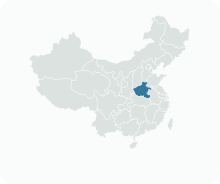
Get to know Wen County

Photo adjustments
EXIF orientation normalized; resized without changing aspect ratio; converted to WebP. No subject edits.
- Administrative area
- County · 县
- Part of
- Jiaozuo
- Chinese name
- 温县
- Local areas
- County guide
Area & population
- Area in the source
- 462.00 km²
- Population · 2019
- 420,900
Source: cited geographic source, as of the dates shown.
Setting and landscape
The county takes its name from a hot spring (温泉) that once rose within its borders. The land lies between 102.3 and 116.1 metres above sea level. Floods of the Yellow and Qin rivers left it higher in the west, with river flats in the south, low land in the north and a central ridge. Thirteen rivers and canals cross it, among them the main channel of the South–North Water Diversion (南水北调), and the Yellow River flats cover 290,000 mu.
History
People lived here some 6,000 years ago, and the county has more than ten sites of the Yangshao, Longshan and Erlitou cultures. Around the 21st century BC a state called Wen, named after the hot spring, had its capital at today's Shangyuan village (上苑村). The area of Zhaoxian (招贤), Gucheng and Anlezhai west of the county town was the old Wen town and the home of Sima Yi (司马懿), later honoured as Emperor Xuan of Jin; its inner wall, raised and strengthened in 1869, survives. At Xizhangji village (西张计村), excavations in 1980–1982 recovered more than ten thousand tablets of Spring and Autumn covenants written in ink with a brush, the Wenxian covenant texts (温县盟书).
What to see
Chenjiagou (陈家沟), on the Qingfeng ridge (清风岭) five kilometres east of the county town, was settled by the Chen family from Shanxi in the early Ming. Chen Wangting (陈王廷, 1600–1680) created taijiquan here from the family's boxing, and the village keeps the Chen ancestral hall, the spot where Yang Luchan (杨露禅) learned the art and the China Taijiquan Museum (中国太极拳博物馆). Taijiquan joined the first national intangible heritage list in 2006.
Cisheng Temple (慈胜寺) in Dawu village (大吴村), Fantian town, was founded in the early Tang; its gate, Hall of Heavenly Kings and main hall survive, and it became a national key cultural relics protection unit in 2001. Yuxian Temple (遇仙观), under the Qin River dyke at Xubao village (徐堡村), is a provincially protected compound with a Jade Emperor hall.
Food and local products
Wen's iron-stick yam (铁棍山药) is named for its weight, and unlike ordinary vegetable yam it does not turn mushy in long cooking. It is planted in February and March, dug in November and December, and a field is left six or seven years before it is planted again. The county government's yam page gives two recipes: honey-glazed yam (蜜汁山药) and yam stewed with pork cartilage in chicken stock.
Highlights
- Chenjiagou 陈家沟: Village where Chen Wangting created taijiquan; Chen ancestral hall, Yang Luchan's training spot and the China Taijiquan Museum.
- Cisheng Temple 慈胜寺: Founded in the early Tang; national key cultural relics protection unit since 2001.
- Iron-stick yam 铁棍山药: Dense Huai yam that holds its shape in long cooking; harvested in November and December.
- Old Wen town 温县故城: Home of Sima Yi; the inner wall was raised and strengthened in 1869.
Sources for this guide
走进温县 · Wen County People's Government
太极拳发源地 全国武术之乡 · Wen County People's Government
温县铁棍山药 · Wen County People's Government
文物古迹 · Wen County People's Government
Original English written from the listed sources and checked sentence by sentence against quoted extracts by a separate reviewer. Updated 2026-09-24.
Explore Wen County
Core places to explore, with English and Chinese names.
Places to explore around Wen County
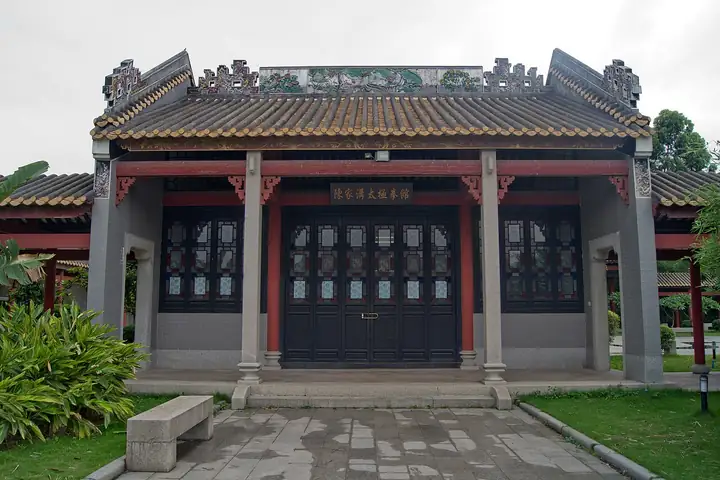 Chenjiagou Village ·
 Plan your visit
Getting there
Wen County is about 35 km in a straight line from central Jiaozuo. Search for 温县 in a map app to find stations and your accommodation.
Where to stay →Build your route
Start with Chenjiagou Village. The linked place guides have entrance and visit details.
Continue with Jiaozuo →More in Jiaozuo
Sources & geographic information
Administrative names and parent areas: Official geographic directory · Reference date 2026-09-06.
Photo: Chenjiagou Village · Caiguanhao · CC BY-SA 3.0. EXIF orientation normalized; resized without changing aspect ratio; converted to WebP. No subject edits.

Map data © OpenStreetMap contributors. Pins mark approximate centres, not entrances or boundaries.