

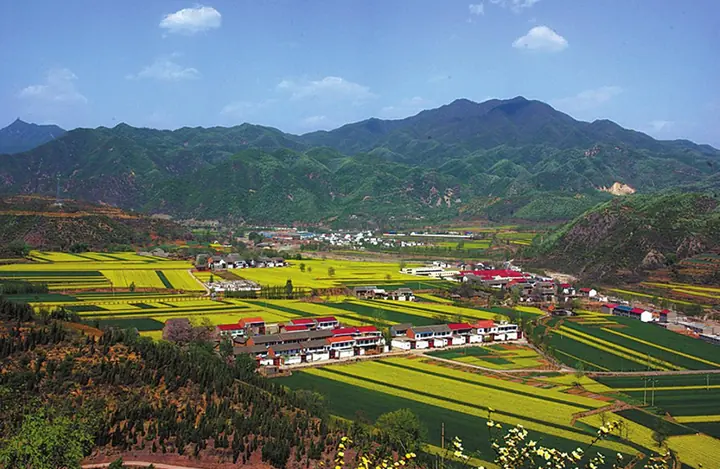
Photo adjustments
Full frame retained; proportionally resized and converted to WebP. No retouching or changes to the photographed subject. Card displays may crop the view.
Explore the region
About Wangwu Mountain
Yangtai Palace is especially rewarding for close inspection: its halls, courtyards and carved stone columns bring mythological figures and everyday scenes into the architecture. The mountain’s Tiantan summit is associated with the Yellow Emperor’s sacrifice to heaven, a tradition that gives the surrounding terrain cultural meaning. A palace visit and a summit outing require very different levels of effort.
In the Han and Wei periods, Wangwu Mountain was ranked first among Taoism's Ten Grotto-Heavens (道教十大洞天), described as the foremost grotto-heaven under heaven; the Tang-dynasty Taoist text attributed to Sima Chengzhen (司马承祯) again placed it first, terming it the heaven of small clarity and emptiness (小有清虚之天). During the Tang dynasty, Emperor Xuanzong (唐玄宗) sent his sister Princess Yuzhen (玉真公主) to practice Taoism at Yangtai Palace (阳台宫) on the mountain.
The mountain rises about 40 kilometres northwest of Jiyuan. It lies within the Wangwushan-Yuntaishan National Park and is designated a national-level scenic area (国家级风景名胜区). Its summit, Tiantan Peak (天坛山), reaches an elevation of 1,715 metres, standing as a single peak above the surrounding ranges.
What to look for
- Yangtai Palace’s carved stone columns, with Taoist figures, animals and secular scenes.
- The Tiantan mountain setting, associated with the tradition of sacrifice to heaven.
Location & getting there
Getting to Wangwu Mountain
Approach the Yangtai Palace and Wangwu scenic area from Jiyuan toward Wangwu. The municipal guide identifies Wangwu, Shaoyuan and Yangtai Palace road services as approaches; confirm current departures and the exact stop before relying on a bus.
Combine your visit
A suggested sequence linking the specific features of this visit.
-
Yangtai Palace courtyards
Start with the arrangement of the lower religious complex.
-
Sanqing Hall and stone columns
Look closely at the relief scenes and structural details.
-
Tiantan mountain route
Add a separate mountain ascent only if the open route and return plan suit your group.
This order is editorial. Confirm access and any transfers between stops; it does not establish a walking route, same-day connection or common admission ticket.
Find Wangwu Mountain
王屋山 · 济源市
The pin marks the area, not the entrance.
More places nearby
Approximate straight-line distances between map pins, not travel distances.
Longtan Grand Canyon 龙潭大峡谷
33 km awayLongtan Grand Canyon cuts through purplish-red quartz sandstone in northern Xin’an County. Water has shaped narrow passages, broader basins and waterfall sections, so the changing rock walls are as significant as the water…
View guide →Museum of Luoyang Eastern Zhou Royal Horse and Chariot Pits 洛阳天子驾六博物馆
54 km awayThis museum preserves an Eastern Zhou horse-and-chariot burial beneath the modern centre of Luoyang. The six-horse team gives the site its name and raises questions about the status of the people buried here. Other arrangements…
View guide →Yingtian Gate 应天门遗址
54 km awayYingtian Gate marked the southern entrance to the palace city of Sui and Tang Luoyang. Today, a large protective reconstruction gives the gateway’s scale and projecting towers a visible form above the archaeological remains. The…
View guide →Sources & visit information
The sources below support the place-specific description and arrival information. Suggested combinations are editorial planning ideas; confirm current opening, entry arrangements and transport services for your date.
- 王屋山 ↗
- www.jiyuan.gov.cn ↗
- www.jiyuan.gov.cn ↗
- Chinese Wikipedia: 王屋山 (revision 92247318, 2026-04-11) ↗
- English Wikipedia: Mount Wangwu (revision 1360202051, 2026-06-19) ↗
Visitor information adapted and edited from Wikipedia contributors, “王屋山” · CC BY-SA 4.0. Source revision 92247318.
Background paragraphs translated and condensed from Wikipedia contributors, "王屋山", Chinese Wikipedia · CC BY-SA 4.0. Source revision 92247318.
Background paragraphs condensed from Wikipedia contributors, "Mount Wangwu", English Wikipedia · CC BY-SA 4.0. Source revision 1360202051.