

Explore the region
Tap any red Chinese text to hear it in Mandarin.
Why this place matters
Yingtian Gate was the southern entrance to the palace city of Sui–Tang Luoyang, the imperial centre now commonly associated with the city’s Ziwei Palace area. It was built in 605, the first year of the Sui Daye era. The gate was first called Zetian Gate and was renamed Yingtian Gate in 705, during the first year of the Shenlong era.
This was not an ordinary city doorway. The gate formed part of the ceremonial axis of the palace city and hosted state celebrations, diplomatic receptions and other court events. Accounts associated with the site include Emperor Gaozong’s proclamation releasing the king of Baekje, Wu Zetian’s accession, and receptions for Japanese envoys to the Sui and Tang courts. These episodes explain why the gate is better understood as a place of imperial ceremony than simply as a photogenic tower.
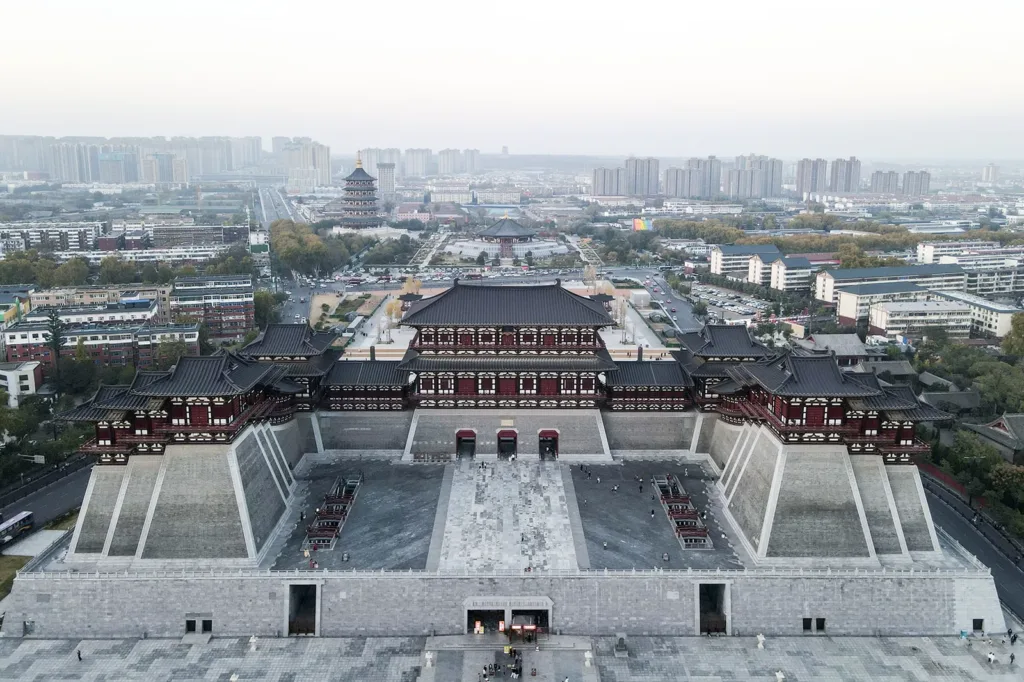
The original gate was destroyed in the Northern Song period. The building visible today is a modern protection-and-display reconstruction above the archaeological remains, not the complete ancient structure surviving intact. The most rewarding comparison is therefore between the remains interpreted inside the museum and the reconstructed central gate and flanking towers outside.
What to look for
The site’s defining architectural idea is the high-status “two towers, three projecting tower units” arrangement, expressed in Chinese as 两重观、三出阙 Liǎng chóng guàn, sān chū què. Look at the central gate, the flanking tower masses and the way the reconstruction turns an archaeological plan into a full-scale urban landmark. The official city description identifies this form as a particularly clear expression of ancient court ritual hierarchy.
Allow time for the archaeological interpretation before stepping back into the square. Details such as foundation traces and recovered architectural components matter here because they keep the spectacular reconstruction tied to evidence rather than presenting it as an untouched Tang building. The surrounding Sui–Tang Luoyang heritage area also places Yingtian Gate in a wider sequence with Mingtang, Tiantang and Jiuzhou Pool, but those are separate sites with their own access arrangements.
Visiting and getting there
The visitor registry lists Yingtian Gate Ruins Museum at the junction of Dingding South Road and Zhongzhou Middle Road. Search or show the Chinese name 应天门遗址博物馆 Yìngtiān Mén Yízhǐ Bówùguǎn when using a ride-hailing service. Use the venue name rather than relying on an English transliteration alone.
The city’s registered museum list gives an admission price of RMB 60 and lists daily hours of 09:00–22:00, with ticket inspection ending at 21:30. It names online booking through the “邂逅隋唐” WeChat account, the “隋唐洛阳城景区” mini-program, Meituan, Ctrip, Tongcheng and Douyin, as well as on-site booking. These details are time-sensitive. The operator’s website currently displays a separate general schedule of Tuesday–Sunday 09:00–17:00, last entry 16:30, with Monday opening on public holidays. Because the two official pages do not match, confirm the date-specific listing and any evening access before setting out.
The cited booking information does not explain whether every platform accepts a foreign passport, which identity fields are required, or whether an English-language booking route is available. International visitors should check passport acceptance and the entry procedure with the venue or the named booking platform before paying. Do not treat a domestic ID-based booking flow as proof that a passport will work.
Luoyang Metro Line 1 stops at 应天门站 (Yingtianmen Station). The official metro network lists 洛阳火车站 (Luoyang Railway Station) and 龙门高铁站 (Longmen High-Speed Railway Station) on Line 2; from either station, travel on Line 2 to 解放路 (Jiefang Road) and transfer to Line 1 toward 杨湾 (Yangwan) for 应天门. After the visit, reverse that route toward 红山 (Hongshan). The official source confirms the lines and station names but does not establish an exit number or a fixed walking time, so follow the current station signs to the museum and recheck the last train for your return.
Inside the museum, follow staff instructions around protected remains. The operator’s general visitor notice asks visitors not to touch exhibits, to keep quiet, and not to bring food into exhibition areas. Plan the museum visit and the exterior square as one comparison: first read the surviving evidence, then move outside to understand the scale and ceremonial composition.
Combine your visit
A suggested sequence linking the specific features of this visit.
-
Gate remains and interpretation
Begin with the surviving evidence beneath the reconstruction.
-
Reconstructed gate exterior
Use the visible scale to understand the former palace entrance.
-
Public square
Step back to see the flanking towers and overall composition.
This order is editorial. Confirm access and any transfers between stops; it does not establish a walking route, same-day connection or common admission ticket.
Find Yingtian Gate
应天门遗址 · 洛阳市
The pin marks the area, not the entrance.
More places nearby
Approximate straight-line distances between map pins, not travel distances.
Museum of Luoyang Eastern Zhou Royal Horse and Chariot Pits 洛阳天子驾六博物馆
2 km awayThis museum preserves an Eastern Zhou horse-and-chariot burial beneath the modern centre of Luoyang. The six-horse team gives the site its name and raises questions about the status of the people buried here. Other arrangements…
View guide →Luoyang Museum · Nietai Road 洛阳博物馆·聂泰路馆址
4 km awayLuoyang Museum presents objects from the successive cultures and capitals of the Luo River valley. Its bronze collection is especially distinctive: a three-wheeled dove cart turns an animal into a small vehicle, while ritual…
View guide →Guanlin 关林
8 km awayGuanlin in Luoyang’s Luolong district is traditionally identified as the burial place of Guan Yu’s head. Its historical complex combines tomb, temple and commemorative grove.
View guide →Sources & visit information
Sources checked on 23 October 2026. Hours, tickets, reservations and transport can change; confirm with the operator before you go.
Image credits & notes (1)
- Aerial view of the reconstructed Yingtian Gate and its flanking towers at the Yingtian Gate Site Museum in Luoyang. Photo: WindmemoriesPhoto: CC BY-SA 4.0