

Photo adjustments
Proportionally resized and converted to WebP without cropping, retouching or changing the photographed subject.
Explore the region
About Jiguan Cave
It is a limestone cave shaped by karst processes.
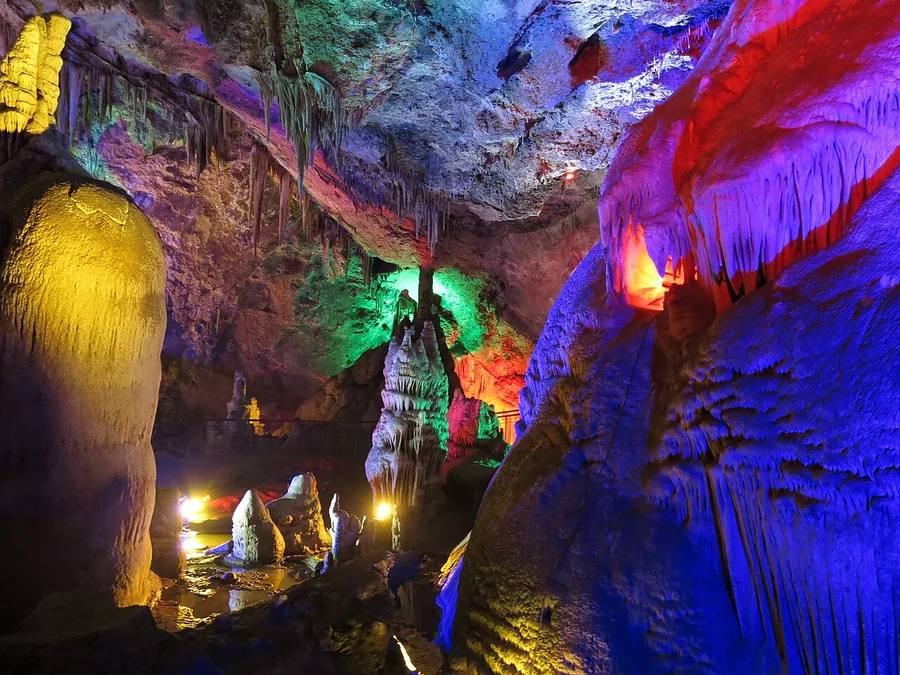
The underground attraction contains stalactites and stalagmites along a managed visiting route. The cave extends beyond the part used by visitors, so the full geological length should not be mistaken for the length of the public route. The hillside location also means that reaching the scenic area and entering the cave are separate stages.
The cave is estimated to have formed about 600 million years ago and was discovered during the Qianlong era of the Qing dynasty. Development began in August 1992, was completed on 31 March 1993, and the cave opened to visitors in April 1993. It was awarded the status of a national 5A tourist attraction (国家5A级旅游景区) on 9 January 2012.
The cave lies at an elevation of 1,021 metres on the side of Jiguan Mountain. It extends 5,600 metres in length, with five vertical tiers and a total drop of 138 metres; about 1,800 metres of passage and 23,000 square metres of chamber area are open to visitors. The interior is naturally maintained at about 18 degrees Celsius year-round. Caves of this scale are described as uncommon in northern China.
What to look for
- Limestone formations include both hanging stalactites and rising stalagmites.
- The managed underground passage shows only part of the larger cave system.
The surrounding area
A city base for Longmen, soup breakfasts, old-city food streets and contemporary hanfu visitor districts.
Location & getting there
Getting to Jiguan Cave
Approach Jiguan Mountain west of Luanchuan county town, then follow the designated cave entrance route.
- Confirm the selected entrance and current internal access before departure.
Combine your visit
A suggested sequence through the source-confirmed features.
-
Hillside cave approach
Examine Hillside cave approach as a separate part of Jiguan Cave.
-
Managed stalactite and stalagmite galleries
Limestone formations include both hanging stalactites and rising stalagmites.
The sequence is editorial. Check local access and connections between sectors; no walking time or same-ticket access is promised.
Find Jiguan Cave
鸡冠洞 · 洛阳市
The pin marks the area, not the entrance.
More places nearby
Approximate straight-line distances between map pins, not travel distances.
Laojun Mountain (Henan) 老君山
8 km awayLaojun Mountain rises above Luanchuan with a combination of rocky peaks, elevated paths and Taoist buildings. The Shili Huaping sector follows a landscape of closely spaced rock pinnacles, while the Golden Summit temples give…
View guide →Baiyun Mountain (Henan) 白云山
24 km awayBaiyun Mountain lies in southern Song County within the Funiu mountain system. Its wooded uplands and frequently clouded peaks are the basis of the landscape attraction.
View guide →Mount Yao in Henan 河南尧山
61 km awayYaoshan rises at the eastern end of the Funiu Mountains, with an outline of separate rock towers rather than a single smooth summit. Yuhuang Peak is the high point, while names such as General Rock and Shiren describe the shapes…
View guide →Sources & visit information
The sources below support the place-specific description and arrival information. Suggested combinations are editorial planning ideas; confirm current opening, entry arrangements and transport services for your date.
- www.wikidata.org ↗
- 鸡冠洞 ↗
- Chinese Wikipedia: 鸡冠洞 (revision 88462152, 2025-07-27) ↗
- English Wikipedia: Jiguan Cave (revision 1346921113, 2026-04-03) ↗
Visitor information adapted and edited from Wikipedia contributors, “鸡冠洞” · CC BY-SA 4.0. Source revision 88462152.
Background paragraphs translated and condensed from Wikipedia contributors, "鸡冠洞", Chinese Wikipedia · CC BY-SA 4.0. Source revision 88462152.
Background paragraphs condensed from Wikipedia contributors, "Jiguan Cave", English Wikipedia · CC BY-SA 4.0. Source revision 1346921113.