

Explore the region
Tap any red Chinese text to hear it in Mandarin.
Why this museum stands out
This is not a general history museum with a token archaeology room. The main experience is moving through a chronological group of tombs relocated and rebuilt on the grounds, then comparing their chambers, painted images, brick decoration, and burial ideas. The sequence runs from the Western Han to the Song and Jin periods, so changes in architecture and what people imagined for the afterlife become visible at human scale.
The museum is also known as the Henan Ancient Mural Museum. Its mural gallery presents 18 groups and 65 paintings from tombs in Henan, while the Song–Jin display has 106 carved bricks depicting everyday life, filial piety, and hopes for good fortune. Together with the Northern Wei Jingling, this makes the visit as much about reading images and spaces as looking at individual objects.
What to look for
- The reconstructed tomb sequence. Follow the chronology rather than treating the underground rooms as one dark attraction. The rebuilt tombs show how layouts, painted subjects, and funerary furnishings changed across nine dynasties.
- Western Han mural tombs. The Bu Qianqiu tomb is a useful place to look for the Han vision of an afterlife journey: the mural depicts the tomb couple riding a dragon and phoenix toward immortality, alongside figures such as Fuxi, Nüwa, and the Four Directional Spirits.
- The tomb of An Pu and his wife. An Pu came from the western-region state of An and served the Tang dynasty. The tomb produced Tang sancai figures and a gold coin from the Eastern Roman period, a compact reminder that Luoyang’s funerary world was connected to long-distance movement along the Silk Road.
- Jingling. On the museum grounds, the Northern Wei Jingling is the tomb of Emperor Xuanwu. It is presented as an excavated imperial mausoleum, with its approach, stone guardians, and burial chamber offering a different scale from the relocated ordinary and elite tombs.
- The mural and carved-brick galleries. Allow time for the “Earth Palace for a Thousand Autumns” mural exhibition and the Song–Jin carved-brick display. Look for the contrast between earlier cosmological imagery and later scenes of domestic life, banquets, and family ethics.
Plan the visit
The museum’s permanent exhibitions are free, but the official visitor guide requires advance real-name reservation. Reservations are made through the museum’s official WeChat account or website; the guide says tickets are released daily at midnight and booking closes at 16:30 on the visit day. Visitors using a passport are explicitly included: after reserving, present the passport to staff for on-site document checking, then use the reservation QR code at the gate. Do not assume that a reservation made with another document or a third-party ticket is interchangeable with the museum’s own process.
The normal schedule is 09:00–17:00, with last entry at 16:30. The museum is closed on Mondays except during public holidays. Holiday hours and temporary arrangements can change, so check the official notice and your reservation on the day you go.
The address is No. 6 Jichang Road, Laocheng District, Luoyang (河南省洛阳市老城区机场路6号). Photography is allowed in some exhibitions, but the museum asks visitors not to use flash or tripods where restrictions apply. The subject is funerary architecture and art; keep voices low and follow each gallery’s signs, especially in the reconstructed chambers.
Getting there
The official guide gives two practical public-transport options:
- From Luoyang Railway Station (洛阳火车站), take Bus 83 directly toward Luoyang Museum of Ancient Tombs (洛阳古墓博物馆).
- Take Metro Line 2 to Mangling Station (邙岭站), then transfer to Bus 83 for the museum.
For a taxi or ride-hailing car, show the Chinese name 洛阳古墓博物馆 Luòyáng Gǔmù Bówùguǎn and the full address above. The museum’s guide does not give a reliable fare or journey time, so those figures are deliberately omitted. Before leaving, check the current 83 stop and direction for the return trip; the official guide confirms the outward connection but does not specify the return stop in detail.
Find Luoyang Museum of Ancient Tombs
洛阳古墓博物馆 · 老城区
The pin marks the area, not the entrance.
Sources & visit information
Sources checked on 23 October 2026. Hours, tickets, reservations and transport can change; confirm with the operator before you go.
Image credits & notes (1)
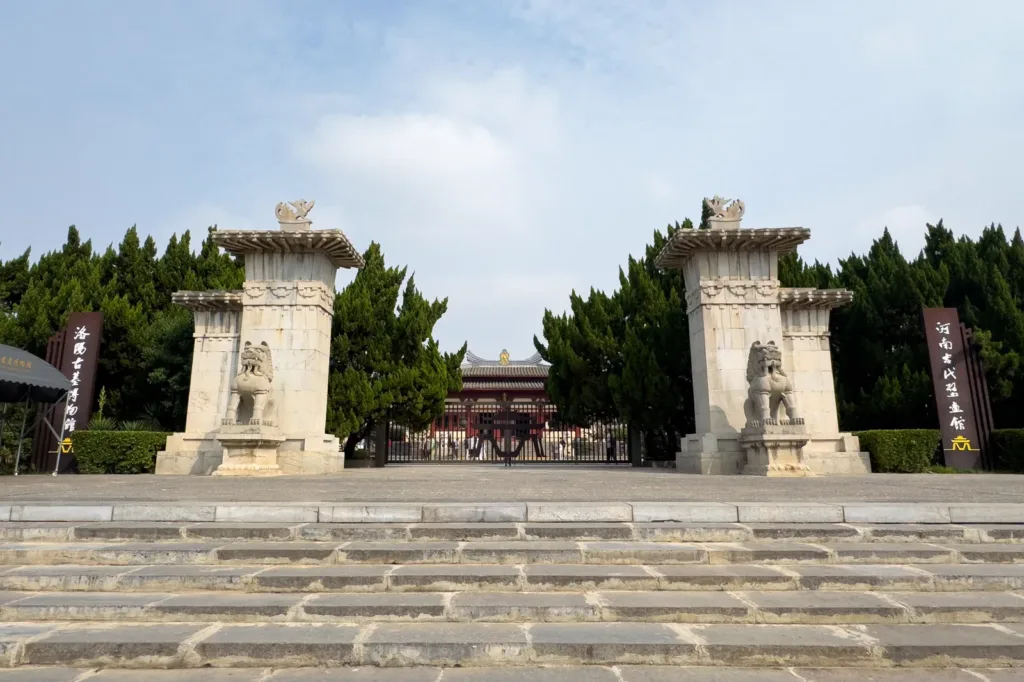
- Entrance to the Luoyang Museum of Ancient Tombs, with stone guardian figures and the museum gate. Photo: Tim Wu (Wikimedia Commons user TimWu007)Photo: CC BY-SA 4.0