

Photo adjustments
Full frame retained; EXIF orientation normalized, proportionally resized to at most 800 pixels and converted to WebP. No generated pixels or subject changes. Cards may crop the display.
Explore the region
About Qicheng site
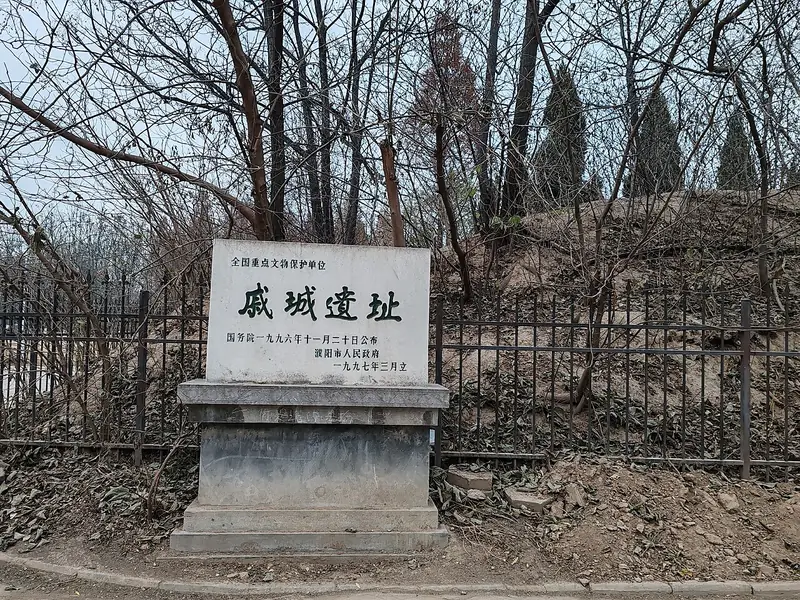
The site is associated with meetings between rulers during the Spring and Autumn period, while archaeological layers extend beyond that single chapter. The park mixes authentic remains with later structures interpreting the region’s history. Concentrate first on the earthworks, then use the meeting-platform interpretation to understand how diplomacy became part of the site’s identity.
The site was first listed as a Henan provincial cultural relic protection unit in 1961; when the provincial government formally announced its first batch of protected units in 1963, the site was registered under the name Kongkui Cheng site (孔悝城遗址), classified as an ancient cultural site of the Zhou dynasty and then located within Puyang County. A trial excavation was carried out in 1965. In 1996 it was listed, under the name Qicheng site, as a Major Historical and Cultural Site Protected at the National Level (全国重点文物保护单位), the fourth such batch announced by the State Council.
Construction of the Qicheng cultural relic scenic area began in March 1991 and took five years to complete. The finished park covers a total area of 760 mu (亩) and contains five memorial scenic spots along with three areas displaying relics and archaeological remains.
What to look for
- Surviving ancient city-wall earthworks, the clearest material evidence of the fortified settlement.
- The meeting-platform interpretation and displays explaining Qicheng’s association with interstate assemblies.
Location & getting there
Getting to Qicheng site
Go to Qicheng Village in Hualong District, on the west side of Jingkai Avenue near Gucheng Road. Use the Qicheng heritage-park entrance for the final local transfer; the archaeological remains lie within the present urban area.
Combine your visit
A suggested sequence linking the specific features of this visit.
-
Ancient wall remains
Begin with the surviving earthworks and the shape of the settlement.
-
Meeting-platform area
Read the later interpretation of assemblies associated with Qicheng.
-
Historical displays
Separate the excavated evidence from the park’s broader cultural reconstructions.
This order is editorial. Confirm access and any transfers between stops; it does not establish a walking route, same-day connection or common admission ticket.
Find Qicheng site
戚城遗址 · 濮阳市
The pin marks the area, not the entrance.
More places nearby
Approximate straight-line distances between map pins, not travel distances.
Youli 羑里城
65 km awayYouli combines a much older archaeological site with later buildings commemorating King Wen of Zhou. The traditional account of his imprisonment and work on the Book of Changes gives the place its meaning, but the visible…
View guide →National Museum of Chinese Writing 中国文字博物馆
71 km awayThe National Museum of Chinese Writing makes scripts its central subject, beginning with early evidence such as oracle bones and following changes in written form. The architecture extends that theme outdoors: the…
View guide →Yinxu Ruins 殷墟
76 km awayYinxu is the archaeological landscape of the late Shang capital around Xiaotun beside the Huan River. Rammed-earth palace and ancestral-temple foundations show the scale of the former city, while Fu Hao’s tomb gives the royal…
View guide →Sources & visit information
The sources below support the place-specific description and arrival information. Suggested combinations are editorial planning ideas; confirm current opening, entry arrangements and transport services for your date.
Visitor information adapted and edited from Wikipedia contributors, “戚城遗址” · CC BY-SA 4.0. Source revision 93968134.
Background paragraphs translated and condensed from Wikipedia contributors, "戚城遗址", Chinese Wikipedia · CC BY-SA 4.0. Source revision 93968134.