

Explore the region
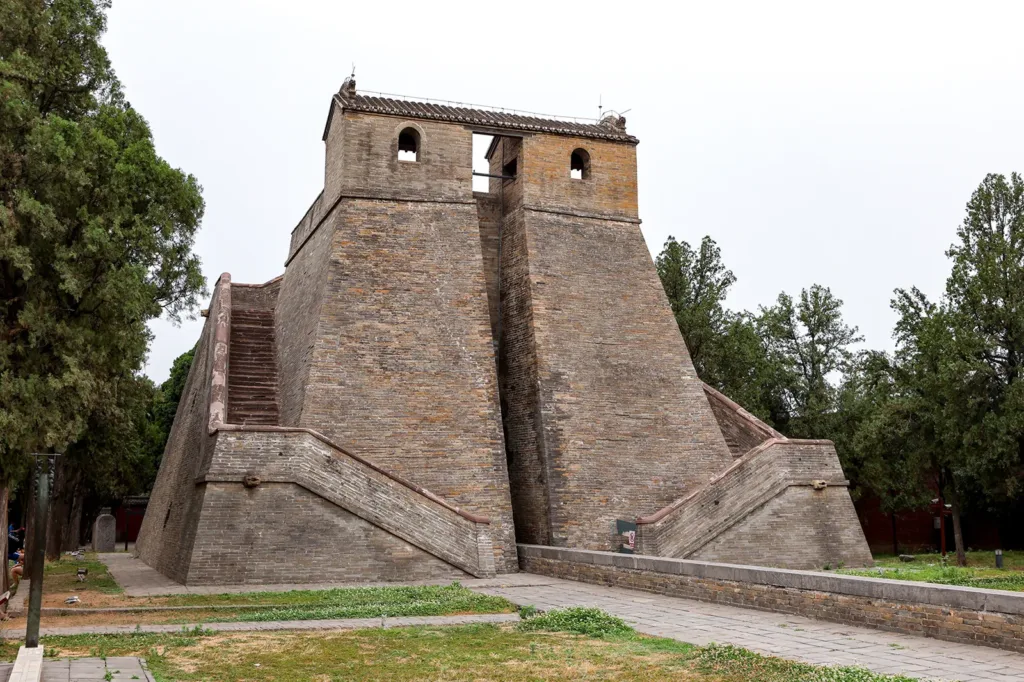
Gaocheng Astronomical Observatory, also called the Dengfeng Observatory, is a heritage site in Gaocheng Town, Dengfeng City. It is not in central Zhengzhou and it is not the same entrance as the Shaolin or Songyang Academy areas. The observatory forms part of the UNESCO-listed Historic Monuments of Dengfeng in “The Centre of Heaven and Earth”, a serial property that brings ritual, education, science and technology together around Mount Song.
What makes it worth the road trip
This is a place where an astronomical method remains legible in the fabric of a building. The Yuan-dynasty platform was designed so that a horizontal bar cast its shadow onto a long stone measuring scale, or shigui, extending north. Two parallel channels in the scale helped establish a level reference. The platform itself is about 9.45 metres high; the scale is 31.19 metres long and made from 36 stone blocks.
The site also preserves the setting of earlier measurements. The astronomical-heritage record describes a Tang-dynasty stele connected with the eighth-century geodetic survey associated with Yi Xing, while the municipal visitor page lists the Zhougong shadow-measuring platform, the observatory, the Zhougong Temple and the Yangcheng Ruins Exhibition Hall among the main sights. These layers explain why the visit is more than a photograph of an old tower: the compound lets you follow a sequence from the idea of measuring the Sun’s shadow to a purpose-built instrument and then to the calendar work that followed.
The observatory’s measurements supported the Shoushi Calendar introduced in 1281. The surviving arrangement is easiest to understand in daylight: look at the horizontal bar, then trace the stone scale northward and notice the levelling channels. This is a heritage visit centred on scientific history, not a promise of a current night-time stargazing programme.
How to visit
Begin with the Duke of Zhou shrine setting, then examine the raised observatory platform and finish by following the stone scale. Keep the three elements in one mental diagram: the bar is the shadow-casting element, the scale is the measuring surface, and the channels explain how a level reference was checked. Do not assume that nearby buildings, exhibitions or other heritage points share one ticket or the same access arrangement.
The site is north of Gaocheng Town, about 12 km south-east of Dengfeng City, in Dengfeng, Zhengzhou municipality. The municipal government’s visitor guide gives a practical local connection: from Yangcheng Road South (阳城路南) in Dengfeng, take the Dengfeng–Gaocheng bus (登封至告成班车). The page does not publish a route number, timetable or last return, so ask locally about the return bus before entering the site. From Zhengzhou, the same guide describes reaching Dengfeng by the Zhengzhou–Shaolin–Luoyang Expressway or S316, then using the Dengfeng–Gaocheng connection.
For a private car or taxi, show 登封观星台(告成镇周公庙) and confirm the current visitor entrance with the driver or venue. The map pin is an area aid rather than proof of an entrance. There is no metro stop or railway station at the monument itself, and no source checked for this article establishes a direct rail or metro transfer.
A specialist heritage record says that the site belongs to the Dengfeng Municipal Bureau of Cultural Relics and is open to the public as a historic monument. I could not verify a current official opening timetable, admission price, reservation channel or passport-specific booking rule from the sources available for this article. Check the venue or local cultural-tourism authority immediately before travelling; do not carry over an old promotional free-admission notice or assume that a domestic-ID booking process accepts a foreign passport.
Combine your visit
A suggested sequence linking the specific features of this visit.
-
Duke of Zhou shrine setting
Begin with the site’s earlier tradition of observation and its commemorative context.
-
Yuan observatory platform
Examine the relationship between the raised bar and the instrument below.
-
Stone measuring scale
Follow the northward line to understand how the shadow became a measurement.
This order is editorial. Confirm access and any transfers between stops; it does not establish a walking route, same-day connection or common admission ticket.
Find Gaocheng Astronomical Observatory
观星台 · 郑州市
The pin marks the area, not the entrance.
More places nearby
Approximate straight-line distances between map pins, not travel distances.
Zhongyue Temple 中岳庙
9 km awayZhongyue Temple lies below the eastern side of Taishi Mountain at Dengfeng. It is a Taoist temple associated with the sacred Central Mountain and imperial mountain worship.
View guide →Mount Song 嵩山
20 km awaySongshan is a mountain range with distinct Taishi and Shaoshi sectors, rather than one summit path. Its exposed rock sequences are important to geology, while temples and academies occupy the lower slopes. Shaolin belongs to the…
View guide →Pagoda Forest at Shaolin Temple 少林寺塔林
22 km awayShaolin’s Pagoda Forest is a cemetery of memorial towers west of the monastery. Brick and stone structures from successive dynasties vary in plan, height, tiers and carved detail. Their inscriptions preserve the names and…
View guide →Sources & visit information
Sources checked on 31 October 2026. Hours, tickets, reservations and transport can change; confirm with the operator before you go.
Image credits & notes (1)
- Side view of Gaocheng Astronomical Observatory in Dengfeng, showing the Yuan-dynasty brick platform and its paired upper chambers. Photo: WindmemoriesPhoto: CC BY-SA 4.0