

Explore the region
Tap any red Chinese text to hear it in Mandarin.
Gongyi Grotto Temple is a compact Buddhist cave-temple complex in Gongyi’s Heluo Town, where Northern Wei court imagery and later carvings remain cut into the foot of Dali Mountain beside the Yiluo River.
Gongyi Grotto Temple is in Siwan Village, Gongyi City—not in central Zhengzhou, even though Gongyi is administered by Zhengzhou. The site stands on the north bank of the Yiluo River, about 10 kilometres north-east of Gongyi, and is protected as a second-batch Major Historical and Cultural Site Protected at the National Level. Its carvings span the Northern Wei, Eastern Wei, Western Wei, Northern Qi, Sui, Tang and Song periods.
Why this small grotto complex matters
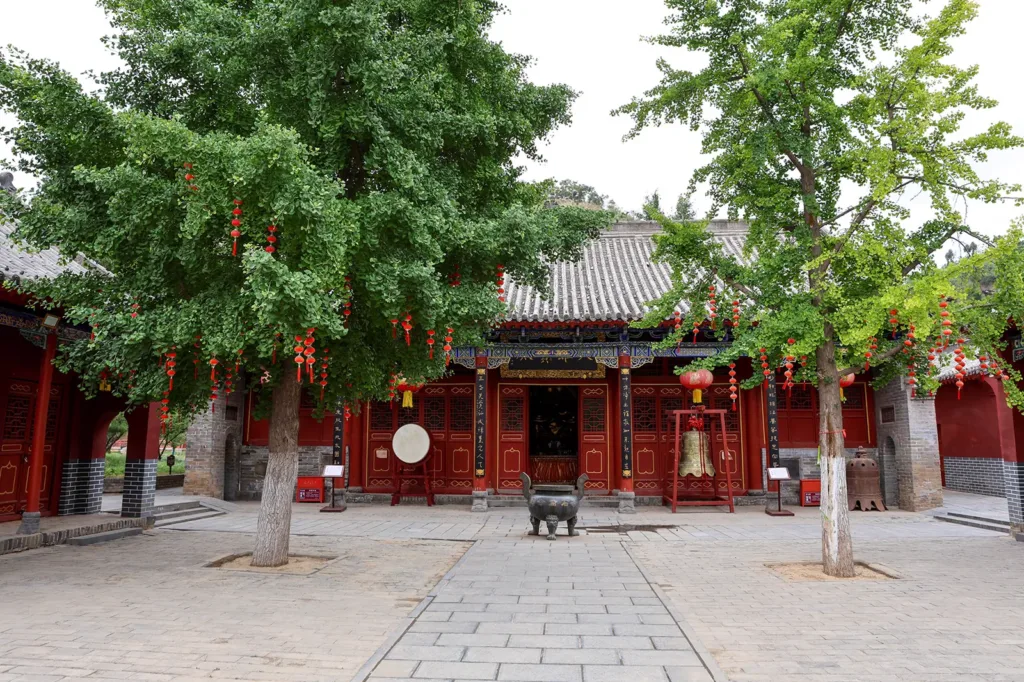
The appeal is not scale. It is the way a relatively compact cliff preserves changing Buddhist sculpture across centuries. The official heritage description records five caves, one thousand-Buddha niche, three cliff-carved statues, 328 rock-face niches, 186 stele inscriptions and 7,743 Buddhist figures. The surviving Qing main hall and east and west wings also show that this was once a temple as well as a carved cliff.
Look closely at the imperial worship reliefs: the emperor, empress and attendants are arranged as a formal procession rather than as isolated devotional figures. Nearby carvings of musicians, god-kings and flying apsaras make the caves useful for reading gesture, costume and movement, not just for counting statues. A 2026 report from the Zhengzhou cultural-heritage authority describes the site as a Northern Wei royal grotto and notes that the imperial worship imagery remains one of its representative works.
How to visit
Allow roughly half a day including the journey from Gongyi and time to look carefully at the cliff, inscriptions and remaining temple buildings. Begin with the caves, then step back to read the open-rock niches and cliff statues as a group. The caves face south, so changing daylight can help reveal relief, but the protected surfaces matter more than a particular photograph. Do not touch the carvings, cross barriers or use flash: the site’s conservation staff specifically warn that skin oils and repeated contact damage stone, and that some areas are restricted.
A current secondary visitor notice reproduced by Wing On Travel says that Cave 2 is temporarily closed because of loose stone and falling-rock risk, and that protective glass has been installed on the floors of Caves 4 and 5. Treat this as a useful warning rather than a promise that every cave will be open; confirm the accessible route at the entrance on the day. The same notice recommends advance booking when visitor numbers are high, but it does not establish a current official booking channel or whether a foreign passport can be used in the same way as a domestic ID.
The local authority signed a 2026 contract to prepare an environmental-improvement plan for the grotto scenic area, including the historic setting, parking, visitor routes and supporting facilities. That announcement is a planning contract, not a closure notice, but it is another reason to check for temporary works or changed parking arrangements before setting out.
Getting there
Use the Chinese destination name 巩义石窟寺 Gǒng Yì Shíkū Sì when searching. Add 巩义市 Gǒng Yì Shì or 寺湾村 Sì Wān Cūn to distinguish the grotto temple from similarly named map results. Amap’s own route-planning guidance supports driving, public transport, walking and cycling searches, and recommends checking the selected POI and reversing the route for the return journey.
- From Zhengzhou or Luoyang by rail: A recent travel guide describes regular trains to 巩义站 (Gongyi Railway Station) and identifies it as the more convenient rail arrival for this excursion than 巩义南站 (Gongyi South Railway Station). From 巩义站, it reports about 15 minutes by taxi or ride-hailing to the grotto temple, but time and fare vary with traffic; enter the exact Chinese destination in Amap and confirm the live quote.
- By local bus: The same guide reports walking to 交通宾馆站 Jiāo Tōng Bīn Guǎn Zhàn and taking 巩义66路 to 石窟寺站 Shíkū Sì Zhàn, with about 40 minutes on the bus and a reported ¥2 fare. The Gongyi government’s transport notice lists line 66 among the routes operating on 22 February 2024, but that notice is not a 2026 timetable. Check the live route, stop direction and last departure in Amap before boarding, then search back from 石窟寺站 Shíkū Sì Zhàn for the return to town or 巩义站 rather than assuming the same service runs late.
- By car or ride-hailing: Set the destination to the verified POI 巩义石窟寺 Gǒng Yì Shíkū Sì and confirm that the pin is in Siwan Village, Heluo Town. Do not use an unverified “Gongyi Grotto Ruins Park” result as a substitute. Parking conditions may change while the 2026 environmental plan is being implemented, and a secondary visitor notice says that parking collection at the site has been handled by villagers rather than the operating unit; confirm the current arrangement on arrival.
There is no reliable basis here for publishing a current ticket price, seasonal opening timetable or passport-specific reservation rule. Confirm those three items with the venue or its current official notice before leaving, and keep enough time for the return leg to the railway station.
Find Gongyi Grotto Temple
巩义石窟寺 · 巩义市
The pin marks the area, not the entrance.
Sources & visit information
Sources checked on 31 October 2026. Hours, tickets, reservations and transport can change; confirm with the operator before you go.
Image credits & notes (1)
- Exterior of the Main Hall at Gongxian Grottoes Temple, showing the surviving temple courtyard, grey-tiled roof, red walls and mature trees. Photo: WindmemoriesPhoto: CC BY-SA 4.0