

Explore the region
The name joins two linked but not identical experiences. Zhengzhou Shang Capital Site Museum (郑州商都遗址博物院) is the indoor interpretation centre; the Shang City walls are surviving parts of a much larger archaeological site spread through Guancheng Hui District. This is not one fenced archaeological enclosure: the site lies beneath and between modern streets, so the museum works best as an introduction to the landscape rather than a substitute for seeing its wall remains.
Why this place matters
Zhengzhou Shang City was an early Shang capital site. The heritage authority describes a roughly 25-square-kilometre archaeological area running from Fenghuangtai in the east to Xishakou in the west, and from Huayuan Road in the north to Erligang in the south. It includes three lines of city wall, a palace area, settlements, burials, craft workshops and storage pits. The best-preserved elements are the inner wall, about seven kilometres in circuit, and the palace area. The site became one of China’s first National-Level Major Historical and Cultural Sites Protected in 1961.
The museum opened formally on 26 July 2022 inside the Zhengzhou Shang Capital National Archaeological Site Park. Its approximately 5,500-square-metre exhibition area includes the permanent exhibition A Towering Bo Capital, a Model Royal City: The Civilisation of the Zhengzhou Shang Capital, arranged in seven sections. Expect bronzes, jades, bone objects and pottery, together with archaeological models, reconstructions and media explaining the capital’s layout, crafts, ritual life and protection. The National Cultural Heritage Administration reported more than 1,000 objects on display at opening.
What to see
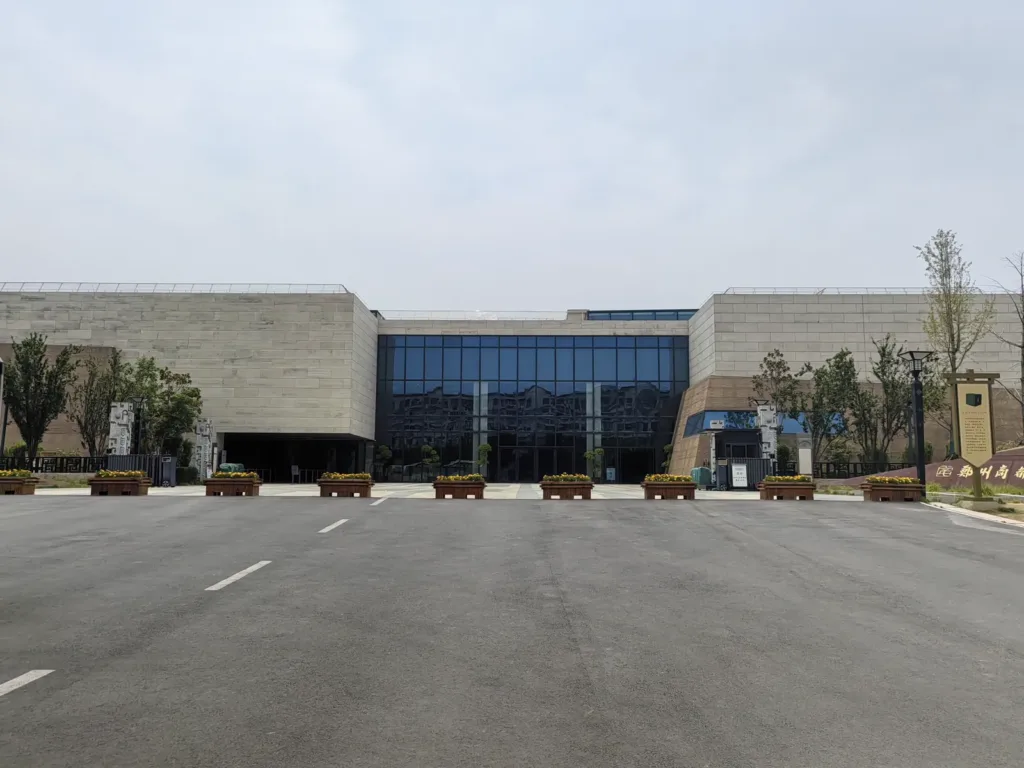
Start inside with the city plan rather than treating the objects as an isolated collection. Look for the way the exhibition connects walls, palace space, workshops, storage and movement through the capital. The building itself echoes archaeological vocabulary through forms associated with city walls, rammed earth, jade, bronze and excavation squares.
Then go outside and look for marked, accessible sections of the rammed-earth walls in the surrounding urban landscape. Their value is partly spatial: they show that the capital was a planned city occupying ground that is now shared with roads, neighbourhoods and public green space. Allow time to orient yourself before walking; the surviving remains are not a single continuous rampart with one entrance. Weather, conservation work and local access arrangements may affect which wall sections can be approached on the day.
A separate Archaeology Museum of the Zhengzhou Municipal Institute of Cultural Relics and Archaeology opened in the same site park and building complex. Its galleries are not the same institution as the Shang Capital Site Museum, so check the name on the booking or entrance information if you intend to visit both.
Plan a visit
The latest Zhengzhou Municipal Cultural Relics Bureau listing checked on 31 October 2026 gives Tuesday–Sunday opening from 09:00 to 17:00; reservations stop at 15:50 and entry stops at 16:00. It lists Monday closure except on national public holidays.
The same current listing names the museum’s WeChat account, but the page does not publish a current admission price or a passport-specific reservation workflow. If you are travelling on a foreign passport, confirm directly with the museum before relying on the booking interface; do not assume that a domestic-ID reservation path will accept a passport. Do not carry an old seasonal event notice forward as a current schedule.
An older visitor notice reproduced by a secondary museum directory listed passports among accepted IDs, but it is dated 24 December 2021 and also contains trial-opening and pandemic-era requirements. Treat it as historical context, not as proof that the current booking system accepts passports.
The museum is an indoor venue, while the wall remains are open-air urban heritage. No separate seasonal timetable for the wall sections was published on the official pages checked, so check for temporary conservation work, public-holiday arrangements and any exhibition changes before setting out.
Getting there
- Metro: Take Zhengzhou Metro Lines 2 or 3 to Dongdajie Station (东大街站). The current municipal museum listing directs visitors to Exit F, then east for about 150 metres.
- Bus: Routes G50, 60, B32 and 89 serve Zhengzhou Wenmiao (郑州文庙) bus stop; the same listing gives an onward walk of about 600 metres. Check the live direction and stop position in Amap before boarding, because city bus routings can change.
- Taxi or ride-hailing: Show the Chinese destination “郑州商代都城遗址博物院,河南省郑州市管城回族区东大街366号”. Amap lists the museum at East Street 366 and is useful for confirming the approach and the return route.
For the return, Dongdajie Station is the clearest fixed reference. If returning by bus, re-check the direction from Zhengzhou Wenmiao stop in Amap rather than assuming the opposite platform or route number. The museum address is in the central urban area, but the wider archaeological site is not a single point: use the Chinese name for the museum and the specific wall section separately when navigating.
Find Zhengzhou Shang Capital Site Museum and Shang City Walls
郑州商都遗址博物院与商城城垣 · 管城回族区
No reliable map pin yet: search by the Chinese name.
Sources & visit information
Sources checked on 31 October 2026. Hours, tickets, reservations and transport can change; confirm with the operator before you go.
Image credits & notes (1)
- The entrance facade of Zhengzhou Shang Capital Site Museum in the Zhengzhou Shangcheng National Archaeological Site Park, photographed on 27 May 2025. Photo: YumetoPhoto: CC BY-SA 4.0