

Explore the region
Tap any red Chinese text to hear it in Mandarin.
In brief: A broad riverside landscape in Huiji District where the Yellow River meets the edge of the North China Plain. Its five visitor areas combine the river’s suspended-channel landscape with the 106-metre Yan and Huang Emperors Statue, a large calligraphy stele forest, geological interpretation and water-engineering history.
Why this place is different
Yellow River Cultural Park is not a compact city museum. The Zhengzhou government’s destination listing describes more than 20 square kilometres of open parkland, organised around Wulongfeng, Yueshan Temple, Dayu Mountain, the Yan and Huang Emperors Statue and Xinghai Lake, with more than 40 named features. It sits on the river’s south bank in Huiji District, about 20 kilometres north-west of central Zhengzhou, with Mount Yue behind it and the Yellow River to the north.
This is a useful place to see how geography and Chinese history are presented together. Local official descriptions place this reach at the end of the Loess Plateau and the beginning of the lower, silt-raised “suspended river” section, near the transition between the Yellow River’s middle and lower courses. From the riverside viewing area, look upstream towards Taohuayu and downstream towards the Zhengjiao Intercity Railway bridge and the remains of the “First Bridge over the Ten-Thousand-Li Yellow River”; these are landscape cues, not just names on a map.
What to look for
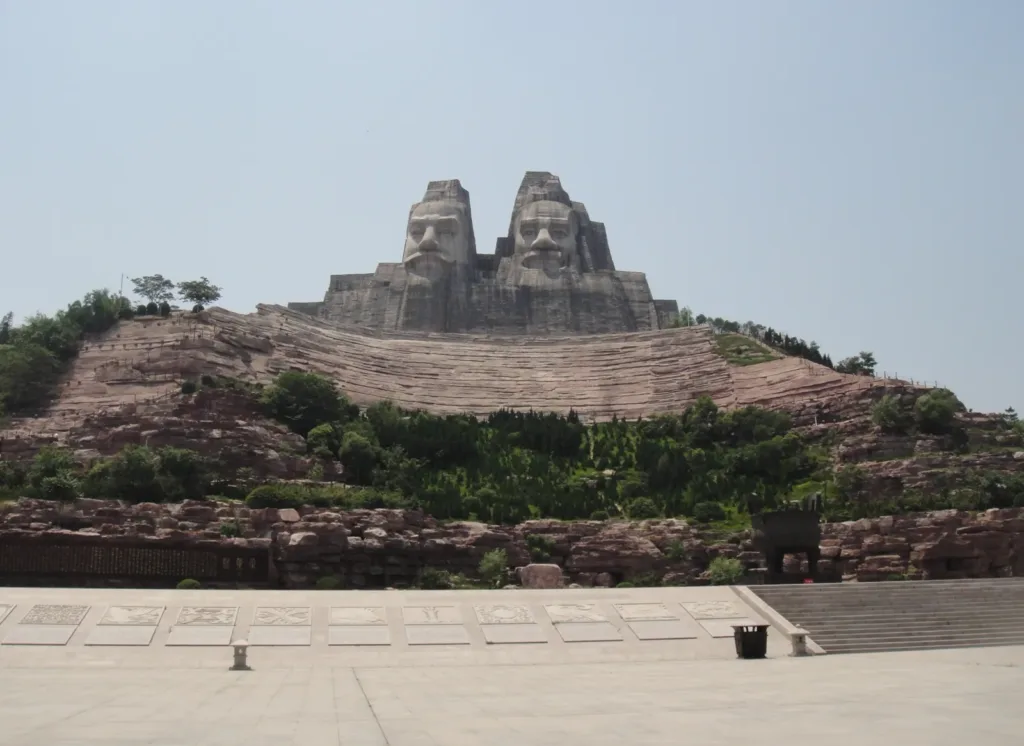
Start with the Yan and Huang Emperors Statue area. The paired heads are built into the hillside and face the river; the official description gives their height as 106 metres. Below them is a large stele carrying the 485-character Yanhuang Fu in Fan Zeng’s handwriting. The square also has a group of 117 historical-figure sculptures arranged under five themes.
In Wulongfeng, the off-white “Nurture” statue shows a mother holding an infant. On the slope, eight large green pipes mark the Mangshan Pumping Station, a water project built between 1970 and 1972 to lift Yellow River water towards Zhengzhou’s waterworks. The pipes are worth noticing because they connect the park’s cultural story to the city’s practical dependence on the river.
The Yellow River Stele Forest is a slower, closer-scale stop: the official account describes thousands of calligraphy works carved in different scripts and techniques. The Zhengzhou Yellow River National Geopark Geological Museum is described as using loess-cave-style halls, with displays on loess, the Yellow River and the North China Plain. Its current opening arrangement is not separately established in the sources used here, so confirm the museum and any indoor galleries at the entrance rather than assuming every listed feature is open.
Planning a visit
The destination listing read for this guide displays opening hours of 07:30–18:00 and a full ticket of RMB48, with a half-price ticket of RMB24. It also lists several age, height, student and occupational concessions. The page does not state a passport-specific booking or admission procedure. Travellers using a foreign passport should contact the park before relying on an online reservation, and should carry the Chinese name 黄河文化公园 Huáng hé Wénhuà Gōng Yuán and the official address 郑州市惠济区黄河南岸1号. Do not treat the listed hours or prices as a guarantee for a future season; recheck them with the venue on the day you plan to go.
Because the park covers a large area, choose a small group of sights rather than trying to cover every named feature. A practical first visit is the Yanhuang Statue and square, the riverside viewing area, then either the Stele Forest or the geological museum if it is open. Stay on marked paths at the river edge. The sources checked here do not establish a current boat schedule or a year-round water excursion, so do not plan around one without a same-day confirmation.
Getting there and getting back
The park address is 郑州市惠济区黄河南岸1号, in Huiji District. There is no direct metro access established in the sources used for this entry.
- Bus: The government destination listing gives Tourist Route 16 (游16路) from Zhengzhou Railway Station via Nanyang Road and Jiangshan Road to the scenic area. Route 18 (18路) runs from the North Third Ring/Cultural Road area via the North Third Ring–Nanyang Road corridor and Jiangshan Road to the scenic area. Check the current direction and last departure in Amap using 黄河文化公园 Huáng hé Wénhuà Gōng Yuán before entering the park; for the return, use the park-side stop and verify the destination shown on the bus.
- Intercity rail: Zhengjiao Intercity trains serve 黄河景区站 (Huanghe Scenic Area Station). The official city listing describes it as the rail option for the park, but its older frequency and travel-time figures should not be reused as a timetable. A China Railway notice shows that stop patterns and individual services can change, including trains that add or cancel a stop, and directs passengers to check 12306. Search 12306 for 黄河景区站 Huáng hé Jǐngqū Zhàn on your actual date, then ask at the station about the current park shuttle or local bus connection. A public station reference reports a park shuttle and a roughly five-minute bus connection, but this is not a substitute for a same-day operating confirmation.
- Taxi or ride-hailing: Show 黄河文化公园,郑州市惠济区黄河南岸1号 to the driver. The government page gives Jiangshan Road as the final approach from the city. Ask to be taken to the visitor entrance, not simply to the riverside; do not assume that a vehicle can meet you at every internal scenic area. Arrange the return from the entrance after checking the closing time.
- Driving: From central Zhengzhou, the official route is via Jingguang Expressway and Jiangshan Road. From Zhengzhou East railway station, the listed approach is via Jingshen Line, Lianhuo Expressway, the North Fourth Ring and Jiangshan Road. These are route corridors, not a promise of a fixed journey time; check traffic and the entrance shown by Amap before setting off.
Find Yellow River Cultural Park
黄河文化公园 · 惠济区
The pin marks the area, not the entrance.
Sources & visit information
Sources checked on 31 October 2026. Hours, tickets, reservations and transport can change; confirm with the operator before you go.
Image credits & notes (1)
- The Yan and Huang Emperors Statue area in Zhengzhou Yellow River Park, viewed across its broad plaza and stone hillside. Photo: YefimsPhoto: CC BY-SA 4.0