

Explore the region
Tap any red Chinese text to hear it in Mandarin.
In brief: Kang Baiwan’s Mansion is a hillside fortified estate in Kangdian, Gongyi, where a merchant-landowning family built linked courtyards, work spaces and defensive walls over several centuries. It is worth the detour from Zhengzhou for its scale, carved details and the way its buildings explain both family life and commercial power.
Why this mansion is different
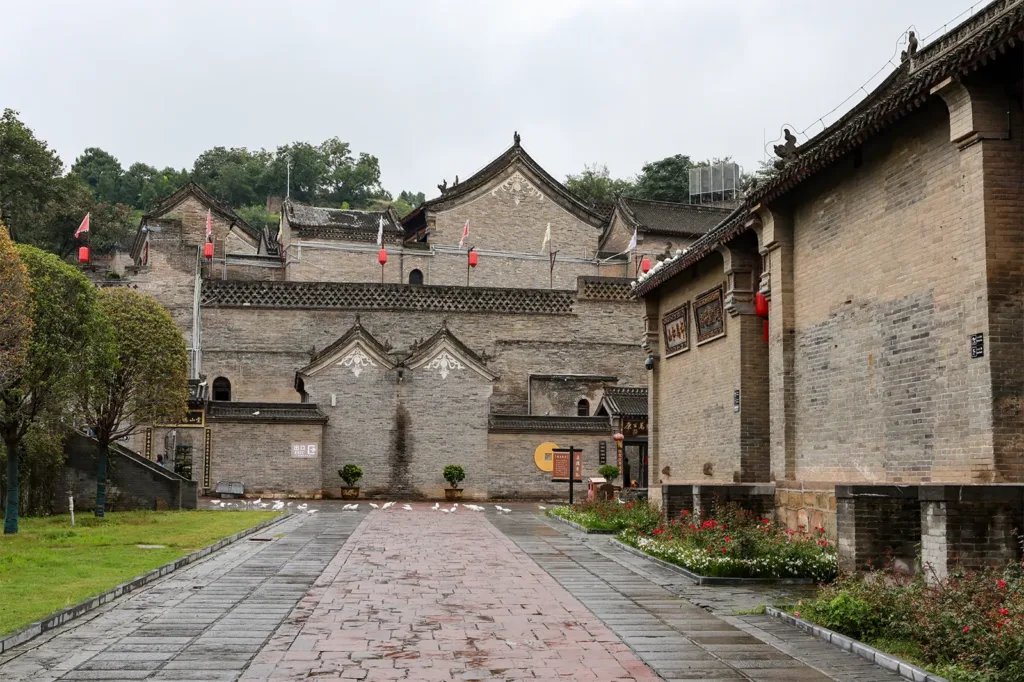
Kang Baiwan’s Mansion is not a single showpiece residence. It is a settlement built into the slope above the Luo River, with courtyards, walls and service spaces arranged as a working estate. The surviving complex represents the Kang family’s long history from the late Ming and Qing periods into the Republic, and the site is officially listed as a Major Historical and Cultural Site Protected at the National Level and a national 4A tourist attraction.
The layout is the main thing to understand. Buildings climb the hillside rather than sitting on one flat axis, so a passage can open into a compact courtyard, while a wall or upper terrace gives the compound a defensive edge. The mansion’s carved brick, stone and wood details, rooflines, threshold stones, tablets and couplets reward a slow look rather than a quick photograph. The site’s best-known family motto is 留余 (liú yú, “leave something in reserve”): look for the plaque and the other inscriptions that connect household conduct with business, education and obligations to the wider community.
The estate is also useful as a material history of commerce. Its residential courts sit alongside spaces associated with storage, reception, work and household management. That combination is why the site feels more like a small, self-contained community than an isolated rich family’s house. The official descriptions and historical accounts identify nineteen sections or building groups, although the parts open to visitors can vary.
How to look around
Start by reading the slope. From the lower courts, compare the depth of the residential lanes with the higher compounds and walls. Then pause at the main residential area for the family inscriptions and carved thresholds before moving toward the former commercial and working areas when they are open. The point is not to count courtyards; it is to see how privacy, storage, reception and movement were fitted together.
Look closely at details at eye level: a door surround, a carved lintel, a tablet or a couplet can reveal more about the family’s ideals than a broad view of tiled roofs. Leave time to notice how the fortified form frames the hill and river. Some sections may not be open on a particular day, so follow the signed visitor route and do not enter closed buildings.
Planning the visit
The current Gongyi government A-level scenic-area list, dated 20 March 2026, gives the address as 59 Zhuangyuan Road, Kangdian Town, Gongyi, Zhengzhou, Henan (河南省郑州市巩义市康店镇庄园路59号), a listed admission price of RMB 50, opening hours of 08:00–17:30, and the telephone number +86 371 64324004. The Zhengzhou municipal tourism page gives an older seasonal description of 08:00–18:00 in summer and 08:00–17:30 in winter, while the Trip.com page I read on 31 October 2026 displayed 08:30–17:30 with admission ending at 17:00. Treat the difference in opening information as a reason to call before travelling, especially outside the main season.
Neither the current government listing nor the visitor pages I could verify states how a foreign passport is handled for purchase, reservation or admission. Do not assume that a domestic-ID booking flow applies to an overseas visitor. Ask the scenic area about passport use and any reservation requirement when you call, and carry the original passport if the operator tells you it is needed.
Allow at least the listed 1–2 hours for the core visit, with more time if you want to read inscriptions and move through the sloping compound. This is a heritage site, not a theme-park reconstruction: keep to marked paths, do not climb walls or touch carvings, and expect uneven paving and stairs.
Getting there and getting back
Kang Baiwan’s Mansion is in Gongyi, an administratively separate county-level city under Zhengzhou, not in Zhengzhou’s urban centre. There is no useful metro leg to the site. From Zhengzhou, check China Railway 12306 for a train to Gongyi South (巩义南) or Gongyi (巩义); a current route query shows both as actual arrival options, but train times and availability change.
For the last leg, enter the exact Chinese destination 康百万庄园(巩义市康店镇庄园路59号) in Amap/Gaode Maps and take a taxi or ride-hailing car from the arrival station. The map pin is not a substitute for confirming the visitor entrance, so show the Chinese name and address to the driver. A published local guide repeats a route from Gongyi Bus Terminal on bus 8, and a transfer from the railway station via bus 2 and then bus 8; I could not verify a current operator timetable or stop list, so treat those buses as a lead to check at the terminal rather than a guaranteed service.
By road, the Zhengzhou municipal tourism page directs drivers from Zhengzhou or Luoyang via the Lianhuo Expressway to the Gongyi exit and onward to Kangdian Town. Use the full Chinese address for the local approach. Before entering the estate, agree with a taxi or ride-hailing driver on where to meet for the return; do not assume that a scenic-area shuttle or a late bus will be running.
Combine your visit
A suggested sequence through the named features described in the source.
-
Lower residential courtyards
Begin with the domestic spaces in the lower part of the estate.
-
Upper slope compound
Compare the upper compound’s position with the slope and defensive layout.
The order is an editorial suggestion. Internal opening arrangements and transfers between sectors need checking; no walking duration or access entitlement is implied.
Find Kang Baiwan's Mansion
康百万庄园 · 郑州市
The pin marks the area, not the entrance.
More places nearby
Approximate straight-line distances between map pins, not travel distances.
Erlitou Xia Capital Site Museum 二里头夏都遗址博物馆
25 km awayThe Erlitou museum brings the finds of an early Bronze Age centre back beside its archaeological landscape. Turquoise-inlaid bronze plaques and jade blades show the specialised craftsmanship associated with the site, while the…
View guide →Shaolin Temple 少林寺
29 km awayShaolin Temple occupies the foot of Wuru Peak in the Songshan range. Beyond its martial-arts reputation, the visit follows a monastic axis of gates and halls, with buildings from different periods and later reconstructions…
View guide →Pagoda Forest at Shaolin Temple 少林寺塔林
29 km awayShaolin’s Pagoda Forest is a cemetery of memorial towers west of the monastery. Brick and stone structures from successive dynasties vary in plan, height, tiers and carved detail. Their inscriptions preserve the names and…
View guide →Sources & visit information
Sources checked on 31 October 2026. Hours, tickets, reservations and transport can change; confirm with the operator before you go.
Image credits & notes (1)
- Kang Baiwan's Mansions in Gongyi: a paved route facing the layered brick buildings and an exit sign within the complex, photographed in late September 2025. Photo: WindmemoriesPhoto: CC BY-SA 4.0