

Explore the region
Tap any red Chinese text to hear it in Mandarin.
Why this place is worth the detour
Although this entry sits under the Zhengzhou page, the temple is in Dengfeng City, not in central Zhengzhou. The Zhengzhou municipal tourism listing places it about 12 kilometres west of Dengfeng’s urban area and gives the scenic address as Shaolin Temple Village, Chengguan Town, Dengfeng City. That setting matters: the visit is a mountain-edge heritage stop, and the road journey is part of the planning rather than a short city-centre outing.
The temple was founded in 495 during the Northern Wei’s Taihe era. Its name refers to the woodland setting on Mount Shaoshi, and the site is associated with Chan Buddhism and the development of Shaolin martial arts. The larger historic setting is also part of the UNESCO-listed Historic Monuments of Dengfeng in “The Centre of Heaven and Earth”, inscribed in 2010. UNESCO lists the Shaolin architectural complex as a component made up of the Kernel Compound, Chuzu Temple and the Pagoda Forest.
That heritage status does not mean that every visible hall is a Northern Wei building. UNESCO notes that many individual structures in the serial property have gone through several periods of rebuilding, while their layout and religious associations remain important. Read the place as a sequence of courtyards, gates, rooflines and devotional spaces, and look for the relationship between the built axis and the wooded Shaoshi setting.
How to experience the temple
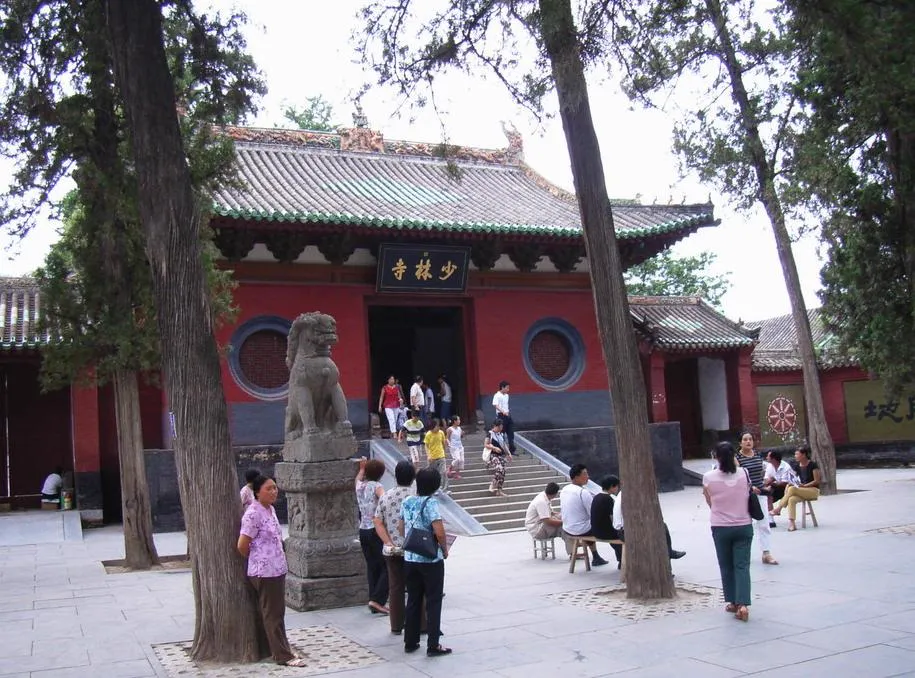
Start with the main temple compound and move slowly along its central sequence of halls. Rather than trying to collect every named building, notice how the axis controls views, how later repairs sit beside older fabric, and how visitors’ movement differs between public courtyards and spaces used for worship. The practical reward is a clearer sense of a working religious site and a historic complex, not a backdrop assembled only for photographs.
The Pagoda Forest is a separate memorial landscape within the broader Shaolin heritage area. Its towers commemorate successive monks and differ in scale, plan and surface detail. UNESCO treats it, the Kernel Compound and Chuzu Temple as parts of one architectural-complex component, but that does not establish a single uninterrupted walking route, a guaranteed common admission arrangement or current access to every associated site. Do not use “Shaolin Temple” as shorthand for the whole Songshan range: Shaoshi and Taishi are different mountain sectors, and the wider scenic area contains other entrances, trails and attractions.
Allow time for quiet observation. Keep voices low in halls, follow signs on photography, do not touch carved or painted surfaces, and remember that monks, worshippers and local staff are not a performance. Martial-arts demonstrations may be an additional experience, but their schedule is operational rather than a permanent feature. A Dengfeng government notice from 2022 recorded a period when performances were suspended, so check the current scenic-area notice instead of building the day around an assumed show.
Tickets, opening and reservation checks
Dengfeng’s municipal tourism page lists the Shaolin Scenic Area ticket at RMB 80 per person, while the Zhengzhou municipal listing gives the same figure and lists opening hours of 08:00–17:00. Neither page displays a current validity date for those visitor-service fields, so treat them as reference values rather than a promise for your travel day.
The latest dated reservation notice I could read was issued on 27 July 2025. It said that the scenic area would use online advance reservation, with visitors asked to reserve two to seven days ahead through the official “嵩山旅游” WeChat account or “漫游嵩山” mini-program. It also stated that Hong Kong, Macao, Taiwan and foreign visitors who successfully reserve online must take their relevant documents to an on-site service counter for verification, ticket purchase and an admission voucher. This is useful evidence of the process, not a guarantee that the same quota, channel or passport workflow remains unchanged in 2026. Before setting out, check the current official notice and ask specifically about foreign-passport booking, available dates, identification requirements and the entrance you should use. The notice gave 0371-62745000 and 0371-62745599 as enquiry numbers, but confirm that they are still active.
Getting there and getting back
From Zhengzhou, the Dengfeng municipal guide gives Zheng-Shao-Luo Expressway or S316 as road approaches to Dengfeng. From Dengfeng, it identifies Dengfeng West Coach Station (登封西客车站) as the departure point for a Dengfeng–Shaolin service (登封至少林班车); it also gives G207 westbound as the driving approach. The official page does not publish a current timetable, route number, exact scenic-area drop-off, or return frequency. Ask at the coach station about the last outward and return services before boarding, and keep a taxi or ride-hailing fallback for the end of the day.
For a taxi or ride-hailing car, show the Chinese destination 少林景区/少林寺村,登封市 Shàolín Jǐngqū / Shàolínsì Cūn, Dēng Fēng Shì and confirm where the driver will drop you and where you can be collected after the visit. No fixed fare or journey time is stated here because both depend on the starting point and current road conditions. There is no verified metro leg to the temple; do not substitute a Zhengzhou city-centre station for the final approach. Search the Chinese name in Amap on the day, compare the result with the official scenic-area instructions, and keep the return plan visible before entering.
Combine your visit
A suggested sequence linking the specific features of this visit.
-
Mountain gate and main halls
Follow the temple’s central sequence and distinguish historic structures from later rebuilding.
-
Lixue Pavilion and Thousand Buddha Hall
Continue to the older rear buildings within the monastic compound.
-
Pagoda Forest少林寺塔林
Compare the temple architecture with its separate memorial landscape.
This order is editorial. Confirm access and any transfers between stops; it does not establish a walking route, same-day connection or common admission ticket.
Find Shaolin Temple
少林寺 · 郑州市
The pin marks the area, not the entrance.
More places nearby
Approximate straight-line distances between map pins, not travel distances.
Pagoda Forest at Shaolin Temple 少林寺塔林
Less than 1 km awayShaolin’s Pagoda Forest is a cemetery of memorial towers west of the monastery. Brick and stone structures from successive dynasties vary in plan, height, tiers and carved detail. Their inscriptions preserve the names and…
View guide →Mount Song 嵩山
4 km awaySongshan is a mountain range with distinct Taishi and Shaoshi sectors, rather than one summit path. Its exposed rock sequences are important to geology, while temples and academies occupy the lower slopes. Shaolin belongs to the…
View guide →Zhongyue Temple 中岳庙
13 km awayZhongyue Temple lies below the eastern side of Taishi Mountain at Dengfeng. It is a Taoist temple associated with the sacred Central Mountain and imperial mountain worship.
View guide →Sources & visit information
Sources checked on 31 October 2026. Hours, tickets, reservations and transport can change; confirm with the operator before you go.
Image credits & notes (1)
- Shaolin Temple's mountain gate in the main temple compound, with the Shaolin plaque and a stone guardian lion. Photo: BaiqitunPhoto: CC BY-SA 3.0