

Explore the region
Tap any red Chinese text to hear it in Mandarin.
Why this site matters
Zhengzhou Shang City is not a single reconstructed fortress. It is an early-Shang urban archaeological site whose surviving rammed-earth wall sections appear within Guancheng Hui District. Archaeological work has traced an inner enclosure nearly 7 kilometres around and identified evidence of palace buildings, water management, storage, craft production and high-status burials across the site. The inner city alone covered about 3 million square metres.
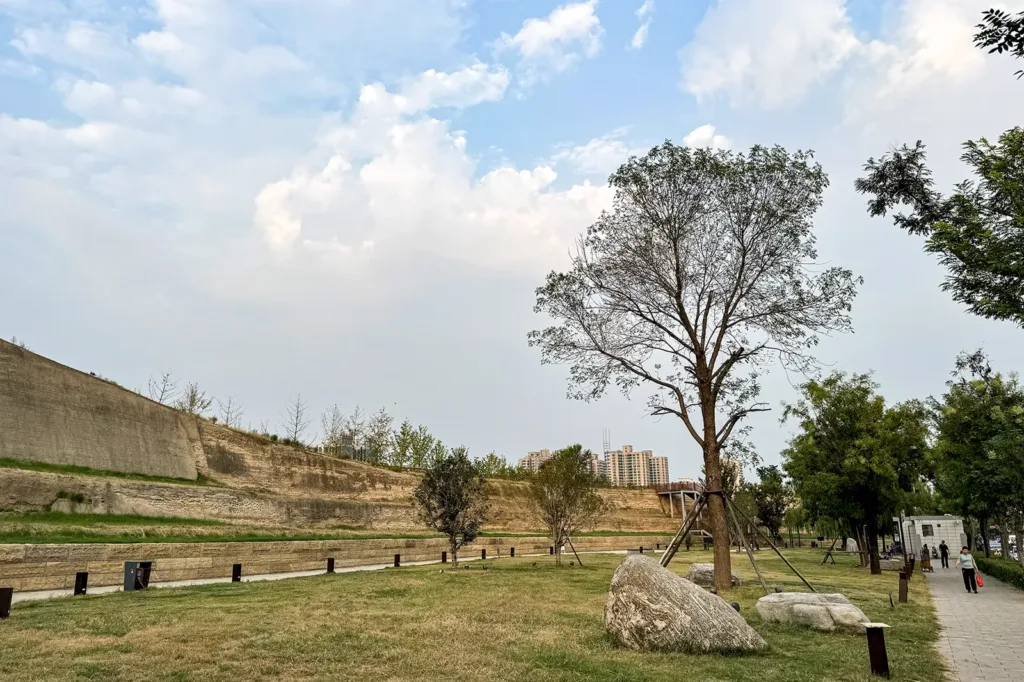
Its value is therefore partly about scale and partly about contrast. A broad, layered earth wall beside a contemporary road can seem modest until you realise that the surviving section is one fragment of a planned capital. Look at the wall’s profile and at the direction in which the remains continue through the urban landscape; do not expect a complete circuit or a stone fortress.
What to look for
- Rammed earth rather than masonry. The wall is made from compacted layers. Where a section is exposed, notice its substantial base, horizontal construction lines and weathered earth profile rather than looking for decorative stonework.
- The relationship between wall and city. The surviving remains make most sense when read against streets, planted parkland and the gaps between visible sections. The point is not to photograph one isolated mound, but to understand how an early capital was enclosed.
- The archaeological story behind the surface. If the museum is open, its displays provide models, artefacts and reconstructed sections that explain the palace, water, craft and burial evidence that cannot be read from an outdoor wall alone. The museum is a site museum within the archaeological park, not a synonym for every surviving wall section.
Planning a visit
Treat this as an archaeological landscape with several visitor points, not as one continuous walled attraction. The official tourism-area route lists an East Gate sequence that includes the inner-city wall remains and the Zhengzhou Shang Dynasty Capital Ruins Museum. Its separate archaeology route begins at North Gate 2 and also links the museum with the wall remains. These are useful orientation routes, but they do not establish that every wall fragment, archaeological worksite or route connection will be open on your date. Follow the signed public paths and keep out of fenced areas.
A practical indoor starting point is Zhengzhou Shang Dynasty Capital Ruins Museum (郑州商都遗址博物院). The Zhengzhou municipal government lists its address as 200 metres west of the junction of Dongda Street and Chengdong Road, on the south side, Guancheng Hui District. The same government venue page lists opening hours of 09:00–17:00, reservation closing at 15:50, last admission at 16:00, and Monday closure except on statutory holidays.
Those hours apply to the museum, not automatically to every outdoor wall section. The government page does not state a current ticket price or a passport-specific booking workflow. Confirm the current reservation channel, identity-document requirements and any temporary closure before travelling; do not assume that a domestic real-name booking rule automatically explains how a foreign passport will be handled.
Getting there and back
- Metro: Use Dongdajie (东大街) Station, which the official Zhengzhou Metro operator lists on both Line 2 and Line 3. Keep the Chinese destination name and the museum’s full address ready in Amap/Gaode Maps. The official sources reviewed do not publish a verified exit number or a door-to-door walking distance, so this guide does not invent one.
- Taxi or ride-hailing: Show the driver 郑州商都遗址博物院 Zhèng Zhōu Shāng Dōu Yí Zhǐ Bó Wù Yuàn and 郑州市管城回族区东大街与城东路交汇处向西200米路南. Ask the driver to confirm whether you are being taken to the museum entrance or to an outdoor park/wall entrance; they are related places, but not one interchangeable gate.
- Returning: For a metro return, use the live map to retrace your walk to Dongdajie Station after finishing at the particular museum or wall section you visited. If you leave from another signed park edge, set the destination as 东大街站 Dōng Dàjiē Zhàn rather than a generic “Shang City Ruins” pin.
A sensible order is to see the museum first when its current admission arrangements work for you, then walk only the signed park and wall sections that are open. That sequence gives the exposed earthworks an archaeological context without pretending that the modern city hides a fully walkable ancient circuit.
Combine your visit
A suggested sequence linking the specific features of this visit.
-
Dongda Street wall area
Begin with a clearly identified section of the surviving earthworks.
-
Chengdong Road wall alignment
Follow the public perimeter to compare the enclosure with the modern street pattern.
This order is editorial. Confirm access and any transfers between stops; it does not establish a walking route, same-day connection or common admission ticket.
Find Shang Dynasty Wall Ruins
郑州商城遗址 · 郑州市
The pin marks the area, not the entrance.
More places nearby
Approximate straight-line distances between map pins, not travel distances.
Henan Museum 河南博物院
5 km awayHenan Museum turns the archaeology of the Central Plains into a sequence of material encounters. The Jiahu bone flute introduces early music-making, while Fu Hao’s owl-shaped bronze vessel shows the sculptural imagination of…
View guide →Henan · Drama Fantasy City 只有河南戏剧幻城
30 km awayOnly Henan is a theatre complex built as a grid of tall, earth-coloured walls and enclosed spaces. Its 21 theatres range from large productions to smaller encounters, with stories linking Henan’s land, food and inherited memory…
View guide →Kaifeng Museum 开封博物馆
52 km awayKaifeng Museum’s collections offer a way to examine the city’s long history through particular objects. A Northern Song bronze bell inscribed Dasheng Yize connects the former capital with court music, while the stone list of…
View guide →Sources & visit information
Sources checked on 31 October 2026. Hours, tickets, reservations and transport can change; confirm with the operator before you go.
Image credits & notes (1)
- A surviving rammed-earth wall section at the Zhengzhou Shang City Site archaeological park, with a public path and modern apartment blocks behind it; photographed on 20 September 2024. Photo: WindmemoriesPhoto: CC BY-SA 4.0