

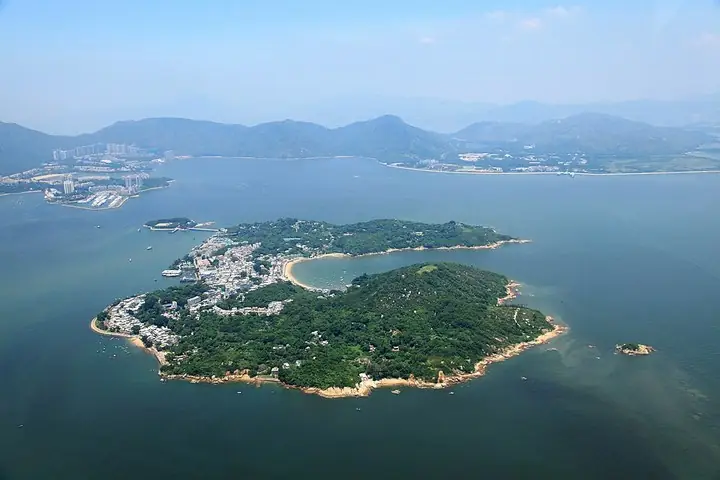
Photo adjustments
The exact downloaded source bytes are separately retained and hashed. Prepared JPEG is proportionally reduced to a maximum 720-pixel long edge; full frame retained, no subject alteration. Final website rendition: full frame retained, proportionally resized to at most 720 pixels and converted to WebP. No additional retouching or subject alteration. Card displays may crop the view.
Explore the region
About Peng Chau
At the former Fook Yuen Leather Factory, discarded chairs, bottles and tyres have become playful installations among painted walls. The Tin Hau Temple on Wing On Street provides a quieter contrast, connecting the island to its seafaring tradition. A visit can concentrate on these street-level places instead of rushing to every island viewpoint; respect working shops, homes and any installation areas closed by their owners.
Fishermen had settled on Peng Chau since the Tang and Song dynasties, and by the mid-Qing dynasty settlers surnamed Lui, Chung and Lam had arrived from nearby villages, living by fishing, trade and some farming around Peng Chau Bay. Ready access to oyster shells, clam shells and coral let the island develop a lime-kiln industry from the late nineteenth to early twentieth century, with as many as eleven kiln factories, until the trade declined in the 1930s and 1940s as cement came into use.
In 1937, the Great China Match Factory (大中国火柴厂), then the largest in Southeast Asia, opened on Peng Chau and employed 2,000 workers until it closed in 1976; only a stone tablet inscribed with its name now remains at Pak Wan (北湾). Industrial activity peaked in the 1960s and 1970s, when the island also had a steel-pipe factory, a teak furniture factory, a shipyard, a textile factory and a leather factory, among more than a hundred factories and small workshops.
The Tin Hau Temple was built in the third year of the Jiaqing era (1798). According to local tradition, Tin Hau once appeared to stop the pirate Cheung Po Tsai (张保仔) from raiding the island; a stele beside the temple records an official prohibition concerning shipping.
What to look for
- The former Fook Yuen Leather Factory uses salvaged objects and graffiti as outdoor art.
- Tin Hau Temple provides a religious counterpoint to the island’s former industrial buildings.
Location & getting there
Getting to Peng Chau
Take HKKF’s Central–Peng Chau ferry to Peng Chau Ferry Pier. Begin along the village streets towards Tin Hau Temple at 69B Wing On Street, then locate the former leather-factory art area on Main Street. Confirm the current ferry pier assignment and return sailing with the operator.
Combine your visit
Suggested order for the visit:
-
Tin Hau Temple
Begin with the Wing On Street religious site.
-
Former Fook Yuen Leather Factory
Look at the salvaged-material installations where public access is permitted.
This is an editorial sequence of named spaces or places. It does not imply a verified walking connection or promise opening, ticket availability or a journey time.
Find Peng Chau
坪洲 · 离岛区
The pin marks the area, not the entrance.
More places nearby
Approximate straight-line distances between map pins, not travel distances.
Hong Kong Disneyland 香港迪士尼乐园
3 km awayHong Kong Disneyland combines elaborate ride settings with the Castle of Magical Dreams, whose design draws on thirteen Disney princess and queen stories. Frozen Ever After takes passengers by boat through Arendelle-inspired…
View guide →Mui Wo 梅窝
5 km awayMui Wo’s waterfront makes a manageable introduction to eastern Lantau. Silvermine Bay Promenade runs between the Cooked Food Market and Silvermine Bay Beach, with open water on one side and the town’s daily activity nearby. The…
View guide →Cheung Chau 长洲
8 km awayCheung Chau offers a clear contrast between its working ferry waterfront, temple streets and eastern beach. Pak Tai Temple on Pak She Street rewards a close look at roof dragons and carved granite dragon pillars. Across the…
View guide →Sources & visit information
The sources below support the place-specific description and arrival information. Suggested combinations are editorial planning ideas; confirm current opening, entry arrangements and transport services for your date.
- Hong Kong Tourism Board: Peng Chau leather-factory art ↗
- Hong Kong Tourism Board: Peng Chau ↗
- Chinese Temples Committee: temple addresses ↗
- HKKF: Central–Peng Chau ↗
- Chinese Wikipedia: 坪洲 (revision 93153391, 2026-06-21) ↗
Background paragraphs translated and condensed from Wikipedia contributors, "坪洲", Chinese Wikipedia · CC BY-SA 4.0. Source revision 93153391.