

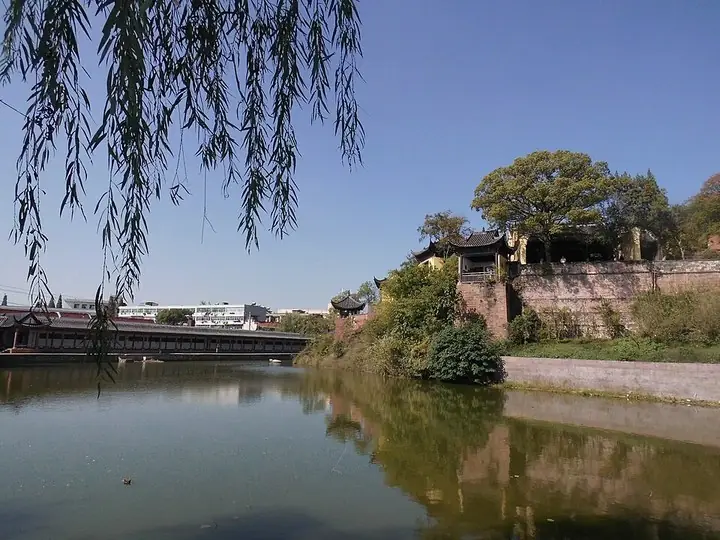
Photo adjustments
The exact downloaded source bytes are separately retained and hashed. Prepared JPEG is proportionally reduced to a maximum 720-pixel long edge; full frame retained, no subject alteration. Final website rendition: full frame retained, proportionally resized to at most 720 pixels and converted to WebP. No additional retouching or subject alteration. Card displays may crop the view.
Explore the region
About Dongpo Red Cliff
Pavilions, memorial halls and inscribed versions of his writings turn a riverside association into a landscape of remembrance. The Two Odes Hall and Dongpo Shrine are useful anchors for reading the site, while Qixia Tower adds a higher architectural viewpoint. Many present buildings reflect later reconstruction. This Huanggang attraction is distinct from the Three Kingdoms battlefield marketed at Chibi, and the poet’s Red Cliff imagery should not be used to conflate them.
The site was originally a rocky outcrop of red-brown stone on the north bank of the Yangtze River, known as Chibi or Chi'an; sedimentation has since left it several hundred meters from the river. Su Shi (苏轼) wrote 'Ode to the Red Cliffs' (赤壁赋) and other works here during his exile in Huangzhou under the Northern Song. In the late Kangxi era (康熙), Huangzhou prefect Guo Chaozuo (郭朝祚) renamed the site 'Dongpo Chibi'. Most of the present buildings were rebuilt in 1868 under prefect Yingqi (英启).
In the late Qing, the scholar Yang Shoujing (杨守敬) compiled Ming- and Qing-dynasty steles and had stonemasons recut rubbings of Su Shi's calligraphy, producing 139 tablets set into the site's pavilions; further inscriptions were added during the Republic era. The site was listed as a Hubei provincial cultural heritage site in 1956 under the name 'Huangzhou Chibi' (黄州赤壁), then designated a Major Historical and Cultural Site Protected at the National Level (全国重点文物保护单位) in 2006 as 'Dongpo Chibi'.
What to look for
- The Two Odes Hall and inscribed commemoration of Su Shi’s writing.
- Dongpo Shrine and Qixia Tower within the later memorial landscape.
Location & getting there
Getting to Dongpo Red Cliff
Use the Dongpo Red Cliff entrance at No 11 Gongyuan Road in Huangzhou District, Huanggang. Specify Huanggang when searching for transport, because Chibi’s battlefield is a different destination.
Combine your visit
A suggested order for exploring this place and its immediate setting.
-
Two Odes Hall二赋堂
Begin with the works that made this landscape famous.
-
Dongpo Shrine东坡祠
Follow the commemoration of Su Shi’s life in Huangzhou.
-
Qixia Tower area栖霞楼
Compare the literary setting with the later garden architecture.
Check access to the individual stops. A suggested sequence does not imply a combined ticket or guaranteed transfer.
Find Dongpo Red Cliff
东坡赤壁 · 黄冈市
The pin marks the area, not the entrance.
More places nearby
Approximate straight-line distances between map pins, not travel distances.
Huanggang Museum 黄冈博物馆
4 km awayHuanggang Museum follows the region from early settlement through cultural exchange, later urban prosperity and modern upheaval. Its chronological displays make a useful counterpoint to a visit focused only on Su Shi…
View guide →Ezhou Museum 鄂州市博物馆
5 km awayEzhou Museum brings together bronze-mirror craftsmanship, the city’s Three Kingdoms associations and local everyday traditions. Its raised, Han-inspired building gives the collections a monumental setting, but the detailed…
View guide →Huangshi Museum 黄石市博物馆
33 km awayHuangshi Museum explains why mining and metalworking are central to this Yangtze city’s identity. Its mining-and-metallurgy exhibition connects local mineral resources with the tools, techniques and industries that developed…
View guide →Sources & visit information
The sources below support the place-specific description and arrival information. Suggested combinations are editorial planning ideas; confirm current opening, entry arrangements and transport services for your date.
- Huanggang heritage profile — literary history and buildings ↗
- Map provider — Gongyuan Road address ↗
- Chinese Wikipedia: 东坡赤壁 (revision 94224407, 2026-09-07) ↗
Background paragraphs translated and condensed from Wikipedia contributors, "东坡赤壁", Chinese Wikipedia · CC BY-SA 4.0. Source revision 94224407.