

Explore the region
Tap any red Chinese text to hear it in Mandarin.
Why come
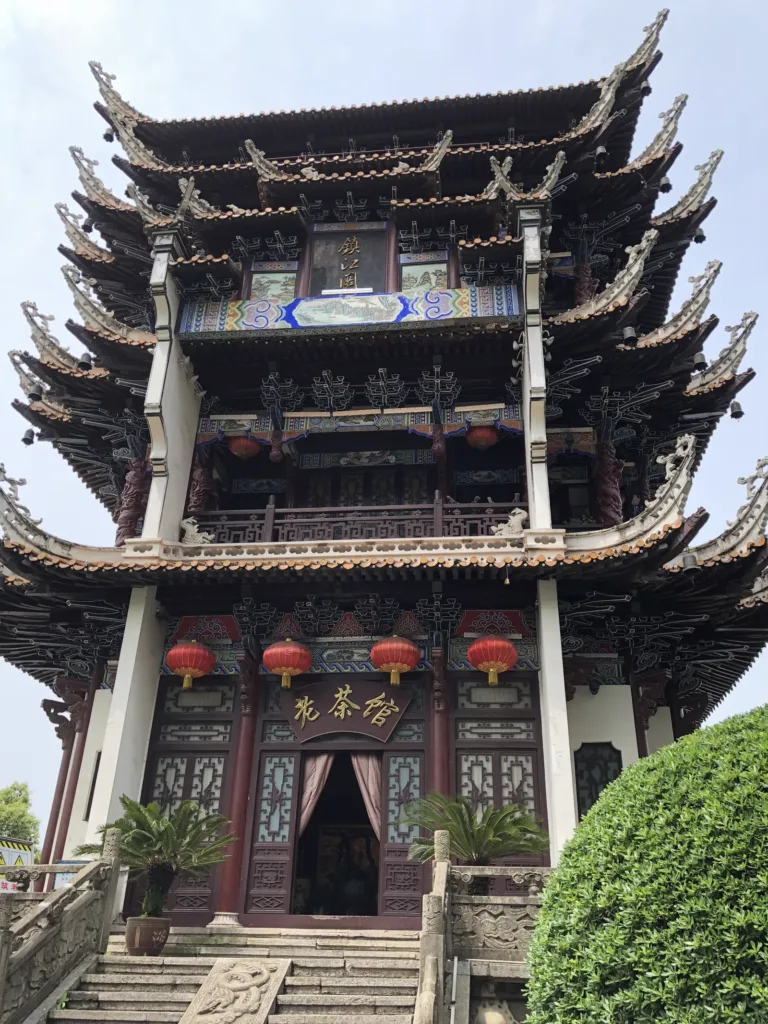
Zhenjiang Pavilion is interesting because it is both a historic name and a twentieth-century reconstruction. The original pavilion was first built in 1699 as a small brick structure and later disappeared after being renamed Yangsi Temple. The city rebuilt the pavilion at its present site in January 1987 and carried out a full restoration on 20 December 2006. The current building covers 536 square metres, has 1,336 square metres of floor area, rises 26.29 metres, and is arranged over four storeys.
The old pavilion belonged to the river-port life of Yichang: local merchants funded it, and the site is associated with grain trading along the Yangtze. Today, read that history through the building rather than through a recreated market. Start at the blue-stone xumizuo base with carved dragons, then look up at the white-marble balustrades, bracket sets and the 34 coiled-dragon columns. Those details make the reconstruction more legible than the broad label “ancient tower.”
The pavilion sits in Binjiang Park, a long public riverside greenway rather than a walled, single-purpose attraction. Local reporting describes the park as a place for walking, exercise, shade and river views, while recent city regulations identify Zhenjiang Pavilion as a historical building to be protected as part of the urban waterfront. This makes a short visit work well: see the building, turn toward the river, and continue along the park instead of treating the pavilion as a separate half-day scenic area.
What to look for
Approach from the park side and give yourself time to see the structure at ground level before looking for a high viewpoint. The dragon-carved base and balustrades show how the building is staged above the promenade; the repeated eaves and bracket sets give the four levels their upward rhythm. From the river side, compare the pavilion’s roofline with the open Yangtze frontage and the newer city buildings behind you. This is a place for observing how Yichang frames a working river with a historical landmark, not for claiming that every visible structure belongs to the old town.
Keep the pavilion, the surrounding Binjiang Park, and any temporary event platform separate. In 2026, official notices used 镇江阁 as a programmed night-tour node, including a summer light-and-shadow show and later holiday cultural activities. Those notices describe dated programmes, not a daily performance schedule; check a current local notice before planning around lights, music or a staged show.
Entry and practical limits
A 2026 local tourism listing gives the address as 宜昌市西陵区沿江大道58号 and labels admission as free, but it also says that the price is only a reference and should follow the scenic spot’s own announcement. I found no current official visitor notice that fixes the pavilion’s interior opening hours, admission procedure, reservation channel or passport-specific entry rules. Use the waterfront park walk as the dependable part of the visit, and treat entering the tower as conditional on the entrance being open when you arrive.
The park and the pavilion are not the same access point. Follow signs and barriers, stay on the managed promenade, and do not climb a riverside revetment or enter a closed building for a better photograph. If a performance or illumination is being set up, leave the working area clear and watch from the public side.
Getting there and getting back
There is no useful metro leg for this riverside stop. The practical choices are a city bus, a taxi, or a walk from another central waterfront stop. An auxiliary route listing associates 6路 (Route 6), 19路 (Route 19), 25-1路 (Route 25-1), and 25-2路 (Route 25-2) with the 镇江阁 Zhènjiāng Gé stop. Because that listing has no publication date and route patterns can change, check the live stop display or the 宜昌公交 service before boarding; do not infer an exact direction or last bus from the listing alone.
For a taxi or ride-hail car, show 镇江阁(宜昌市西陵区沿江大道58号). No stable named visitor gate or dedicated drop-off lane was identified in the sources read here, so ask the driver to leave you by the park-side pavilion access and confirm the return pick-up point before walking along the waterfront. The address comes from a local tourism listing, so match it against the live map label and roadside signs on the day.
A separate 滨江观光巴士 Bīnjiāng Guānguāng Bāshì did stop at 镇江阁, but the 2026 report says that edition ran only from 24 September through 6 October. It is useful evidence that the pavilion is part of the city’s waterfront event network, not proof of a current service. Do not build an itinerary around that temporary bus after its stated dates.
Find Zhenjiang Pavilion Riverside
镇江阁江畔 · 西陵区
The pin marks the area, not the entrance.
Sources & visit information
Sources checked on 1 November 2026. Hours, tickets, reservations and transport can change; confirm with the operator before you go.
Image credits & notes (1)
- The front elevation of Zhenjiang Pavilion in Yichang, showing layered eaves, decorative bracket sets, the central sign, and the carved dragon ramp. Photo: FxqfPhoto: CC BY-SA 4.0