

Explore the region
Tap any red Chinese text to hear it in Mandarin.
Why visit
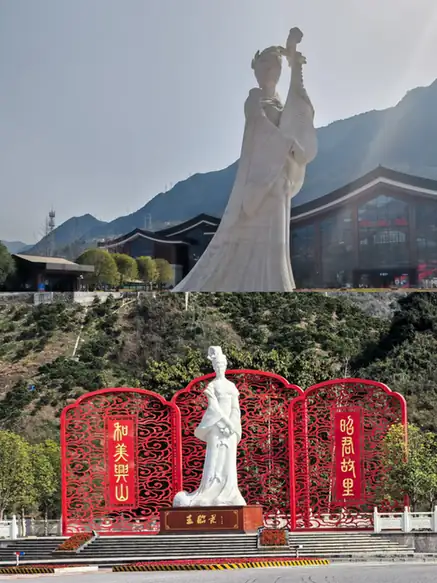
Zhaojun Village lies beside the Xiangxi River, with Shamao Mountain behind it. The place is traditionally identified as Wang Zhaojun’s home village, and the visitor area brings together a memorial hall, Zhaojun House, Zhaojun Academy and a group of landscape sites associated with her story. The river, green slopes and citrus orchards are part of the experience: the story is tied to a particular valley rather than presented as a freestanding museum display.
Much of the setting is a reconstructed and developed cultural landscape. The village and its visitor facilities were rebuilt or expanded from the early 1980s, and the provincial tourism department records the attraction as a national 4A scenic area since December 2019. Read the architecture as a modern presentation of local memory and historical literature, not as an untouched Han-dynasty settlement.
What to look for
Start with the Zhaojun Memorial Hall. Its exhibition follows Wang Zhaojun’s life, her departure from the Han court and the later peace-and-unity meaning attached to the story. The nearby Zhaojun Academy preserves books, inscriptions and other materials connected with the literary afterlife of the legend. A hall inscription bearing Guo Moruo’s handwriting is one of the details to notice before moving outdoors.
Then follow the named sites rather than rushing from photo stop to photo stop. Nanmu Well (楠木井) and Niangniang Spring (娘娘泉) connect the story to water; the Dressing Terrace (梳妆台) and Qin-playing Terrace (抚琴台) connect it to domestic memory and performance. Zhaojun House, the statue, the river edge and the mountain-facing paths show how the site layers reconstructed Han-style buildings with a real rural landscape. Local and official accounts describe more than twenty such named sights, although not every point has the same level of interpretation or indoor access.
The village around the scenic area is not a theme-park cast. Residents live and work here, and recent reports describe local families participating in cultural activities and agriculture. Ask before photographing people, do not treat a performance as permission to enter private spaces, and keep away from any unprotected river edge or closed path.
Tickets and timing
A current local Yichang tourism listing gives the scenic-area opening hours as 08:00–17:30, an adult sightseeing ticket of ¥55, and a separate ¥20 return battery-car ticket. The same listing labels the prices as reference fares, so confirm the day’s ticket, shuttle operation and any performance schedule with the venue before setting out.
Domestic senior or child concessions listed on travel pages should not be treated as proof that a foreign passport can use the same reservation or discount channel. Bring your passport and ask the ticket office about foreign-visitor identification, payment and any advance booking requirement. These rules were not stated in the sources checked for this guide.
Getting there
By high-speed rail and bus. Xingshan Station (兴山站) is now an operating high-speed rail stop: the Yi-Xing high-speed line opened on 28 September 2026 and links Xingshan with Yichang and the wider Zhengyu/Shanghai–Chongqing–Chengdu rail network. From Yichang, the 808 intercity service is a practical route to Xingshan. A Hubei Daily notice published a 2025 winter timetable whose stop list included Xingshan High-Speed Railway Station (兴山高铁站), Zhaojun Bridge (昭君桥), Zhaojun Xiaohe (昭君小河) and Zhaojun Coach Station (昭君客运站), with the service continuing to Xingshan Coach Station and Yichang East-area coach terminal. Because that notice is seasonal and predates the current 2026 travel year, confirm the current departure time, return service and which listed stop is best for the scenic-area entrance.
By taxi or ride-hailing car. Give the driver the Chinese destination 昭君村古汉文化旅游区游客中心 Zhāojūn Cūn Gǔ Hàn Wénhuà Lǚyóuqū Yóukè Zhōngxīn, address 湖北省宜昌市兴山县昭君镇昭君村 Húběi Shěng Yíchāng Shì Xīngshān Xiàn Zhāojūn Zhèn Zhāojūn Cūn. A visitor centre is part of the scenic-area facilities, and the local listing gives the village address; ask the driver to confirm the current visitor drop-off rather than using only the nearby names 昭君广场 or 昭君桥. Do not rely on a guessed fare or journey time.
There is no applicable metro route to this rural scenic area. No regular passenger boat service or seasonal water shuttle was verified, so the Xiangxi River should be treated as part of the landscape, not as a planned arrival or return connection.
Find Zhaojun Village
昭君村 · 兴山县
The pin marks the area, not the entrance.
Sources & visit information
Sources checked on 1 November 2026. Hours, tickets, reservations and transport can change; confirm with the operator before you go.
Image credits & notes (1)
- Zhaojun Village · 昭君村Photo: gs.ctrip.comResized for the web; the photo itself has not been edited.