

Explore the region
Tap any red Chinese text to hear it in Mandarin.
Dawei Mountain is a remote, spread-out mountain visit in eastern Liuyang, not a park near central Changsha. The range lies by the Hunan–Jiangxi border and is described by the park and Hunan forestry authorities as the source of the Liuyang River. Its six named scenic zones—Limuqiao, Chuandiwo, Honglian Temple, Qixingling, Baimianshi and Maweicao—cover a large area, so the Chinese name alone does not identify one trailhead or one compact walking loop.
The main landscape is a meeting of forest and exposed mountain forms. Qixing Peak (Qixingfeng) rises to 1,607.9 metres, while the Limuqiao area is noted for glacial deposits, polished bedrock, roches moutonnées, cirques and U-shaped valleys. Above the lower stream valleys, higher slopes support rhododendron communities; flowering is seasonal and weather-dependent, so a spring photograph should not be treated as a promise of bloom on the day you visit.
What to look for
- Glacial landscape at Limuqiao. Look for the shapes of the valley and exposed rock rather than expecting a single monumental formation. The forestry account identifies glacial cellars, U-shaped valleys, glacial outlets, striated stones, block moraine and polished bedrock among the park’s most distinctive geological features.
- The high ridges around Qixingling. Qixingfeng is the mountain’s main peak, and the upper slopes are the place to understand Dawei Mountain as a broad ridge system rather than a low woodland stroll. Weather, trail access and seasonal restrictions matter more here than a fixed sightseeing checklist.
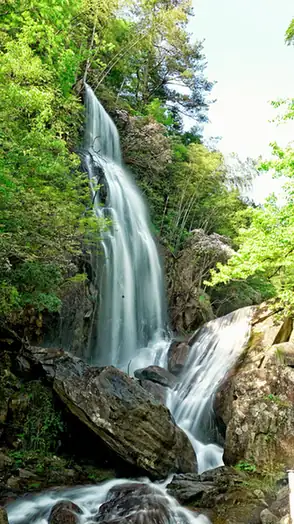
- Streams, waterfalls and forest. Longquan Stream and the park’s forested valleys provide the more accessible side of the landscape. The park describes extremely high forest cover and a range of plant communities, but protected animals are not a wildlife-show guarantee; keep to managed paths and do not approach, feed or search for them off-trail.
- Mountain temples and revolutionary history. Remains and sites associated with Honglian Temple, Chen Zhenren Temple and Zhuzhuang Temple sit among the slopes. Jinshoutang, a large late-Qing manor used by the Hunan provincial Soviet government in 1931, preserves revolutionary-era wall slogans and account records; the Shangping meeting site is another part of the area’s modern history.
Entering the park now
Since 1 October 2026, visitors touring the scenic area must first complete ticketing and entry checks at Sifangqiu Visitor Service Centre (四方丘游客服务中心). The South Gate at Zhangfang (张坊), West Gate at Niwu (泥坞) and the old gate service centre no longer handle tickets or admission checks, although the roads remain open. The Liuyang Daily notice places Sifangqiu near the roundabout where the park’s two main roads meet and says to search maps for 大围山国家森林公园四方丘游客服务中心 Dàwéi Shān Guójiā Sēnlín Gōngyuán Sìfāngqiū Yóukè Fúwù Zhōngxīn.
This change also separates the scenic area’s paid core from nearby destinations. People going to Anzhou Hakka Cultural Folk Village, the park management office or the Forest Hotel area at Longquan Stream do not need the scenic-area ticket; Honglian Temple Square and the Qixingling scenic area remain within the paid area according to the same notice.
The current sources do not establish a dependable daily opening timetable, a current tariff, an advance-reservation route or whether every passport-holder transaction is supported. A Hunan government listing quotes CNY 90 in peak season and CNY 68 in the off-season, but that page is an older reference and should not be used as today’s price. Confirm the current ticket product, last admission and passport procedure with the park before travelling: 0731-83488701.
Getting there and back
This is a road-first destination. The park’s traffic guide directs drivers from Changsha onto the G6021 Hangchang Expressway. For the western approach, leave at Gugang (古港) and follow the Liudong Road through Dawei Mountain town toward the West Gate. For the southern approach, leave at Zhangfang (张坊) and follow the Dawei Mountain tourism road toward the South Gate.
Those directions describe the approach roads and pre-2026 gate arrangement, not the current ticket desk. After arriving in the park area, follow signs or map directions to 大围山国家森林公园四方丘游客服务中心 Dàwéi Shān Guójiā Sēnlín Gōngyuán Sìfāngqiū Yóukè Fúwù Zhōngxīn for the admission check, then continue to the scenic zone you intend to visit. Do not assume that a map pin for “Dawei Mountain” is a trailhead. The operator does not publish a current through-bus timetable to Sifangqiu in the sources used here, so visitors without a car should arrange a confirmed local transfer from Changsha or Liuyang rather than rely on old direct-bus times. Plan the return before entering the mountain; a last return service and current internal shuttle schedule are not confirmed here. The park’s consultation line is the safest final check for weather, road access, trail closure and same-day entry.
Find Dawei Mountain
大围山 · 浏阳市
The pin marks the area, not the entrance.
Sources & visit information
Sources checked on 24 October 2026. Hours, tickets, reservations and transport can change; confirm with the operator before you go.
- Introduction to Dawei Mountain — Dawei Mountain National Forest Park ↗
- 大围山国家森林公园 — 湖南省林业局 ↗
- Dawei Mountain National Forest Park — The Official Website of the People's Government of Hunan Province ↗
- 交通指南 Traffic Guide — Dawei Mountain National Forest Park ↗
- 大围山国家森林公园新游客服务中心10月1日启用 — 浏阳日报 ↗
- 大围山国家森林公园十一正式启用新游客服务中心 — 新湖南 ↗
Image credits & notes (1)
- Dawei Mountain · 大围山Photo: cn.tripadvisor.comResized for the web; the photo itself has not been edited.