

Explore the region
Tap any red Chinese text to hear it in Mandarin.
Why visit
Miyin Temple stands below Pilu Peak on Mount Wei in Weishan Township, Ningxiang City. Ningxiang is a county-level city administered by Changsha, so this is a western mountain excursion, not a temple in Changsha’s built-up centre. The mountain setting and the temple’s relationship with the wider Weishan landscape are part of the experience, not just the backdrop to the buildings. The temple was established in 807 and is regarded as an ancestral temple of the Weiyang school of Chan Buddhism, associated with the monk Lingyou and the later link between Weishan and Yangshan.
The present complex is not a single untouched Tang-dynasty building. Local reporting describes most of the surviving buildings as reconstructions from the late Qing period and the Republican era, and records the temple as a Hunan provincial protected cultural site. That mixture of religious continuity and later rebuilding is part of what you are seeing.
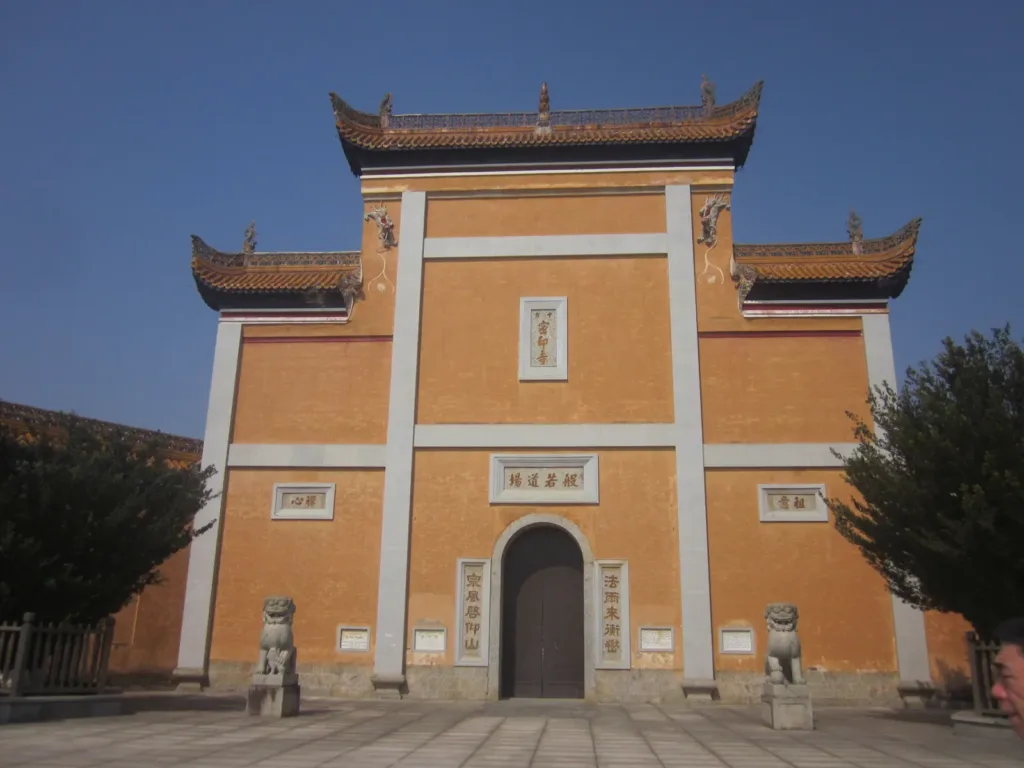
Start at the shanmen, or mountain gate. Look for the inscriptions “般若道场” (a place for the practice of wisdom), “祖意” and “禅心”, the couplet “法雨来衡岳,宗风启仰山”, and the pair of stone lions. The wording explains the temple’s claimed lineage: “Weishan” and “Yangshan” give the Weiyang school its name.
Wanfo Hall (万佛殿) is the complex’s most distinctive interior. Its four walls carry more than twelve thousand small gilded Buddha images. Published accounts give different totals, including 12,182 and 12,988, so treat the reliable visitor fact as the dense field of gilded images rather than as a single verified record. The hall’s “万佛殿” plaque is attributed to Chiang Kai-shek and dated 1945. If the hall is closed for worship, conservation or an event, do not expect the overall scenic-area ticket to guarantee access to its interior.
The other buildings reward a slower circuit. Jingce Hall (警策殿) takes its name from Lingyou’s Weishan Jingce, a text associated with impermanence and monastic life. Wenshu Hall and Puxian Hall are dedicated to Manjushri and Samantabhadra; the bell and drum towers help retain the sense of a working Buddhist monastery rather than a detached museum display. Ask before photographing inside halls, keep voices low, and follow any temporary restrictions posted by the temple.
A second layer of the visit is the memorial to Mao Zedong’s 1917 study tour. A Hunan Daily report says he stayed for three days and two nights and later identifies rooms used for lodging, dining and conversation. The same report cautions that the stone text displayed in the rear courtyard was assembled from Mao’s calligraphy rather than copied from a contemporary inscription. Treat the rooms and tablet as a twentieth-century memorial landscape, not as proof that every displayed detail is unchanged from 1917.
The 99.19-metre gilded-copper Guanyin statue and its 619-step approach are associated with the wider Weishan Miyin Scenic Area, but the statue is a separate park-scale attraction rather than another temple hall. The provincial tourism description likewise distinguishes the temple, the Guanyin cultural park and the visitor-service facilities. Check whether that adjacent area is open and separately ticketed before adding it to your route.
Visiting and getting there
Opening and ticket information needs a same-day check. On 24 October 2026, Trip.com’s current venue card for Weishan Miyin Scenic Area displayed 08:00–17:00 opening, a 16:30 stop for ticketing and entry, and tickets from ¥35. This is a travel-platform listing for the scenic area, not an official guarantee that every temple hall is open. It also does not establish whether a foreign passport can be used for purchase or entry, and no official passport or online-reservation policy was found in the sources reviewed. The same listing gives the operator numbers +86 731 8735 1177 and +86 188 0731 5803; they were not independently verified here. Ask specifically whether a foreign passport is accepted, whether Wanfo Hall is open, what the current ticket covers, and when the last return transport leaves.
For a car or taxi, use the Chinese destination 沩山密印景区游客中心 Wéishān Mìyìn Jǐngqū Yóukè Zhōngxīn rather than only “Changsha”. The official tourism account of the scenic area confirms a visitor service centre and ecological parking, while current platform directions also use the visitor-centre name. The final approach is mountainous and winding; after parking, follow the current signs for the temple entrance and any internal shuttle.
Public-transport references record a coach from Changsha West Bus Station (长沙汽车西站) to Weishan (沩山), taking about three hours. A current travel listing also describes changing at Ningxiang South Station (宁乡南站) for a local minibus to Weishan Township. Neither source provides a dependable current timetable or last return departure. Confirm the outbound and return legs at the station and again in Weishan before entering the scenic area; if you are travelling late, arrange a return car rather than assuming a same-day bus.
Find Weishan Miyin Temple
沩山密印寺 · 宁乡市
The pin marks the area, not the entrance.
Sources & visit information
Sources checked on 24 October 2026. Hours, tickets, reservations and transport can change; confirm with the operator before you go.
Image credits & notes (1)
- The frontal shanmen (mountain gate) of Weishan Miyin Temple, viewed from the opposite side of the square. Photo: Huangdan2060Photo: CC0 1.0