

Explore the region
Tap any red Chinese text to hear it in Mandarin.
Walking the two streets
Taiping Street and Pozi Street are best understood as a connected old-city walk rather than a single gated attraction. Taiping Street is the quieter, more tightly preserved historic lane; Pozi Street is the broader commercial street that carries the walk west toward the river. Together they show how Changsha’s old trading core still works as an urban neighbourhood, with heritage buildings, snack shops, cultural venues and ordinary city movement sharing the same streets.
Start on Taiping Street if you want the clearest historic sequence. Its main lane is about 380 metres long. The fishbone plan of a principal street and side alleys remains legible, and the area contains six immovable cultural relics and 31 designated historic buildings. Jia Yi’s former residence stands at the southern end, while No. 17 Majia Lane, a short detour from the main lane, is the former site of the Gongjinhui of the 1911 Revolution.
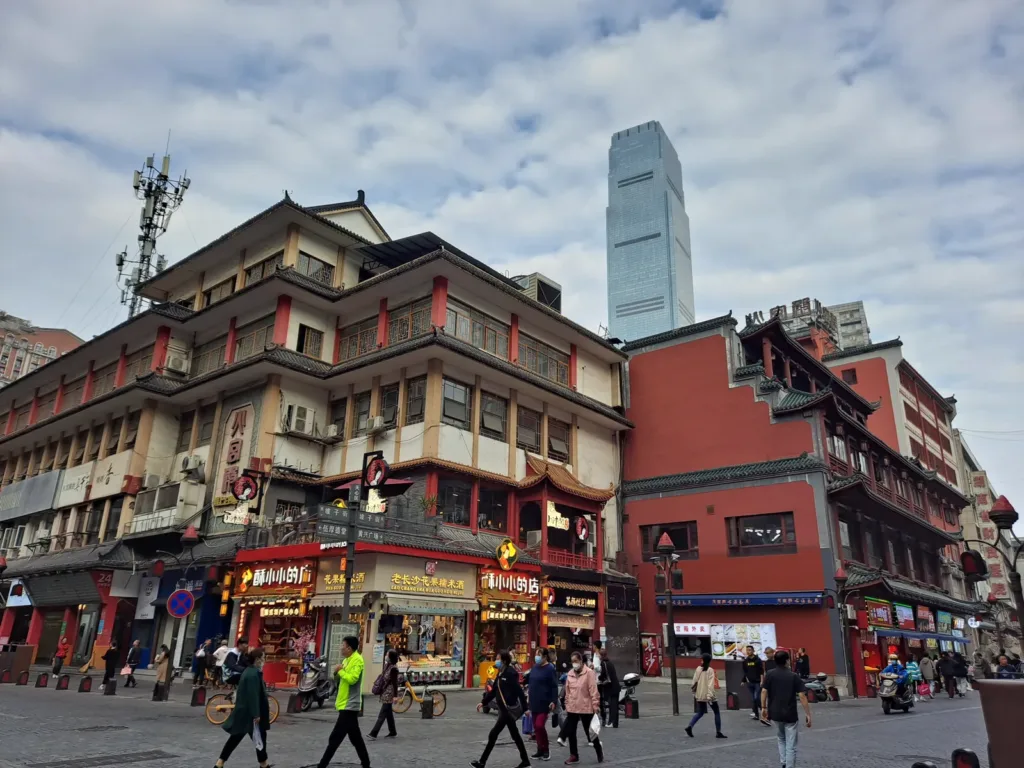
Continue west toward Pozi Street, whose present route runs 640 metres from Huangxing South Road to Xiangjiang Avenue. The street connects the Wuyi commercial area with the Jiefang West Road bar area and the Huangxing South Road pedestrian street. Its 27 protected heritage units are easy to miss if you treat the street only as a snack run. Archaeological work on the southern side also recorded city-wall remains from the Ming, Song and Five Dynasties periods, a reminder of the older city beneath today’s shops.
What to look for
At Taiping Street, look up and into the side lanes rather than following only the busiest shopfronts. Traditional rooflines, timber doors, stone archways, an old opera stage and the surviving lane pattern make the street more legible as a historic district. At the north end, Taipingli Cultural and Creative Market occupies a former 1980s sugar-and-wine factory and adds exhibitions, cafés and small cultural businesses to the old-street walk.
On Pozi Street, Fire God Palace—also called Qianyuan Palace—is the key landmark. The temple was first built in 1747 and rebuilt in 1826. After the 1938 fire, it was rebuilt in 1941; its temple, stage and food tradition explain why this address is both a historic site and a place associated with Changsha snacks. The street’s official local-history account lists foods such as stinky tofu, tangyou baba, rice noodles, spicy crayfish and suoluo among its long-established food associations. Treat those as things to look for in the wider street-food area, not as a promise that every stall serves every item.
Visiting and getting around
The two streets are public urban streets, not one single ticketed enclosure. Walking the lanes does not by itself confirm entry to Jia Yi’s former residence, Fire God Palace interiors, exhibitions, performances or any particular shop. Those places can have their own opening hours, admission, queueing or reservation arrangements. No single street-level passport or reservation procedure is established by the sources used here, so check the specific venue on the day if you plan to go inside.
For the metro, use the Chinese names when planning the last walk. Huangxing Square (黄兴广场) is on Line 1 and is the practical station name for the Huangxing South Road side of Pozi Street. Xiangjiang Middle Road (湘江中路) is on Line 2 and is the useful station name for the river-side approach. Wuyi Square (五一广场) is served by both Lines 1 and 2 and is another central approach. Nanmenkou (Tianxin Pavilion) (南门口〔天心阁〕) is also on Line 1 for the southern end of the old centre.
Do not guess an exit number or a fixed walking time. Before leaving the station, put 太平街 Tàipíng Jiē, 坡子街 Pōzi Jiē or the precise building name into AMap and choose the street end that matches your plan. AMap Global describes walking, transit and taxi route planning and offers English alongside Chinese, but station exits and pedestrian routing still need a live check. For the return, use the same station or another station that fits where you finish: Line 1 trains at Huangxing Square and Wuyi Square are signed toward 金盆丘 Jīnpénqiū or 尚双塘 Shàngshuāngtáng, while Line 2 trains at Xiangjiang Middle Road and Wuyi Square are signed toward 龙虎岭 Lónghǔlǐng or 光达 Guāngdá. Confirm the platform direction and the last train before starting an evening food walk.
Find Taiping Street and Pozi Street
太平街与坡子街 · 天心区
The pin marks the area, not the entrance.
Sources & visit information
Sources checked on 24 October 2026. Hours, tickets, reservations and transport can change; confirm with the operator before you go.
- Changsha Taiping Old Street: A Fashionable Expression of Huxiang Culture ↗
- Pozi Street: A Thousand-Year Glimpse of Changsha ↗
- Changsha Time-Honoured Brand: Fire God Palace ↗
- Huangxing Square Station ↗
- Xiangjiang Middle Road Station ↗
- Wuyi Square Station ↗
- AMap Global App Store Listing ↗
- Nanmenkou (Tianxin Pavilion) Station ↗
Image credits & notes (1)
- Pozi Street in Changsha, showing traditional-style commercial frontage beside the modern city skyline. Photo: EditQPhoto: CC BY-SA 4.0