

Explore the region
Tap any red Chinese text to hear it in Mandarin.
What makes it worth a visit
This is more than a flower park. Founded in 1985, the garden covers 1,789.8 mu and has about 90% forest cover. Its official overview describes 16 specialist gardens and more than 5,100 conserved plant types, within a public institution that combines plant conservation, research, education and ecological tourism.
The Cherry Garden has a particularly concrete history. After Hunan and Japan’s Shiga Prefecture became friendship partners in 1983, Shiga gave 2,000 Somei-Yoshino cherry trees in 1985. They became the core planting of the garden’s cherry area. The collection now includes 20 cherry species and more than 120 cultivars; its 310-mu core area was approved as a national forest-tree germplasm bank in 2021. The main flowering season is in March, but the exact display and any festival arrangements are seasonal rather than a year-round promise.
The National Azalea Garden is the other major seasonal focus. It covers 450 mu, holds more than 230 rhododendron species or cultivars and more than 100,000 plants, and is divided into areas for different rhododendron groups and horticultural varieties. The garden’s published flowering calendar runs from early March into June, with different kinds peaking at different times.
For a quieter, more plant-focused walk, look for the Rare Plant Garden. It covers 20 hectares and conserves 176 nationally or provincially protected wild plant species. The garden names Cathaya, the dove tree, dawn redwood, ginkgo and other protected plants among its collection. Read the labels and stay on the paths: the point is to see a conservation collection, not to handle or collect specimens.
Other specialist areas make the garden suitable outside the headline flower season, but it is too large to treat every named garden as a separate attraction. Choose the display that fits your dates, then use the rest of the visit for a slower walk through the wooded grounds.
Plan the visit
Admission is free, but the garden operates a reservation-entry system. Use the official “湖南省植物园” WeChat account and be ready to show the reservation QR code at the entrance. The visitor notice says that people aged 65 or above may enter without a reservation with their original ID, and children under 14 do not need an individual reservation but must be accompanied by a guardian. It also lists 40,000 reservations per day: 20,000 for the next day released at 20:00, and the remaining 20,000 for the same day released at 06:00. A special spring exhibition may use different rules.
The same notice gives seasonal hours of 08:00–18:00 in summer and 08:00–17:30 in winter. A separate garden visitor page displays 08:00–18:00, so check the day’s official notice before setting out, especially outside the main flower season.
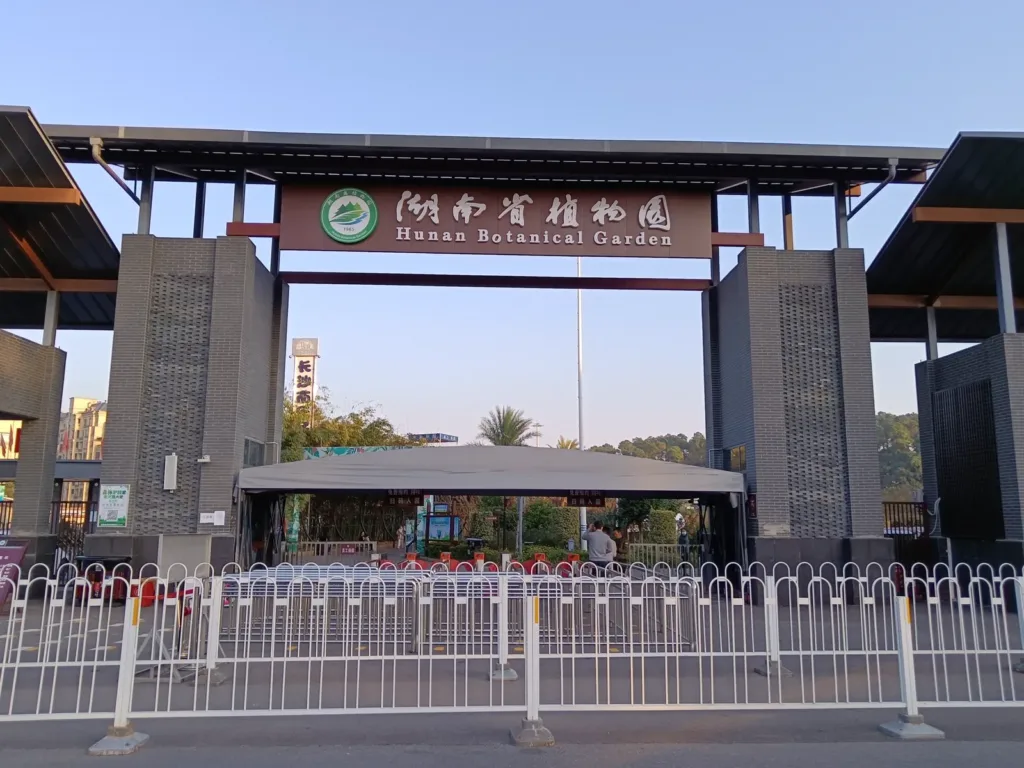
There are two useful visitor entrances. The west gate is at 湖南省长沙市雨花区植物园路111号. The north gate is on 湘府东路 Xiāngfǔ Dōng Lù. The published notice does not clearly explain how a foreign passport is entered in the WeChat reservation flow. If you are travelling on a passport, confirm the booking and entry procedure with the garden before relying on a same-day visit; the visitor service number listed by the garden is 0731-85498986.
Getting there and back
For the north gate, the garden lists buses 16, 602 and 938 to 湘府路省植物园北站 Xiāngfǔ Lù Shěng Zhíwùyuán Běi Zhàn. For the west gate, buses including 7, 17, 102, 103, 107, 120, 123, 147, 152, 502, 702, 703, 801, 802 and 806 serve 省植物园站 Shěng Zhíwùyuán Zhàn; the garden’s notice says to walk from that stop to the west gate.
The simplest rail options are gate-specific. From Metro Line 5, get off at 板塘冲站 Bǎntángchōng Zhàn and walk or transfer to bus 16, 602 or 938 for the north gate. From Metro Line 1, get off at 省政府站 Shěng Zhèngfǔ Zhàn and transfer to bus 938 for the north gate. The Changsha–Zhuzhou–Xiangtan intercity railway’s 湘府路站 Xiāngfǔ Lù Zhàn is next to the garden’s north side. These connections are listed in the garden’s own visitor information and in an English-language Hunan government guide.
For the return, leave through the gate you used and follow the corresponding corridor: 湘府路省植物园北站 Xiāngfǔ Lù Shěng Zhíwùyuán Běi Zhàn or 湘府路站 Xiāngfǔ Lù Zhàn from the north side, and 省植物园站 Shěng Zhíwùyuán Zhàn from the west side. Check the live direction of the bus or train before boarding; no reliable fare, departure interval or station-exit detail is supplied by the sources used here.
The garden asks visitors not to bring pets, bicycles, scooters, skates or skateboards, and prohibits drones and high-powered loudspeakers. Do not pick flowers, climb into planted areas or approach water edges for photographs.
Find Hunan Botanical Garden
湖南省植物园 · 雨花区
The pin marks the area, not the entrance.
Sources & visit information
Sources checked on 24 October 2026. Hours, tickets, reservations and transport can change; confirm with the operator before you go.
Image credits & notes (1)
- The entrance archway of Hunan Botanical Garden in Yuhua District, Changsha, with the bilingual garden name visible above the visitor lanes. Photo: Huangdan2060Photo: CC BY 3.0