

Photo adjustments
Proportionally resized and converted to WebP without cropping, retouching or changing the photographed subject.
Explore the region
About Wudang Lamasery
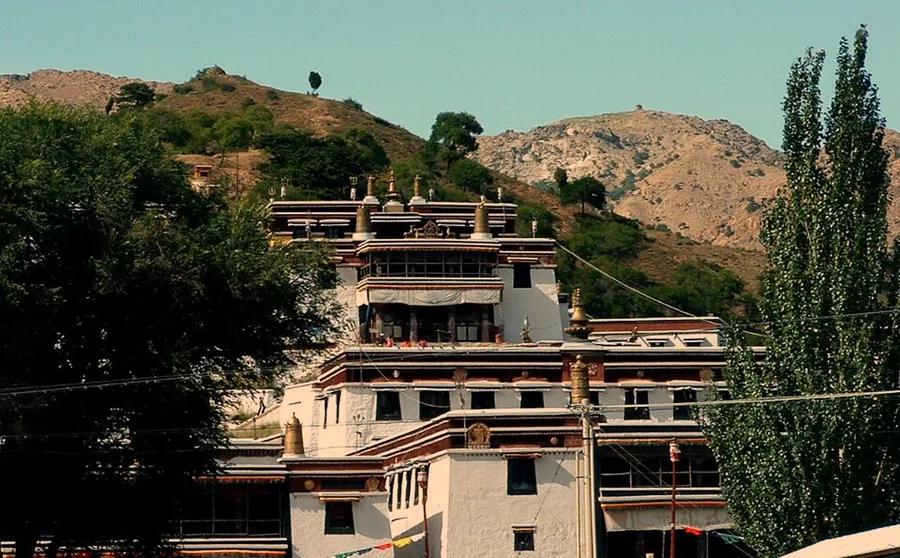
White, flat-roofed buildings form a Tibetan architectural ensemble, with larger teaching and assembly halls set among smaller monastic residences. Suguqin Hall provides the main ceremonial focus, while Dongkuo'er Hall recalls the monastery's study of calendrical and astronomical subjects. The hillside arrangement gives the visit its structure: look at the complex from below, then follow the open paths between the principal halls.
The monastery's founding date is unknown; it was built by nobles of the Ordos Left-Wing Front Banner (鄂尔多斯左翼前旗) in or before the Kangxi era. In 1749 the first Living Buddha, Luobusang Jialacuo (罗布桑加拉错), led a major expansion modeled on Tashi Lhunpo Monastery (扎什伦布寺) in Tibet, and the Qianlong Emperor then bestowed the Chinese name Guangjue Temple (广觉寺) in 1756. It was expanded further under the Jiaqing, Daoguang and Guangxu emperors, and at its height comprised eight main halls, three living Buddha residences, a mausoleum hall, two brick stupas and more than ninety monks' quarters.
The complex climbs the mountainside from low to high ground across more than 300 mu (亩), with 2,538 rooms in its main buildings; in addition, ninety-nine monks' residence buildings along its sides hold more than 2,500 rooms. Most halls face south, except Ahui Hall (阿会独宫), which faces east.
Wudang Lamasery is the largest Tibetan Buddhist monastery in Inner Mongolia and is described as the region's only complex built entirely in Tibetan style. It follows the Gelug school (格鲁派) of Tibetan Buddhism and was long known as “Eastern Tibet” for training senior Buddhist scholars. On 20 November 1996 the State Council listed it as a Major Historical and Cultural Site Protected at the National Level, in the fourth national batch.
What to look for
- The white Tibetan-style buildings stepping up the hillside.
- Suguqin assembly hall and Dongkuo'er Hall, including their accessible painted interiors.
The surrounding area
Western city base with a separate monastery excursion to Wudangzhao.
Location & getting there
Getting to Wudang Lamasery
Travel from Baotou toward the Wudang Lamasery visitor area in the Jihuluntu valley of Shiguai District; the approach follows the Baotou–Wudang road corridor.
- Arrange a return road transfer and use the authorised visitor route between halls; monastic residences are not part of an unrestricted walk.
Combine your visit
Suggested order within this visit:
-
Lower forecourt
Understand the hillside arrangement from below.
-
Suguqin Hall
Continue to the main assembly space.
-
Dongkuo'er Hall area
Finish with another of the monastery's principal teaching halls.
This sequence is an editorial suggestion based on the features described in the sources. Access to individual buildings or areas should be checked locally; no travel time or shared admission is implied.
Find Wudang Lamasery
五当召 · 包头
The pin marks the area, not the entrance.
More places nearby
Approximate straight-line distances between map pins, not travel distances.
Chunkun Mountain 春坤山
34 km awayChunkun Mountain rises into high meadow country northeast of Guyang. Its main summit, Hongqi Peak, reaches 2,340 metres, and the open upper slopes give a very different outlook from the industrial city of Baotou to the south…
View guide →Meidaizhao 美岱召
39 km awayMeidaizhao combines a fortified settlement, princely residence and Buddhist monastery within one walled enclosure. Taihe Gate gives the first clue to its civic scale, while the halls inside show Chinese roof forms alongside…
View guide →Baotou Museum 包头博物馆
44 km awayBaotou Museum connects the city's trading history with the older cultures of the Yinshan region. Its rock-art collection is especially useful: animal figures, hunting and pastoral scenes preserve a visual record that differs…
View guide →Sources & visit information
The sources below support the place-specific description and arrival information. Suggested combinations are editorial planning ideas; confirm current opening, entry arrangements and transport services for your date.
- Wikipedia: 五當召 ↗
- Baotou Daily on-site report: Wudang's valley and road approach ↗
- English Wikipedia: Badekar Monastery (revision 1367326554, 2026-08-02) ↗
Visitor information adapted and edited from Wikipedia contributors · CC BY-SA 4.0. Source revision 93741433.
Background paragraphs translated and condensed from Wikipedia contributors, "五當召", Chinese Wikipedia · CC BY-SA 4.0. Source revision 93741433.
Background paragraphs condensed from Wikipedia contributors, "Badekar Monastery", English Wikipedia · CC BY-SA 4.0. Source revision 1367326554.