

Explore the region
Tap any red Chinese text to hear it in Mandarin.
Enhe is best understood as a lived-in township and village area rather than a single fenced attraction. In Ergun, Hulunbuir, the township is identified in official and state-media reporting as China’s only Russian ethnic township. Enhe Village was included in the second batch of China’s Traditional Villages in 2013, which gives the place a more specific identity than a generic “Russian-style” resort.
The visitor focus is Enhe Village, set in the northern Greater Khingan forest region beside the Khau’er River. Its traditional 木刻楞 (mukeleng) houses use interlocked logs, with thick walls, pitched roofs and painted decoration around doors and windows. Look at the way the houses meet the lanes, the carved or coloured details, and the contrast between private yards and public streets; these are working homes, not a reconstructed film set.
Enhe’s Russian connection is also a living one. Local families of Russian descent run guesthouses and food businesses, while visitors may find Russian-style baking, home cooking and small hands-on activities. Reporting from the township describes homemade 列巴 (lieba, Russian-style bread), blueberry jam, locally made drinks and milk tea, as well as family stays in wooden houses. Treat these as local traditions and current possibilities rather than a fixed menu or guaranteed performance.
What to do in the village
Start with a slow walk through Enhe Village. The wooden houses are the main subject, but the useful detail is in the ordinary scale of the place: fences, porches, workshops, small food businesses and residents going about their day. Ask before photographing people, entering a yard or treating a home as a museum. A homestay can make the architecture easier to understand, but choose it by current reviews and direct confirmation rather than assuming that any building with a Russian name offers the same experience.
Ask locally whether a bread-making or matryoshka-painting session is available on the day you visit. Recent Xinhua reporting records both activities, together with meals, horse riding and village events, but it does not establish a daily timetable for every operator. If you encounter singing, accordion music or a folk-dance event, watch as a guest and follow the host’s invitation; do not expect a staged show at a particular hour. The Russian folk dance tradition was listed as an Inner Mongolian intangible cultural heritage in 2007, and the Bazhke festival was added to the national intangible cultural heritage list in 2011, but festival dates and public programming still need current confirmation.
The wider township lies in China’s northern border region, yet not every lane is a border viewpoint. Do not walk toward restricted areas or assume that visiting Enhe provides access to the frontier itself. Keep the village visit focused on its houses, food and resident-led experiences unless local authorities or your host give you a current, lawful route.
Getting there and getting back
This is a road-based rural stop. The Ministry of Culture and Tourism’s Ergun countryside route links Ergun Wetland, Birch Forest, Enhe Village and Shiwei Village, making Enhe a practical stop on a northern Ergun loop rather than a stand-alone urban attraction. For map search, use 恩和村 Ēnhé Cūn together with 恩和俄罗斯族民族乡 Ēnhé Éluósīzú Mínzúxiāng and 额尔古纳市 É’ěrgǔnà Shì; search the village name as well as the township name so that the final destination is the visitor core.
A Hulunbuir government-portal travel guide gives a possible public-transport sequence of Hailar to Labudalin (the urban area of Ergun), followed by Labudalin to Enhe. The page does not publish a current departure board, route number or return timetable, so verify the second leg at the Ergun coach station before setting out. No confirmed metro, city-bus stop or fixed last-mile shuttle is established by the sources used here. In practice, arrange a car, driver or confirmed local pickup for the road leg to Enhe Village and agree the return plan before leaving Ergun. The official countryside itinerary continues onward from Enhe Village to Shiwei Village; if you are not doing that loop, do not assume a late ride back will be available.
The same route source lists late August to early October as the best season for its autumn itinerary. That is a seasonal recommendation for the route, not a promise that every activity operates then. Outside the main travel season, confirm accommodation, road conditions and any hands-on activity directly before departure.
Find Enhe Russian Ethnic Township
恩和俄罗斯族民族乡 · 额尔古纳市
The pin marks the area, not the entrance.
Sources & visit information
Sources checked on 1 November 2026. Hours, tickets, reservations and transport can change; confirm with the operator before you go.
Image credits & notes (1)
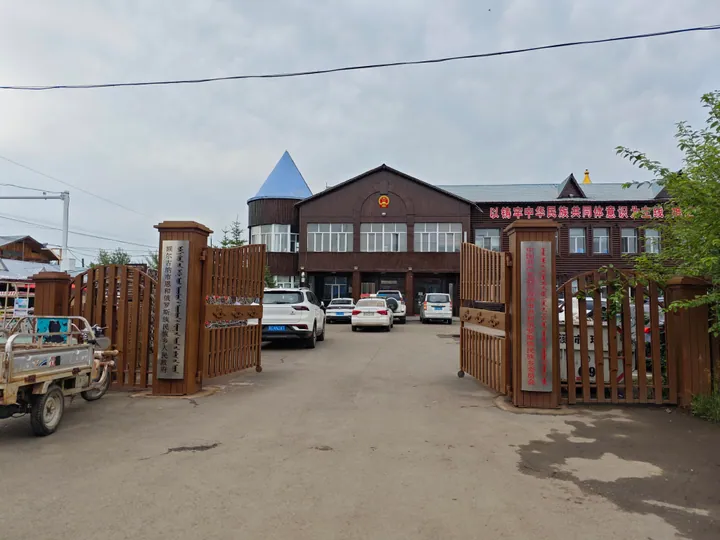
- The government office building of Enhe Russian Ethnic Township, Ergun, with its log-cabin-style architecture · 额尔古纳市恩和俄罗斯族民族乡政府,木刻楞风格建筑Photo: Liuxingy · CC BY-SA 4.0 · taken 2025-07-15Resized for the web; the photo itself has not been edited. Thumbnails may show a cropped view.
