

Explore the region
Tangshan is not one bathhouse behind one gate. The name covers a hot-spring district: 29.74 km² of hills in eastern Jiangning District (江宁区), about 30 km east of Nanjing South Railway Station, where resort hotels, a homestay village, two parks, a Ming quarry and a set of geological sites sit around a group of thermal wells. In October 2015 the area was approved as a national-level tourist resort — one of the first batch in China and the only one in Nanjing.
The water comes out of the ground at 60–65 °C, at a reported rate of about 5,000 tonnes a day. It is a calcium-magnesium thermal water with more than 30 minerals and trace elements, including fluorine, silicon, barium, strontium and lithium, and it is low in sulfur, so the pools do not carry the heavy rotten-egg smell that some visitors expect from Chinese hot springs. Bathing here is documented from the Southern Dynasties, when the Liang court is said to have valued the spring as a “sacred spring” (圣泉); local accounts put the history of use at about 1,500 years. In 2011 the Ministry of Land and Resources named Tangshan a “home of hot springs” (中国温泉之乡), and in 2012 the World Federation of Hydrotherapy and Climatotherapy designated it a “world-famous hot spring town” and the permanent venue of the World Hot Spring Forum. Publicity also describes the water as the only in China certified by both European and Japanese hot-spring bodies; treat that as a promotional claim rather than something you can check at the poolside.
Because the district has no single ticket, the useful question is not “what is the entrance fee for Tangshan” but “which venue am I going to”. Everything below is separately owned, separately priced and separately timed.
Soaking: three different ways to do it
Resort bath complexes. The big venues are shared outdoor bathing areas with dozens of themed pools. 汤山一号温泉 (Tangshan No. 1) has red-wine, milk and Chinese-medicine pools plus indoor pools, a gym and a buffet; 颐尚温泉 (Easpring) is the family favourite, with more than 70 outdoor pools — a Chinese-medicine pond, a Turkish “doctor fish” pond, a hot “volcano” pond — and staff who walk round with hot ginger tea; 汤山圣泉 (Shengquan) runs similar themed pools with an indoor swimming pool and therapy rooms; 紫清湖森林温泉 (Ziqing Lake) puts its pools on a wooded hillside and adds mineral-salt and stone-slab baths. Each sells its own day ticket, and some open only in the afternoon or only on certain days, so confirm the session you want before travelling.
Free soaking in public parks. 金乌温泉公园 (Jinwu Hot Spring Park, at the junction of 美泉路 and 延祥路) was built on the site of the area’s No. 1 well and opened at the end of 2017 as China’s first free hot-spring wellness park. Mist plazas, foot-soak pools, hand basins and face-steaming taps use water straight from the well; the park itself is open all day and costs nothing, and only the 金乌阁 tower charges a separate small fee. The water at the outlet is around 65 °C, so sit a metre or two back from the source to soak comfortably.
Private pools in a village guesthouse. 汤家家温泉民宿村 (Tangjiajia, on 汤龙路) is a 310-mu village of 108 households that opened as a hot-spring guesthouse cluster in May 2013. More than 30 guesthouses, each decorated in a different style, almost all have their own in-room spring pool (私汤) fed by the same Tangshan water. The village square has a free foot-soak corridor, 流泉长廊, and the old well; this is the cheapest way to sleep beside a private pool rather than queue for shared ones.
The rest of the district
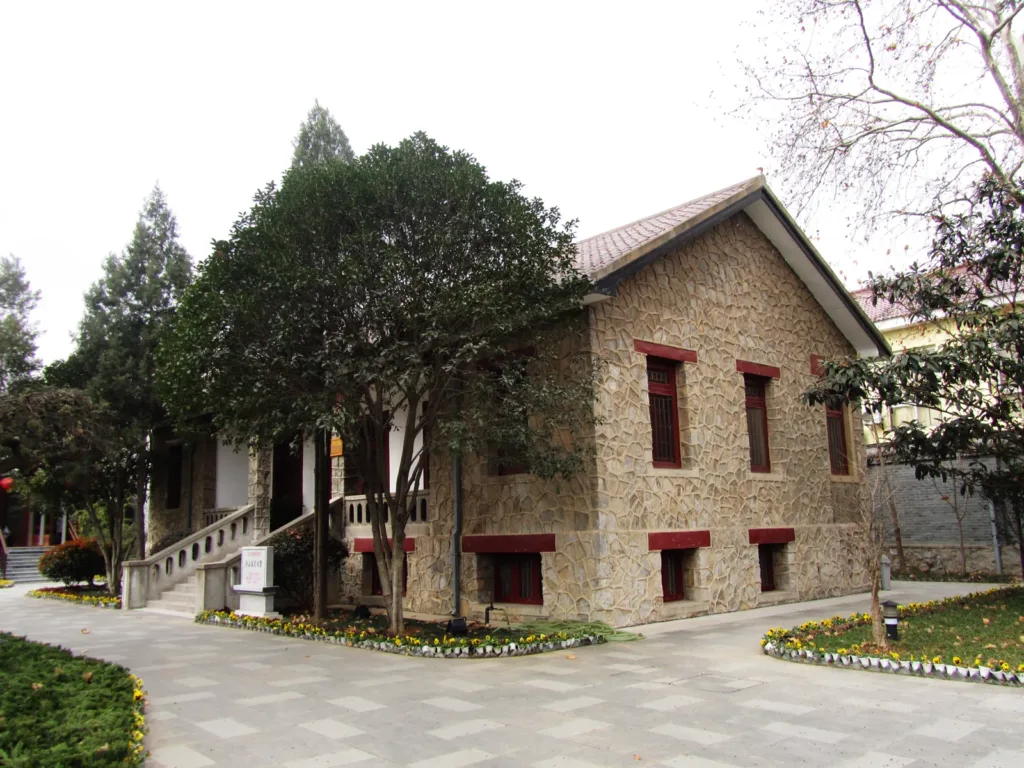
蒋介石温泉别墅 (Chiang Kai-shek’s hot-spring villa) stands on 温泉路 in the town centre, by the Tangshui River. Built in 1920 — accounts differ on whether the first owner was 陶保晋 or 张静江 — it was taken over by the Nanjing municipal government in 1946 and rebuilt between autumn 1946 and March 1947 as the private hot-spring villa of Chiang Kai-shek and Soong May-ling. It is a small two-storey house with ten single-storey rooms, blue-grey stone walls and a brown glazed-tile roof; the half-basement corridor holds the baths in sequence — attendants’, guards’, May-ling’s and the presidential pool — and ends at a passage that once ran to a military-police post and is now sealed. It became a military reception house after 1949 and is now open to visitors as a Jiangsu provincial protected heritage site (listed 2002). Listing sites show a split day, roughly 09:00–12:00 and 13:30–17:00, with a small admission charge; hours change, so confirm at the gate.
汤山矿坑公园 (Tangshan Quarry Park, 美泉路) is the area’s other surprise: a limestone quarry worked from 1972 to 2002, reopened in 2019 as a landscape park of terraced cliffs, lakes and lawns, with the cliff face used for projected light shows. It is listed as open all day with no admission price.
Geology and prehistory. 汤山古猿人洞 (the Ape Man Cave, also called 葫芦洞) yielded two Homo erectus skulls in 1993, dated to roughly 580,000–620,000 years ago; the cave is open 09:00–17:00 and charges admission. The 汤山方山国家地质公园博物馆 nearby covers the same story and closes on Mondays (09:00–16:00).
阳山碑材 (Yangshan quarry) is a Ming-era stone-working site: three enormous blocks cut for a memorial tablet for the founding emperor Zhu Yuanzhang, with a total height of about 40 m and a total weight of 9,677 tonnes, recognised by a Chinese records body as the largest stele blank in the world. It is a national key heritage site and a 4A-rated scenic area, with the reconstructed Ming Culture Village at its foot.
江苏园博园 (Jiangsu Garden Expo Park), south of the village, was built in a restored quarry and gathers garden architecture from all 13 Jiangsu cities, plus a cluster of hotels — Banyan Tree, Westin and others — inside the park. Entry to the park is free with individual attractions charging separately; it opens 09:00–18:00 Monday to Thursday and until 21:00 Friday to Sunday.
Getting there
Metro. Line S6, the Nanjing–Jurong intercity line (opened 28 December 2021, 43.64 km, 13 stations), is the backbone. It starts at 马群 (Maqun), where you change from Line 2 — the east–west line through the centre — so from 新街口 (Xinjiekou) or 大行宫 (Daxinggong) you simply ride east to Maqun and change. Four S6 stations serve different parts of Tangshan: 古泉 (Guquan) for 阳山碑材 and the water park; 南京猿人洞 (Nanjingyuanrendong) for 紫清湖 and the Homo erectus cave, about 1.3 km away; 汤山 (Tangshan) for the town centre on 温泉路 — exits 2 and 3 are signed for 温泉路 and 宁卉路, and exit 1 for 汤泉湖公园; and 泉都大街 (Quandudajie) for the quarry park, about 1.6 km away, and the 美泉路 belt.
From 南京南站 (Nanjing South Railway Station), take Line 1 to 新街口, change to Line 2 eastbound, then change again at 马群 to S6. From 南京站 (Nanjing Railway Station), take Line 1 or Line 3 into the centre, then Line 2 and S6. This is a long ride — well over an hour end to end — and the last stretch is metro, not a walk to the pools.
Bus. At the 汤山东 stop beside 汤山站 exits 2 and 3 you can pick up 837 (东山总站⇆汤山溶洞, formerly the 金汤线), 843, 902, 903, 926 and 926区间, 927 and 938, plus D19 (钟灵街⇆碧桂园·凤凰城, formerly D11) and a Jurong line to 宝华山 that passes through Tangshan. Several of these are 定时班车 with only a handful of departures a day, so read the timetable at the stop rather than assuming a frequent service. Route 845 (环一线/环二) is the useful link from 古泉站 to 阳山碑材 and on towards 美泉路. 汤家家 has its own stop on 汤龙路 (汤铜公路·汤家家), served by 845, 902, 903 and 927.
Taxi or ride-hailing. Type the Chinese name of the specific place, not “Tangshan Hot Springs”: 汤山温泉 or 汤山街道温泉路 for the town core, 金乌温泉公园 and 汤山矿坑公园 on 美泉路, 汤家家温泉村 on 汤龙路, 江苏园博园, 蒋介石温泉别墅. The district is about 30 km from Nanjing South Railway Station and about 60 km from Lukou International Airport, and roughly an hour by car from the city centre via the Shanghai–Nanjing expressway. There is no single drop-off for the whole area — the driver will take you to the venue you name.
How to organise a visit
The venues are spread across the district, so group them by road rather than trying to walk between them.
- Town core, around 汤山站: the villa on 温泉路, 汤山一号温泉, 汤山圣泉, and 汤泉湖.
- 美泉路 belt: 金乌温泉公园 for the free foot soak, 汤山矿坑公园, the geopark museum and the Homo erectus cave and its museum — a bus or short taxi ride from the core.
- 汤家家, north on 汤龙路: guesthouses, the free foot-soak corridor, dinner.
- 园博园, to the south: gardens and hotels; reachable by taxi, or by Metro Line 4 to 孟北 (Mengbei) and a 2.3 km walk. Give it a half-day of its own.
A workable day: arrive at 汤山站 in the morning, walk 温泉路 for the villa and the town, take bus 845 or a taxi out to 美泉路 for the free foot soak and the quarry park, then soak at a bath complex in the core or check into a 汤家家 guesthouse, and ride S6 back from 汤山站 or 泉都大街.
Winter is the season. The Tangshan Hot Spring Culture Tourism Festival has run annually since 2009 — the 15th edition was in 2023 — and usually opens in early winter. Weekends and public holidays in the soaking season are the busiest, so book a venue session or a room ahead and expect queues at the popular pools.
Two practical notes. The resort complexes are shared outdoor baths, so swimwear is what people wear; the 私汤 pools in guesthouses are private and in your room. At the free foot-soak areas the water arrives straight from the well at around 65 °C — the pools nearest the outlet are the hottest, and the ones further along the channel are more comfortable.
Find Tangshan Hot Springs
汤山温泉 · 江宁区
The pin marks the area, not the entrance.
Sources & visit information
Sources checked on 22 October 2026. Hours, tickets, reservations and transport can change; confirm with the operator before you go.
- 汤山温泉旅游度假区, Jiangning District People's Government ↗
- 南京汤山温泉旅游度假区, Baidu Baike ↗
- 汤家家温泉村, Baidu Baike ↗
- 金乌温泉公园, Baidu Baike ↗
- 金乌温泉公园建成开放 市民可免费泡脚, Nanjing Morning Post via Sina ↗
- 度假区特刊之汤山温泉篇, Sohu ↗
- 汤山温泉别墅, Chinese Wikipedia ↗
- 汤山站, Chinese Wikipedia ↗
- Line S6 (Nanjing Metro), English Wikipedia ↗
- The ultimate guide to Tangshan hot springs, China Daily / english.nanjing.gov.cn ↗
Image credits & notes (1)
- Former Chiang Kai-shek hot-spring villa on Wenquan Road, Tangshan - a Jiangsu provincial heritage site since 2002. Photo: 猫猫的日记本 (Wikimedia Commons)Photo: CC BY-SA 3.0