


Get to know Jiangning District

- Administrative area
- District · 市辖区
- Part of
- Nanjing
- Chinese name
- 江宁区
- Local areas
- District guide
Area & population
- Population · 2020 census
- 1,926,117
Source: English Wikipedia, as of the dates shown.
Jiangning wraps Nanjing on three sides — east, south and west — and is the largest of the city's 11 districts, at 1,563.32 sq km. At the 2020 census it held 1,926,117 residents, about a fifth of Nanjing's population. It is not one place with one centre. Inside it are a former county town that became the district's downtown (东山 Dongshan), a lakeside shopping quarter (百家湖 Baijiahu), two mountains that pull visitors from across the city (牛首山 Niushoushan and 汤山 Tangshan), a working international airport, and a rural belt of tea villages and duck-curing towns that runs for tens of kilometres.
The name is older than the district. 江宁 was an old name for Nanjing itself: the city's one-character abbreviation 宁 comes from it, and so does the 江 in Jiangsu. Jiangning County was converted into a district in 2000.
Ten subdistricts make up the district: 东山 Dongshan, 秣陵 Moling, 汤山 Tangshan, 淳化 Chunhua, 禄口 Lukou, 江宁 Jiangning, 谷里 Guli, 湖熟 Hushu, 横溪 Hengxi and 麒麟 Qilin. The district government is at 上元大街369号 in Dongshan. One naming trap: 江宁街道 Jiangning Subdistrict is one of the ten subdistricts, not another name for the whole district.
How the district divides
Four zones matter to a visitor, and they sit far apart.
- North-east — Tangshan. Hot springs, the Yangshan stele quarry, the Nanjing Man cave site, and the Jiangsu Garden Expo Park on old quarry ground. Reached by metro line S6.
- South-west — Niushoushan. The Buddhist mountain with the Usnisa Palace, plus the Southern Tang tombs and Zheng He's tomb at its foot. Reached by metro line 1, line 3 or S1, then a bus.
- Centre — Dongshan, Baijiahu, Jiulonghu and the university belt. The district's own downtown, threaded by metro lines 1, 3 and 5.
- South and west — the rural belt. Tea villages, reservoir villages and the duck town of Hushu, linked by the 30 km 苏花路 scenic road.
A sensible division of time: one day for Niushoushan, one for Tangshan, and a half-day for Dongshan and Baijiahu if you want to eat and shop where people actually live. Trying to combine Tangshan and Niushoushan in a single day means crossing the whole district.
Tangshan: springs, a stele that was never raised, and a garden on quarry scars
汤山温泉旅游度假区 has a planning area of 29.74 sq km, some 150,000 mu of woodland and 80% forest cover, and in October 2015 became Nanjing's only national-level tourist resort. Two nationally protected sites stand inside it — 阳山碑材 and the 南京猿人遗址 — along with the provincially protected Chiang Kai-shek hot-spring villa, the 雷公洞 and 葫芦洞 karst caves, more than 20 hot-spring hotels of resort standard, and 30-plus guesthouses in 汤家家 hot-spring homestay village.
阳山碑材 Yangshan stele quarry
In 1405 Zhu Di, newly on the throne, ordered a stele cut to praise his father Zhu Yuanzhang, and had three colossal blocks carved out of the hillside at Yangshan. The district government gives the cut dimensions: the head block 6.5 m high, 10 m thick and 18 m wide; the body 52.5 m by 4.1 m by 13 m; the base 16 m by 30 m by 12.2 m — 75 m and 26,000 tonnes in total. Nothing that size could be moved, and nothing was: the blocks still lie where the masons left them, and the stele actually erected at 明孝陵 is a 14 m substitute. The quarry has been a national key cultural relic since 2013. The visitor area is rated 4A and also contains a reconstructed Ming-period village and a rock garden.
Access is the weak point. Metro line S6 stops at 汤山, 泉都大街, 南京猿人洞 and 古泉 in this area. Bus 845, a loop run as 环一 and 环二, links 阳山碑材 with 汤山地铁站, 泉都大街地铁站西, 古泉社区 and 汤山溶洞 — but a 2026 route listing shows five departures a day on the 环一 loop alone, so treat the bus as plan A with a taxi as plan B.
南京猿人洞 and the Tangshan karst
The S6 station is itself called 南京猿人洞 and sits beside the Homo erectus fossil museum, so the cave site has a station named for it. The resort authority lists the 南京猿人遗址 as one of its two national key heritage sites; the same area also holds the 雷公洞 and 葫芦洞 caves and geological sections recording some 700 million years of strata.
江苏园博园 Jiangsu Garden Expo Park
圣湖路8号, 3.45 sq km (about 5,175 mu), built across industrial remains and quarry cliffs and opened for trial operation on 17 April 2021. Since 29 June 2024 the gate ticket has been abolished and the public landscape is free; 苏韵十三园 (70 yuan) and 抱抱乐园 (50 yuan) are ticketed separately, and the park's trains, shuttle buses and cable car are charged. Opening hours are 09:00–18:00 from Sunday to Thursday and 09:00–21:00 on Friday and Saturday. The official listing gives the address but no fixed bus route, so the practical approach is a taxi to 江苏园博园 or asking at the S6 汤山 or 泉都大街 stations about the current shuttle; the resort publishes notices through its 四季汤山 mini-programme.
Niushoushan: the relic, the pit and the Southern Tang
牛首山文化旅游区 (宁丹大道18号) takes its name from twin summits that look like an ox's horns; the mountain rises to 242.9 m and is the birthplace of the Niutou branch of Chan Buddhism. The 4A scenic area opened on 27 October 2015, the same day the Buddha's parietal relic was installed in the 佛顶宫.
That palace is the reason most people come. It sits in the scar of the west peak, which was stripped by iron mining in 1937 and 1958, leaving a pit more than 60 m deep; the building is about 136,000 sq m over nine levels — three above ground, six below — divided into the 禅境大观, 舍利大殿 and 舍利藏宫. 佛顶塔 stands 88 m tall in nine storeys, and 佛顶寺 is a 23,000 sq m Tang-style compound laid out on the traditional seven-hall plan.
The relic itself is shown in public seven times a year: over the New Year, Spring Festival and National Day holidays, and on the Buddha's renunciation day (二月初八), parinirvana day (二月十五), birthday (四月初八) and enlightenment day (十二月初八). On any other day you are visiting the palace and the exhibition spaces, not the relic — worth knowing before you build a trip around it.
Tickets and hours, as published by the scenic area: 160 yuan full price, 80 yuan concession; open 08:30–17:30 with ticket sales and entry ending at 16:30; the internal shuttle runs 08:30–18:00; timed online reservation is required and cashless payment is encouraged. Entry is free on 11 July, China's Maritime Day, because Zheng He's tomb lies on the mountain.
Also on and around the mountain: 南唐二陵, the tombs of Li Bian and Li Jing of the Southern Tang, excavated in 1950 and a national key heritage site since 1988; 郑和墓 and the Zheng He cultural park; 弘觉寺塔, 45 m and described by the scenic area as the oldest surviving imitation-timber brick pagoda in Nanjing; the rampart from Yue Fei's 1130 ambush of the Jin army; Ming cliff carvings; and the tomb of Li Ruiqing. The 金陵小城 complex and its hotels sit at the edge of the scenic area for anyone staying overnight.
Getting there. The scenic area publishes its own routes, and they are the ones to use:
- Metro line 1 to 天隆寺, exit 2, then bus 712 or 755 to 牛首山风景区 (east gate), or bus 710 to 周村(牛首山风景区西) (west gate).
- Metro line 1 to 百家湖, exit 2, or line 3 to 天元西路, exit 3, then bus G70 to the same east-gate stop.
- From the airport side, S1 to 河海大学·佛城西路, exit 2, then bus G70.
- By taxi or ride-hailing, give the destination as 牛首山文化旅游区东入口 — the east gate is the main visitor centre with the large car parks; the west gate has its own.
Dongshan, Baijiahu and the metro spine
东山 is the old county town and still the district's administrative centre, with 上元大街 running through it. Metro line 5 has the densest cluster of stations here: 吉印大道 (interchange with S1), 九龙湖南, 诚信大道 (interchange with line 3), 前庄, 科宁路, 竹山路 (out-of-station transfer to line 1), 新亭路, 东山 and 文靖路. The southern section opened on 31 March 2024 and the line was completed through to 方家营 on 6 August 2025, so this is a recent addition to the district's map.
Line 1's 胜太路 and 百家湖 stations serve the lake quarter. The 百家湖1912 block opened in 2011 on the lake edge beside 百家湖 station, with a lakeside boardwalk and a mix of restaurants and bars; it was named a provincial pedestrian-street upgrading case in 2024. The surrounding 百家湖商圈, formally named in May 2016, is now a provincial night-consumption cluster with more than 1 million sq m of commercial floor space and average daily footfall above 150,000 — the district's answer to downtown Nanjing for shopping and dinner.
Line 1 continues through the university belt at 南医大·江苏经贸学院, 南京交院 and 中国药科大学, while line 3 runs down the eastern side through 九龙湖, 诚信大道, 东大九龙湖校区, 秣周东路, 上秦淮西 and 秣陵. Line 3's third phase opened on 19 December 2025 and moved the terminus to 秣陵.
方山, also called 天印山, is a low hill of volcanic rock south of Dongshan. At its northern foot stands 定林寺塔: built in 1173, 14.5 m tall, seven storeys and eight sides, brick in imitation of timber, and leaning — 5°35′ after a 2003 repair, down from a maximum of 7°59′. It is a provincial heritage site listed in 1982 and cannot be climbed.
The rural belt
Jiangning's countryside is a separate trip, not a walk from the metro. The district counts 550 village sites at municipal level or above, 23 provincial characteristic rural villages and 21 villages holding national titles such as 中国最美乡村, and the 苏花路 scenic road links them over about 30 km.
黄龙岘, in 牌坊村 of 江宁街道, is a tea village: a tea-culture street, 雨花茶 from the surrounding hills, and — according to the district government — more than 80% of the villagers who had left have come back to run businesses there. 苏家理想村 in 秣陵街道 has 11 guesthouses, one of them rated A nationally, and receives about 500,000 visitors a year. 石塘人家 is one of the villages the district counts among its national-title winners. 佘村 is promoted as 金陵古风第一村 and keeps a group of Ming and Qing houses. 杨柳村 has a larger Ming–Qing building group.
湖熟 is also the district's duck town. The Nanjing cured-duck and salted-duck craft (南京板鸭、盐水鸭制作工艺) appears on the municipal intangible-heritage list with the 江宁区湖熟鸭业协会 as the protecting body, and has since been elevated to provincial level. The same list carries 雨花茶 pan-firing, 牛首山 spring-outing custom, 铜山高台狮子舞, 周岗红木 carving, 方山 picture mounting and 窦村 stone-carving from Jiangning. 横溪 is known for watermelons.
Eating
The district's signature dish is 东山老鹅: a goose cut into chunks and braised with potato, heavy on garlic and spices — star anise, cassia, bay leaf, cardamom — with the potato pressure-cooked along with the bird. It is a hot, savoury, sauce-heavy dish built for sharing, and it takes its name from 东山, where the restaurants that popularised it opened on 东新南路. Cured duck (板鸭) is the other local staple — the salt-cured, pressed duck that the Hushu association still makes to the listed craft — with 红烧麻鸭 as the braised alternative.
Two practical notes. 老鹅 is a shared dish, so ask for 小份 if there are two of you. Cured duck is salty by design and the goose sauce is soy-based; say what you cannot eat rather than judging from the menu. Restaurants cluster in 东山 and around 百家湖 and the 1912 block.
Getting to and around Jiangning
Metro. Five lines reach the district.
| Line | Stations inside Jiangning | Notes |
|---|---|---|
| 1 | 河定桥, 胜太路, 百家湖, 小龙湾, 竹山路, 天印大道, 龙眠大道, 南医大·江苏经贸学院, 南京交院, 中国药科大学 | Southern extension opened in 2010; the line's southern terminus is 中国药科大学 |
| 3 | 胜太西路, 天元西路, 九龙湖, 诚信大道, 东大九龙湖校区, 秣周东路, 上秦淮西, 秣陵 | Terminus moved to 秣陵 when the third phase opened on 19 December 2025 |
| 5 | 吉印大道, 九龙湖南, 诚信大道, 前庄, 科宁路, 竹山路, 新亭路, 东山, 文靖路 | Completed through the city centre on 6 August 2025 |
| S1 | 翠屏山, 河海大学·佛城西路, 吉印大道, 正方中路, 翔宇路北, 翔宇路南, 禄口机场, 空港新城江宁 | The airport line; 翔宇路南 connects to S9, 空港新城江宁 to S7 |
| S6 | 麒麟门, 东郊小镇, 古泉, 南京猿人洞, 汤山, 泉都大街 | Change from line 2 at 马群, which is in Qixia district |
Rail. 南京南站 (Nanjing South) at 玉兰路98号 straddles the Yuhuatai–Jiangning boundary in 南部新城 and is the practical rail gateway for the district, with lines 1, 3, S1 and S3 meeting underneath it. Do not confuse it with 江宁站, a small two-platform stop on the Nanjing–Hangzhou high-speed line in 淳化街道, opened on 1 July 2013 and used mainly by students at the university town; buses 768 (to 安德门, on lines 1 and 10), 809 and 829 connect it towards 河定桥. 江宁西站, in the 江宁滨江经济开发区 on 站前路, is on the Nanjing–Anqing line and opened on 6 December 2015; loop bus 873 (环一 and 环二) serves it. For most visitors neither Jiangning station is useful — Nanjing South is.
Air. 禄口国际机场 lies in 禄口街道, about 36 km (straight-line distance) from the city centre, with S1's 禄口机场 station between Terminals 1 and 2. If you land here you are already in Jiangning: S1 runs to 南京南站, and a taxi to 东山 or 百家湖 is a shorter run than continuing into the city centre.
Taxi and ride-hailing. Give the Chinese name of a specific gate or village — 牛首山文化旅游区东入口, 江苏园博园, 汤山温泉, 黄龙岘, 石塘人家, 禄口机场T2航站楼. A 1,563 sq km district has no single drop-off point.
Distances. Tangshan and Niushoushan sit on opposite sides of the district, and 东山 to either 汤山 or 黄龙岘 is a road trip rather than a walk. Plan one zone a day and check the return leg before you set out, especially for the rural villages and the quarry, where buses are few.
Where to stay
Staying in 东山 or around 百家湖 puts metro lines 1, 3 and 5, restaurants and the 1912 lakefront within reach, and makes the airport line straightforward. Tangshan is the choice if the hot springs are the point: more than 20 resort-standard hot-spring hotels and 30-plus guesthouses in 汤家家, plus the hotel cluster inside the Garden Expo Park. At Niushoushan the scenic area itself lists 金陵小城's 满庭芳客栈 and the 牛首山希尔顿, and publishes a two-day itinerary that pairs the mountain with an overnight there. In the countryside, 苏家理想村's 11 guesthouses are the established base.
Guide sources
- 江宁区 — 维基百科(中文)
- 南京市第七次全国人口普查公报 — 南京市统计局
- 牛首山文化旅游区简介(含交通、门票与开放时间) — 中国南京牛首山官方网站
- 汤山温泉旅游度假区 — 南京市江宁区人民政府
- 南京明文化村(阳山碑材)景区 — 南京市江宁区人民政府
- 阳山碑材 — 维基百科(中文)
- 江苏园博园(票价、开放时间、地址) — 南京文旅信息服务平台
- 江苏园博园6月29日起取消入园大门票 — 新华网江苏
- 南京地铁1号线 — 维基百科(中文)
- 南京地铁3号线 — 维基百科(中文)
- 南京地铁5号线 — 维基百科(中文)
- 南京地铁S1号线(机场线) — 维基百科(中文)
- 南京地铁S6号线(宁句城际) — 维基百科(中文)
- 南京禄口国际机场 — 维基百科(中文)
- 江宁站 — 维基百科(中文)
- 江宁西站 — 维基百科(中文)
- 南京南站 — 维基百科(中文)
- 百家湖1912街区上榜江苏省步行街改造提升典型案例 — 南京市商务局
- 江宁开发区百家湖商圈成功入选江苏省夜间消费集聚商圈 — 新华网江苏
- 市政府关于公布第一批南京市非物质文化遗产名录的通知 — 南京市人民政府
- 中外媒体探访江宁美丽乡村 — 南京市江宁区人民政府
- 南京845路环一公交路线(阳山碑材环线) — 车主手册
- 方山定林寺(定林寺塔) — 维基百科(中文)
- 东山老鹅:鹅块与土豆红烧 — 中国天气网江苏
Explore Jiangning District
Core places to explore, with English and Chinese names.
Places to explore around Jiangning District
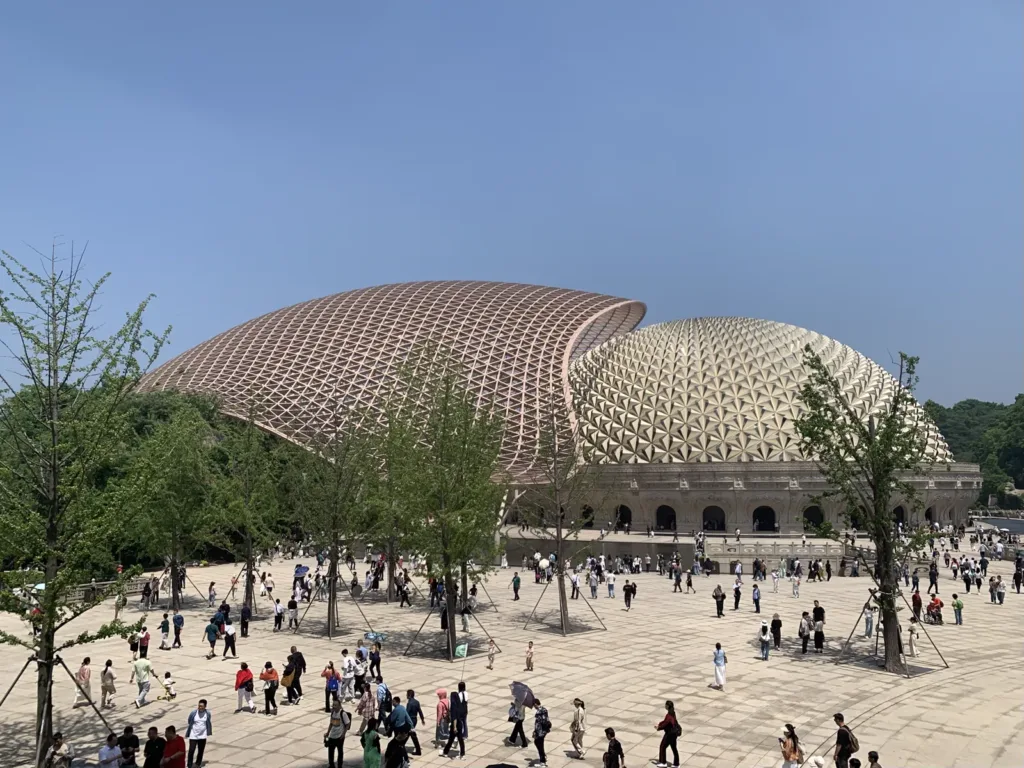 The Foding Palace on Niushou Mountain: the great ridged dome and the lotus-based small dome, seen from the esplanade. Photo: Chainwit. (Wikimedia Commons user) · CC BY 4.0
Niushou Mountain Cultural Scenic Area牛首山文化旅游区
Niushou Mountain Cultural Scenic Area (牛首山文化旅游区) in Jiangning, southern Nanjing, pairs a historic Buddhist mountain — a Ming brick pagoda, Ming cliff carvings, Yue Fei's stone rampart and Zheng He's tomb on the East Peak — with the Foding Palace of 2015, a nine-level complex built into an abandoned iron pit to house the world's only Buddhist parietal-bone relic. Full admission CNY 160; timed online reservation required; metro plus bus, no station at the gate.
Read the place guide →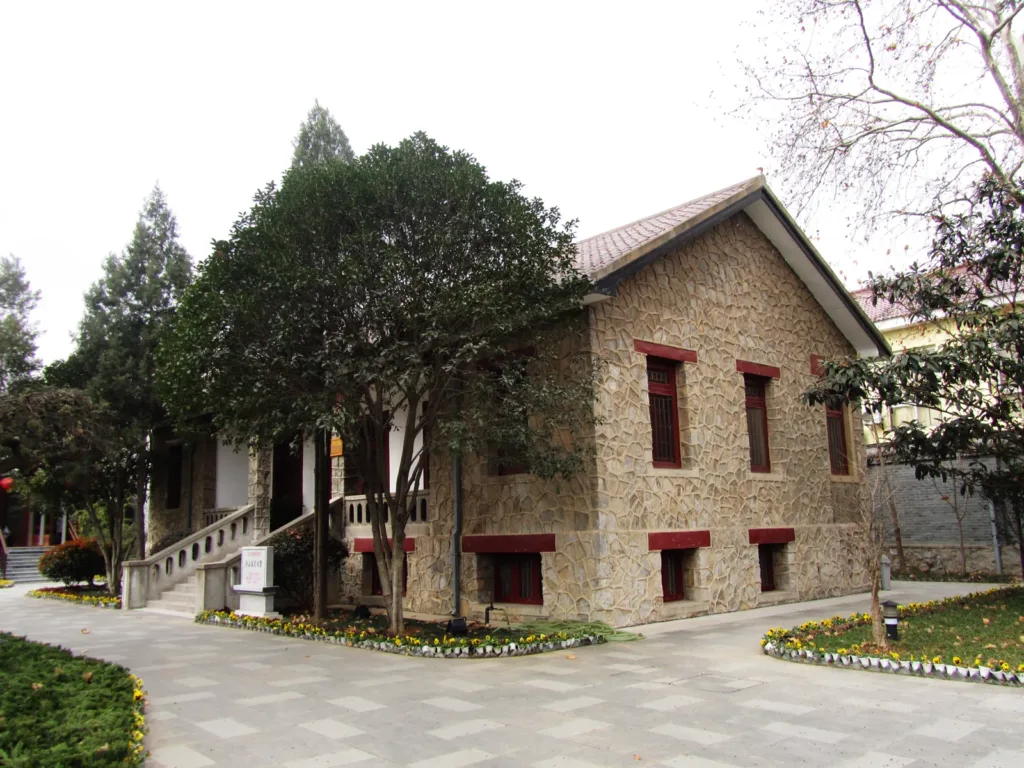 Former Chiang Kai-shek hot-spring villa on Wenquan Road, Tangshan - a Jiangsu provincial heritage site since 2002. Photo: 猫猫的日记本 (Wikimedia Commons) · CC BY-SA 3.0
Tangshan Hot Springs汤山温泉
A hot-spring district in eastern Nanjing's Jiangning District: 29.74 km2 of hills where resort bath complexes, the Tangjiajia guesthouse village, the free Jinwu Hot Spring Park, a 1920 villa later rebuilt for Chiang Kai-shek and a Ming quarry sit around wells running at 60-65 C. There is no single ticket - every venue is priced and timed separately, and Metro Line S6 links the different clusters.
Read the place guide →Plan your visit
Getting there
Jiangning District is about 20 km (straight-line distance) from central Nanjing. Search for 江宁区 in a map app to find stations and your accommodation.
Where to stay →Build your route
Niushou Mountain Cultural Scenic Area and Tangshan Hot Springs are about 35 km apart (straight-line distance). The linked place guides have entrance and visit details.
Continue with Nanjing →More in Nanjing
Sources & geographic information
Administrative names and parent areas: Official geographic directory (dmfw.mca.gov.cn) · Reference date 2026-09-06.
Background text adapted from Jiangning, Nanjing — Wikipedia contributors, under CC BY-SA 4.0. Text has been shortened and reorganized; source revision 1340168901.
Map data © OpenStreetMap contributors. Pins mark approximate centres, not entrances or boundaries.
Image credits & notes (1)
- Streetfront shops and seafood stalls in Jiangning District, Nanjing. Photo: Taken on 10 March 2014.Photo: 东京村子 · CC BY-SA 3.0Resized for the web; the photo itself has not been edited. Thumbnails may show a cropped view.
