

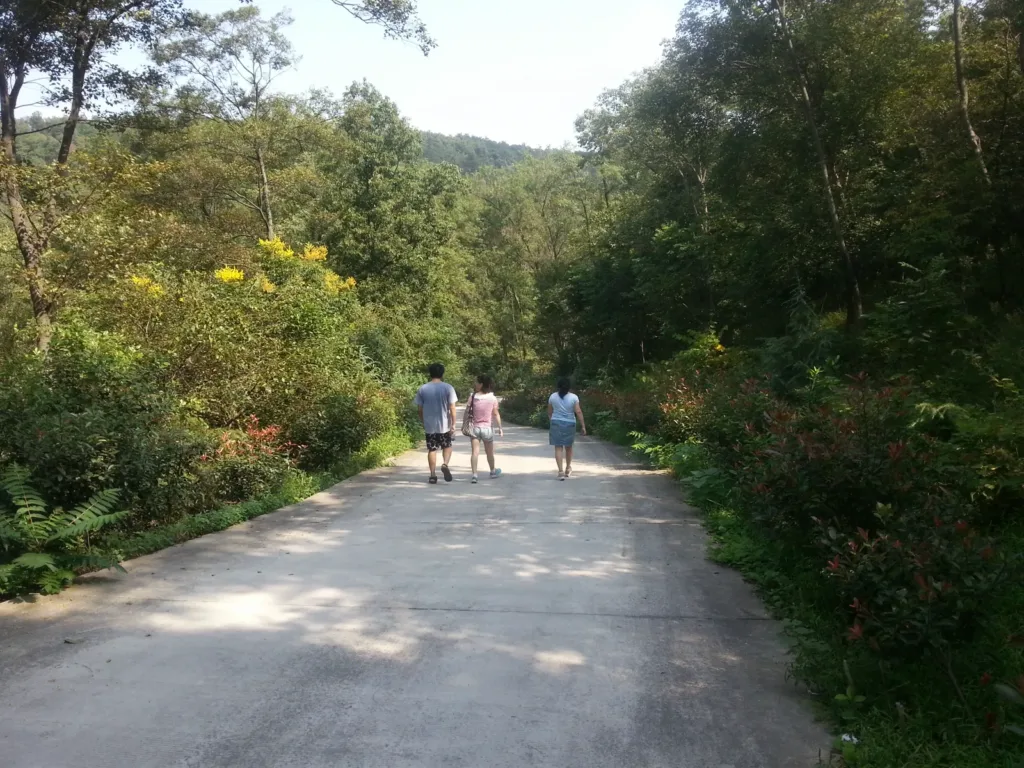
Explore the region
Laoshan National Forest Park takes in the wooded ridge that runs across Pukou District (浦口区) on the north bank of the Yangtze, west of central Nanjing. It covers 5,063 hectares with 89 peaks and roughly 90 per cent forest cover, and both the district government and the park’s own account call it Nanjing’s “green lung”. The Pukou district government describes Laoshan as Jiangsu’s largest national forest park and the largest single patch of urban green space in the Nanjing metropolitan area — which is why locals treat it as the mountain of the north bank rather than a landscaped park with one gate.
It is worth knowing what you are choosing between. The park is a mountain range, not one enclosed attraction. It is managed as three blocks — 狮子岭 (Shiziling), 平坦 (Pingtan) and 老鹰山 (Laoyingshan) — and the block developed for visitors, with the ticket gate, stairways and signposted sights, is the eastern 老鹰山 / 七佛寺 area entered from 黄山岭路 (Huangshanling Road), the address the park and the municipal price list both use. The forest roads, ridge paths and villages at the foot are used as open green space. Decide whether you want the ticketed summit walk or a free forest-road walk, and build the day around that.
What you are walking through
The forest itself is the attraction: mixed deciduous and evergreen woodland over limestone, with the range’s traditional features listed as forest, springs, rock and caves (林、泉、石、洞). A district-wide survey updated the count to 2,081 species (excluding aquatic life), about 47.7 per cent of Jiangsu’s terrestrial species: 1,187 vascular plants, 718 insects, 136 birds, 19 reptiles, 10 amphibians and 11 mammals. A stand of 秤锤树 (Chinese bladdernut), once thought extinct in Jiangsu, was rediscovered on this mountain.
Two animals explain why the mountain is protected. 中华虎凤蝶, the Chinese windmill butterfly, has its largest habitat in Jiangsu here, and in 2023 the national forestry administration listed 老山 as a key habitat for it and for the 獐 (Chinese water deer) — the province’s only designated forest-ecosystem wildlife habitat. Black kites, crested honey buzzards and kestrels circle the ridges, and the area is one of the richer firefly sites in the Yangtze Delta.
For birds you do not need luck: egrets, herons and grey magpies are common, the park keeps a grey magpie rearing base, and the 百鸟园 (bird garden) further into the park is unfenced, with birds landing on visitors.
Colour changes through the year. The park’s own seasonal calendar runs from snow on the ridge in January and plum, winter jasmine and magnolia from February, through spring blossom, to late-autumn foliage. The 珍七 road below the park was planted as a “ten-li gallery” — cherry and crabapple in spring, crape myrtle in summer, goldenrain tree and osmanthus in autumn.
The climb up Laoying Mountain
At 326 m, 老鹰山 is not high, but the main walking route is a stairway. From 清风林 the 老山云梯 (“Laoshan cloud ladder”) climbs the south slope in several thousand stone steps to the summit tower, built in 1991: five storeys, six sides, about 20 m, a fire-watch tower that doubles as the best lookout in the park. From the top you look over the canopy to the Yangtze and the city on the far bank. If steps are not the plan, a 5.2 km mountain road, 老山十八盘, winds up to the summit area.
Near the foot of the route, 状元广场 marks 张孝祥 (Zhang Xiaoxiang), the Southern Song poet who placed first in the 1154 palace examination and is buried on 黄山岭. The park has repaired the tomb, planted 清风林 and set up a 状元及第 archway and a statue; the tomb has been a Nanjing municipal protected site since 1992. 七佛寺, a temple first built in 1444 and rebuilt on its present site in 1995, stands beside the park’s eastern entrance.
The Zhenqi Line forest trail
The best-known route here is not the summit stairway but 珍七线 (Zhenqi Line), the forest trail running from the 七佛寺 main entrance towards 珍珠泉 (Pearl Spring). Jiangsu’s forestry administration added it to the provincial forest-trail list in January 2024.
The 吴家大洼 section was re-laid in 2023 as part of an overall upgrade of the line. The old 枫杨 (Chinese wingnut) grove was kept, and the repairs used local stone, bamboo and timber under a “leave no trace” approach that the forest farm summed up as “letting the path grow out of nature”.
On the ground that means grey stone-flag steps, log handrails, timber rest pavilions and several viewing platforms looking out at the Laoshan peaks, with bamboo and wingnut closing over the path. In late autumn the wingnut leaves turn gold and the 乌桕 (Chinese tallow) crimson. The trail ties the forest park, 不老村, 四方当代艺术湖区 (the Sifang art area) and 珍珠泉 into one walking route and has hosted marathon races; it is a local footpath, not a theme-park walkway.
Getting there and back
No metro station serves the gate. The park’s own directions end with a bus, so plan on two legs from the city.
Metro, then bus. Metro Line 10 is the line that crosses the Yangtze to Pukou. The park’s official directions are: Line 10 to 龙华路站 (Longhualu), then from 江浦客运站 (Jiangpu bus station) bus 608, 610 or 611 to the 森林公园 stop.
In practice 608 and 610 are the two to look for, because both now call at stops named 七佛寺 (Qifo Temple), 老山森林公园南 (Laoshan Forest Park South) and 老山森林公园 (Laoshan Forest Park).
- 608 runs 雨山路地铁站南 ⇌ 星甸公交总站 and connects with Metro Line 10 at 雨山路站 (Yushanlu). It runs 05:30–21:30 at both ends and costs ¥2–3, paid with an IC card, Alipay or a UnionPay QR code.
- 610 runs 省人民医院浦口分院 ⇌ 余家湾总站 and calls at 江浦市民广场, the stop at Line 10’s 文德路站 (Wendelu). Fares are ¥2–3.
- 611 is the third route the park lists; its city-side terminus has been changed more than once, so check a live map before relying on it.
On the city side, Line 10 interchanges with Line 2 at 元通 (Yuantong) and with Line 1 at 安德门 (Andemen), so most central hotels need one change.
Taxi and ride-hailing. Give the driver 老山国家森林公园, or the address 南京市浦口区黄山岭路90号 (No. 90 Huangshanling Road, Jiangpu Subdistrict, Pukou District). If you are heading for the 珍七线 trail, the useful drop-off is the 七佛寺 gate, where the trail starts.
By car. The park’s own approach notes run from the river crossings: 扬子江隧道 or 长江隧道, then 宁滁快速通道; or 南京江心洲长江大桥 (the Fifth Bridge), then 江新大道. Parking is charged per entry rather than by the hour — reference sources give ¥8 for a blue-plate car, and rates are posted at the gate.
Coming back. The park is open 08:00–17:00 and last admission is 17:00. Bus 608 keeps running into the evening, while 610’s last departures are in the late afternoon to early evening. If you plan to stay out on the open forest roads after the ticket gate closes, arrange your ride back before you set off.
Tickets, hours and rules
- Opening: 08:00–17:00 daily; last admission 17:00.
- Tickets: the standard adult price is ¥30 per visit. Ticketing platforms list the same figure, with reduced tickets for children and students, and Trip.com sells an entry ticket in English from about US$4.5 — the simplest option if you cannot use Chinese apps.
- Booking: the park’s visitor notice asks visitors to book tickets in advance, and says special groups enter on the relevant permit.
- Free days: each January the Nanjing price authority publishes one free-open day for the park among the municipal government-guided-price attractions; the 2026 date was 21 June. The Pukou district government also opens the park free to visitors aged 60 and over on 重阳节 (Double Ninth Festival; 18 October in 2026).
- Preferential entry: holders of a Chinese veteran’s or bereaved-family preferential-care card (优待证) enter free under a 2023 municipal scheme that covers government-priced parks.
- Rules posted at the gate: no overnight camping, no flames or smoking, no hunting, catching, picking or digging of plants and animals, no trampling flower beds.
- Phone numbers: enquiries 025-58112708; rescue 025-58110990; complaints 025-58880744.
Practical notes
- Two gates on one road. Maps pin the park at the 黄山岭路 address, where the ticket gate and car park are; the 七佛寺 gate further along the same road is the trailhead for the 珍七线. Both have stops on the same two bus routes.
- Terrain. The summit route is stone steps in the thousands, with steep sections, and the stone is slick after rain. The park lists barrier-free facilities among its visitor services; treat those as covering the visitor centre and lower paths rather than the summit stairway, and ask at the desk what is usable that day.
- Sightseeing cars run inside the park. The fare is not published on the park’s website, so ask at the ticket desk.
- Weather and notices. Forest weather turns quickly; check the forecast and the park’s WeChat account — the channel it uses for closures and event notices — before travelling out.
Around the park
- 不老村 (Bulao Village) sits at the south foot beside 象山湖 (Xiangshan Lake), next to 七佛寺. The lake has a roughly 4 km loop path and is a common place to finish a walk.
- 四方当代艺术湖区 (the Sifang art area) is on the same trail network, if you want art with your forest.
- 珍珠泉风景区 (Pearl Spring Scenic Area) is a separate AAAA ticketed attraction at 珍珠街178号 (No. 178 Zhenzhu Street), not covered by the forest park ticket, with its own free-open day — 5 July in 2026.
- West of the park, 汤泉 has the hot-spring belt and 惠济寺, whose three ginkgos are said to have been planted in the Southern Dynasties, more than 1,400 years ago.
- In the 狮子岭 block, the late-Ming 兜率寺 stands under 西华峰. It is documented as a park feature but lies off the maintained visitor circuit, so check locally before setting out for it.
Find Laoshan National Forest Park
老山国家森林公园 · 浦口区
The pin marks the area, not the entrance.
Sources & visit information
Sources checked on 22 October 2026. Hours, tickets, reservations and transport can change; confirm with the operator before you go.
- 老山国家森林公园, Nanjing Jiangbei New Area Administration Committee ↗
- 南京老山国家森林公园 official website ↗
- 入园须知 / Admission notice, Nanjing Laoshan National Forest Park ↗
- 秋后的老山森林公园,是惬意的, Nanjing Laoshan National Forest Park ↗
- 市发展改革委关于公布2026年度南京市实行政府指导价管理景区免费开放日的通知, Nanjing Municipal Development and Reform Commission ↗
- 南京市退役军人和其他优抚对象免费乘坐公共交通工具、免费游园实施方案, Nanjing Municipal People's Government ↗
- 森林里的“民生道”④|南京老山:步道“森系美学”成就“网红打卡地”, 中国江苏网(江苏省委新闻网转载) ↗
- 绿脉蜿蜒、幸福可及,江苏交出“655公里”的森林步道民生答卷, 中国绿色时报(中国林业生态发展促进会转载) ↗
- 江苏新增20条森林步道, National Forestry and Grassland Administration ↗
- 南京老山国家森林公园, 百度百科 ↗
- 南京公交608路, 百度百科 ↗
- 南京公交610路, 百度百科 ↗
- 南京地铁10号线换乘指南, 南京本地宝 ↗
- 南京老山国家森林公园门票价格, 南京本地宝 ↗
- 老山国家森林公园门票多少钱?(开放时间+地址+游玩攻略), 大河票务 ↗
- Laoshan National Forest Park of Nanjing, Trip.com (English) ↗
- 2026南京重阳节60周岁及以上老年人免门票景区汇总, 南京本地宝(注明来源:南京浦口区人民政府) ↗
- 全国首批陆生野生动物重要栖息地名录发布,江苏这14地上榜, 新华日报·交汇点 ↗
- 通报南京生物多样性本底调查成果及其保护情况, 南京市人民政府新闻发布会(2023-12-28) ↗
- 老山国家森林公园, 好客南京(南京市文旅门户) ↗
Image credits & notes (1)
- A forest road through the Laoshan woodland in Pukou District, on the north bank of the Yangtze. Photo: Weiping Yu (Panoramio)Photo: CC BY 3.0