


Get to know Pukou District
- Administrative area
- District · 市辖区
- Part of
- Nanjing
- Chinese name
- 浦口区
- Local areas
- District guide
Area & population
- Area
- 913.75 km²
- Population · 2017
- 769,900
Source: English Wikipedia, as of the dates shown.
Pukou is Nanjing's north-bank district — the city's 北大门, or "north gate" — and it is not a small one. It runs from the Yangtze in the south to the Chuzhou river (滁河) on the Anhui border in the north, borders Luhe District to the east and Ma'anshan's Hexian County to the west, and covers about 910 sq km. The 2020 census counted 1,171,603 residents. The district government sits in 江浦街道, at 文德路18号.
Since December 2025 the district has been run by one leadership team together with the Nanjing Jiangbei New Area (江北新区): the two administrations share a single Party committee and government and operate as one integrated unit. On the ground that means signs, buses and news from the north bank now say 江北新区 as often as 浦口区; the administrative district itself is unchanged. The new area's own description claims 94 km of Yangtze shoreline, the 老山 hills behind it and 12 higher-education institutions.
Two things Pukou is not. It is not a single walkable downtown: the riverfront at 桥北 and the farmland around 星甸 are roughly 30 km apart, with 老山 in between, so a day here usually means metro plus a short ride. And it is not only a place you cross on the way into Nanjing — the national forest park, the hot springs at 汤泉, the closed river station and the working Yangtze ferry all sit on this bank.
How the district divides
江浦 — the district seat. Line 10 ends here, with 龙华路 (Longhualu), 文德路 (Wende Lu) and 雨山路 (Yushanlu) stations serving the old Jiangpu town centre, and 南京工业大学 (Nanjing Tech) and 浦口万汇城 (Pukou Wanhuicheng) stations further north. This is the administrative and shopping core, the base most visitors use for 老山 and 求雨山.
桥北 and the riverfront. Line 3 and the S8 line meet at 泰冯路 (Taifeng Lu) and run through 天润城 (Tianruncheng) and 柳洲东路 (Liuzhoudonglu) in the most densely built part of the district, close to the north end of the Nanjing Yangtze River Bridge. The old 浦口码头 ferry pier and the 浦口火车站 heritage block are just north of the bridge.
The 老山 belt. The wooded ridge and its resorts — 老山国家森林公园, 珍珠泉, 佛手湖 and the art lake district — occupy the middle of the district, with the villages of 不老村 and 响堂 on the southern and eastern slopes.
The west and north. 汤泉 (hot springs, old ginkgoes), 永宁 (Chuzhou river farmland) and 星甸 (orchards, fish ponds, halal roast duck) are rural streets reached by bus or car. The far south of the district, around 桥林, is served by the S3 line.
The riverfront: a closed station, a working ferry
The reason to start here is 浦口火车站, the southern terminus of the old Tianjin–Pukou railway (津浦铁路). The station was built from 1911 and opened in 1914, with a British-designed three-storey main building; it handled passengers until 2004 and has been a national key cultural heritage site (全国重点文物保护单位, "浦口火车站旧址") since 2013. It was named 南京北站 from 1997 until May 2026, when the name was handed to the new high-speed station under construction elsewhere in Pukou and the old building reverted to 浦口站. Freight still uses the yard, so there are no passenger trains.
The station is the setting of Zhu Ziqing's essay 《背影》 ("Back View"), and the surrounding heritage block opened to the public on 11 October 2024 after years in which only the forecourt and the covered walkway (雨廊) could be seen. The restored buildings now hold a bookshop, an old-object shop, a qipao shop, a guesthouse, small exhibition halls, snack stalls, teahouses and the 背影咖啡 café, whose windows carry lines from the essay; a small tourist train runs past the façade and the 中山停灵台, the memorial platform for Sun Yat-sen's 1929 funeral procession, still stands on the square.
Next to it is 浦口码头, where the 宁浦线 commuter ferry crosses to 中山码头 (also called 下关码头) on the south bank. Reported service is roughly 05:00–23:00 at about 20-minute intervals, the crossing takes about 15 minutes, and a single ride has been quoted at 2 yuan, with bicycles and e-bikes carried for a fee; the same ferry carried Sun Yat-sen's coffin across in 1929, which is how the south-bank pier got its name. Check the current timetable and fare at the pier before planning around it.
Above the waterfront, the Nanjing Yangtze River Bridge (南京长江大桥) opened its rail deck on 30 September 1968 and its road deck on 29 December 1968 — the first major Yangtze bridge designed and built entirely in China. It is a double-deck structure: 4,588 m of road on top with a 2.25 m walkway on each side, and 6,772 m of double-track railway below, carried on nine piers and ten spans, with 70 m bridgehead towers topped by the "three red banners" sculpture and 202 cast-iron relief panels along the road parapets. It is also the only crossing of the Yangtze at Nanjing that pedestrians and cyclists may use; every newer bridge and tunnel in the city excludes them, and metro lines 3, 10 and S3 cross the river in five to six minutes instead.
老山: the wooded middle
老山国家森林公园 (Laoshan National Forest Park) is the district's green core: 5,063 hectares, 90.3% forest cover and 89 peaks, divided into the 狮子岭, 平坦 and 老鹰山 areas, of which 老鹰山 is the developed one. The summit gives a view over the tree cover towards the Yangtze and the city. The park entrance is at 浦口区江浦街道黄山岭路90号. A recent local guide lists the park ticket at 30 yuan; opening hours are commonly listed as 08:00–17:00, so confirm both before setting out.
There is no metro station at the gate. The usual route is Metro Line 10 to 龙华路站 (Longhualu), then bus 608 to the 老山森林公园 stop; 611 also reaches the park, from the 江浦客运站 bus station. The park is crossed by hiking and fire roads rather than a single marked trail: local walking routes describe a gentle 10 km loop of 象山湖公园 → 吴家大洼 → 大椅山 → 老山森林公园 → 七佛寺 → 不老村 → 象山湖公园, an 18 km version that starts at 林场 metro station, and a 20 km traverse from 云幽谷旅游区 past 龙洞 to 不老村. Parts of these lines pass through ticketed ground, and mobile coverage in the valleys is patchy, so carry water and an offline map.
At the foot of the ridge are the village stops worth building a day around. 不老村, by 象山湖 and 七佛寺, is a cluster of guesthouses and teahouses; 响堂, deeper in the hills, has the 栀咖啡 café, the 回艺 craft space, the 宿里 guesthouse, a 6 km loop over 大马山 and a paragliding launch point, with sunrise views from 鹰嘴崖.
珍珠泉, 佛手湖 and the art lakes
珍珠泉风景区 (Zhenzhu Spring) sits at the eastern foot of 老山 and has been marketed as 江北第一游观之所 since the Ming and Qing dynasties. It is a national 4A scenic area and a national water-conservancy scenic area. The spring is the point: clapping or noise sets off strings of bubbles, giving the "one spring, three scenes" of 珍珠泉, 喜客泉 and 晴雨泉. Standard opening hours are 08:30–17:00, and the resort sells tickets through its WeChat account 南京珍珠泉度假区 or at the gate.
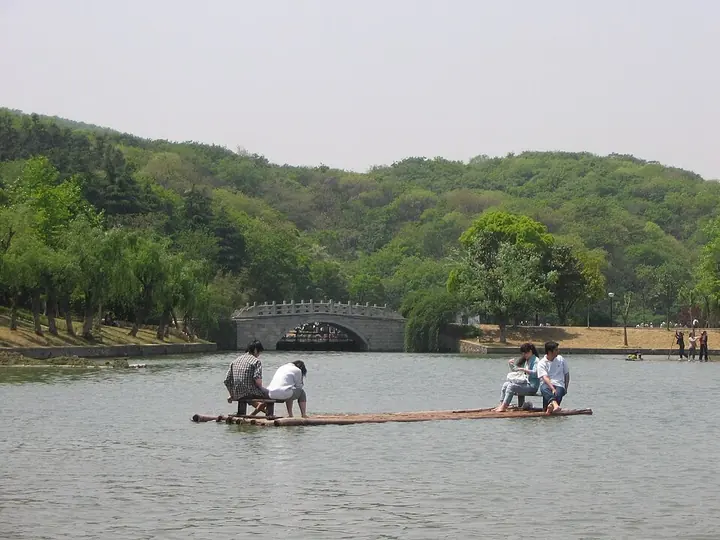
Inside the same resort are the 野生动物园 (800 mu of tigers, lions, bears, monkeys and birds), the 镜山湖 for bamboo rafts and boats, an 800 m mountain slide, the 定山长城 — a 3,000 m replica wall built in 1995 on the ridge between 妙高峰 and 芙蓉峰 — and a 1,040 m cable car that takes about 18 minutes one way. Prices are tiered and change with the season and with the day/night programme; a January 2026 newspaper guide put the resort entry at 60 yuan while ticketing platforms have quoted around 40 yuan, so treat any single figure as indicative and check the official channel.
West of it, 佛手湖中央生态公园 reopened on 1 May 2026 as a free public park and is now joined to the 四方艺术湖区 by a floating bridge across the lake. The art lake district holds more than 20 buildings by international architects — including the 孟菲斯楼, 水榭 and 三合宅 that are lit at night — and the whole area is reached by the 扬子江 tunnel and 沿山大道 if you are driving. A branch of Nanjing's Hongshan Forest Zoo is planned next to the lake.
江浦 and 求雨山
The four memorial halls on 求雨山 — to the calligraphers and painters 林散之, 胡小石, 高二适 and 萧娴, known together as 金陵四家 — were built between 1992 and 2006 and form the 求雨山文化名人纪念馆. The four halls occupy 60 mu with 5,200 sq m of building, a 25,000 sq m cultural square and more than a thousand works; the complex is a national third-grade museum and a 3A scenic area, and from the upper floors you look out towards the Yangtze.
Entry is free and the address is 浦口区江浦街道雨山路48号. The museum's own notice gives opening hours of Tuesday to Sunday 09:00–17:00, with last entry at 16:30 and Monday closures except on public holidays. The nearest metro is Line 10's 文德路站 (Wende Lu), about a 15-minute walk away, or a short ride-hailing trip; local guides also suggest going in the early morning or late afternoon for the light.
Also in the seat: 凤凰山公园, the university campuses whose names appear on Line 10 and S8 station signs, and the 江苏警官学院博物馆, a small museum of police history and fingerprinting inside Jiangsu Police Institute that requires an advance booking through its own WeChat mini-program.
汤泉 and the west: hot springs, ginkgoes, orchards
汤泉街道 is 109 sq km of hillside and river plain on the district's north-west edge, with about 35,000 residents. It is one of China's first "hot spring townships" (中国温泉之乡) and holds 18 natural hot springs flowing at about 4,000 cubic metres a day, with water temperatures of 25–52°C, alongside nine cold springs; the springs are strung along a belt locals call the 十里温泉带, and historic pools such as 太子汤, 琥珀泉 and 银泉 are remembered by name. The street is also a nursery-stock town, with more than 40,000 mu of saplings, and it has one 4A scenic area of its own, 云幽谷旅游区.
The single best-known stop is 古惠济寺, a free temple park at 浦口区惠济北路与高华中心路交叉口北150米. Three ginkgo trees in its grounds are said to have been planted by the Liang-dynasty prince 昭明太子 and are around 1,500 years old; they are named 千年垂乳, 撑天覆地 and 雷击复苏, and they turn gold between late November and mid-December. A 昭明茶室 next to them serves tea under the canopy. To get there, take Metro Line 10 to 雨山路站 (Yushanlu), then bus 608 to the 汤泉东 stop and walk about seven minutes.
North of 汤泉, 永宁街道 is the district's farming street: 109 sq km, about 39,000 people, five flood-plain polders and 16.7 km of the 滁河 inside its boundary, plus a 35 sq km band of farmland laid out along the river. It is a national rural-tourism town, holds the 知青故里 village and its museum of sent-down-youth history in 侯冲社区, and gives its name to 永宁青虾, a freshwater shrimp with a national agro-geographical indication.
West again, 星甸街道 covers 141 sq km with about 30,000 residents and two "pearl villages": 九华茶坊, where most households grow tea on nearly 4,000 mu of hillside, and 山贡里人家, where roughly 10,000 mu of ponds raise crabs and shrimp. The street's Muslim community has cooked here since the mid-Qing, and its halal roast duck and five-spice beef are listed as Nanjing municipal intangible heritage — the duck is hung and roasted, then served with a ladle of seasoned broth. 星甸螃蟹, sold under the 山贡蟹 brand, and the district's 盘城葡萄 were added to the national "famous, special and new agricultural products" list in 2026.
Getting to Pukou
Metro. Four lines already cross or serve the district, and they are the simplest way in. Line 3 runs from 南京站 (Nanjing Railway Station) and 南京南站 (Nanjing South) straight to 浦口区 stations 柳洲东路, 天润城, 泰冯路, 东大成贤学院, 星火路 and 林场 (Linchang), with a change to the S8 line at 泰冯路. Line 10, Nanjing's first cross-river metro (opened 2014, extended east in December 2025), comes from 河西 and 奥体 and ends at 雨山路, calling at 临江, 浦口万汇城, 南京工业大学, 龙华路 and 文德路 on the way. The S3 line leaves 南京南站 over the 大胜关 bridge and stops at 马骡圩, 兰花塘, 双垅, 石碛河, 桥林新城, 林山 and 高家冲 in the district's south. The S8 line (宁天城际) links 泰冯路 with 长江大桥北, 毛纺厂路 and 泰山新村 before heading north to Luhe.
Under construction — do not plan around it yet. Line 11 (一期) is being built from 马骡圩 to 浦洲路, 26.7 km and 20 stations with nine interchanges, work having started in November 2021. Line 4 phase 2 will run about 10 km from 龙江 under the Yangtze to 珍珠泉东; its tunnel was 77% complete in late 2025. The new 南京北站 at 花旗营, next to 永宁, is due to open with the 北沿江 high-speed line in October 2027 with 16 platforms and 30 tracks, and metro lines 3, 4, 15, 18 and S4 are planned to serve it.
Road and ferry. The 南京长江大桥 carries road and rail and is the only Yangtze crossing in Nanjing open to pedestrians and cyclists; the district is also reached by the 大胜关长江大桥, 应天大街长江隧道, 定淮门长江隧道, 扬子江隧道 and 江心洲长江大桥, with 建宁西路长江隧道 and 新生圩长江大桥 still under construction. The 宁浦线 ferry from 中山码头 to 浦口码头 is the slowest crossing but lands you next to the old station.
Bus and taxi. Buses cover the last stretches that metro does not: 608 from 龙华路站 (Line 10) to the 老山森林公园 stop, where 611 also calls; 604, 681, D58 and 694 to the 珍珠泉西大门 stop at Zhenzhu Spring, with G48 serving the 珍珠泉总站; 608 from 雨山路站 (Line 10) to 汤泉东 for 惠济寺; and 637/639/664/695 around 浦口公园 near the ferry pier, with G43 from 雨山路地铁站南 running at weekends and on public holidays only. There is no single drop-off point for a district this size — give the driver a Chinese destination such as 老山森林公园, 珍珠泉风景区, 浦口火车站街区 or 求雨山文化名人纪念馆. Note that 浦口站 itself handles freight only, so no train will take you there.
Getting around, and where to stay
Plan on two or three separate outings rather than one loop. The riverfront — ferry, 浦口火车站街区, the riverside park and the bridge — fits into a half or full day on foot and by bus, with Line 3 or S8 back to the city. 老山 needs its own day, and the villages at its foot (不老村, 响堂) are where guesthouses make sense. 珍珠泉 and 佛手湖 are another half-day, and 求雨山 is a two-hour stop on Line 10. 汤泉, 惠济寺, 永宁 and 星甸 are 25–40 km west of the riverfront and belong to a separate trip by car or bus.
For a base: 江浦 (Line 10, 文德路/龙华路/雨山路) keeps 求雨山 and the 老山 gate within a bus ride; 桥北 puts the bridge, the ferry and the old station within walking distance of Line 3; and the 珍珠泉/佛手湖 area has resort hotels and lakeside guesthouses, including 南京四方酒店傲途格精选 and 澹兮·珍珠泉温泉湖畔山居, while 响堂's 宿里 and the 不老村 houses are the choice if you want to sleep under the trees.
Three practical notes. The district is large and cross-town rides are long, so check the last metro departure before a late dinner out west. The ginkgo season at 惠济寺 and the hot-spring season at 汤泉 both peak from late November, and the resort's water park is summer-only. Finally, keep the ferry and riverside plans flexible: the 宁浦线 can be suspended in fog or high wind, and the 南京长江大桥 is a busy commuter crossing at peak times.
Guide sources
- 浦口区 — 维基百科(中文)
- 概况信息(南京江北新区) — 南京江北新区管理委员会
- 老山国家森林公园 — 南京江北新区管理委员会
- 扬小游游游记|“北岸”微度假,于“山江泉村”间焕活能量 — 扬子晚报·紫牛新闻
- 南京浦口火车站街区低调开街 — 新华网江苏频道
- 浦口站 — 维基百科(中文)
- 朱自清《背影》中的车站“回来”了 — 新华网
- 南京北站 — 维基百科(中文)
- 南京北站刷新建设“进度条” — 南京江北新区管理委员会
- 南京地铁3号线 — 维基百科(中文)
- 南京地铁10号线 — 维基百科(中文)
- 南京地铁S3号线 — 维基百科(中文)
- 南京地铁S8号线 — 维基百科(中文)
- 话说十一号线 — 南京江北新区管理委员会
- 地铁4号线二期最新进展 — 南京市建邺区人民政府
- 珍珠泉风景区(国家AAAA级) — 南京江北新区管理委员会
- 宁有回响 · 珍珠泉游园会(含开放时间与票务说明) — 中国江苏网
- 山水入城,南京佛手湖升格北岸绿心 — 中共江苏省委新闻网
- 求雨山概况 — 南京求雨山文化名人纪念馆官网
- 求雨山文化名人纪念馆 — 南京江北新区管理委员会
- 浦口古惠济寺银杏与交通提示 — 新华日报·交汇点
- 汤泉街道概况 — 南京江北新区管理委员会
- 永宁街道概况 — 南京江北新区管理委员会
- 星甸街道概况 — 南京江北新区管理委员会
- 江北新区永宁青虾、星甸螃蟹喜获“国字号”品牌认证 — 南京市农业农村局
- 中山码头 — 维基百科(中文)
- 南京长江大桥 — 维基百科(中文)
- 千军万马过大桥:“电动车大军”渡江记 — 中国江苏网(新华日报·交汇点)
- 南京夏天避暑去哪玩(含老山森林公园交通) — 南京本地宝
- 南京珍珠泉风景区地址及交通指南 — 南京本地宝
Explore Pukou District
Core places to explore, with English and Chinese names.
Places to explore around Pukou District
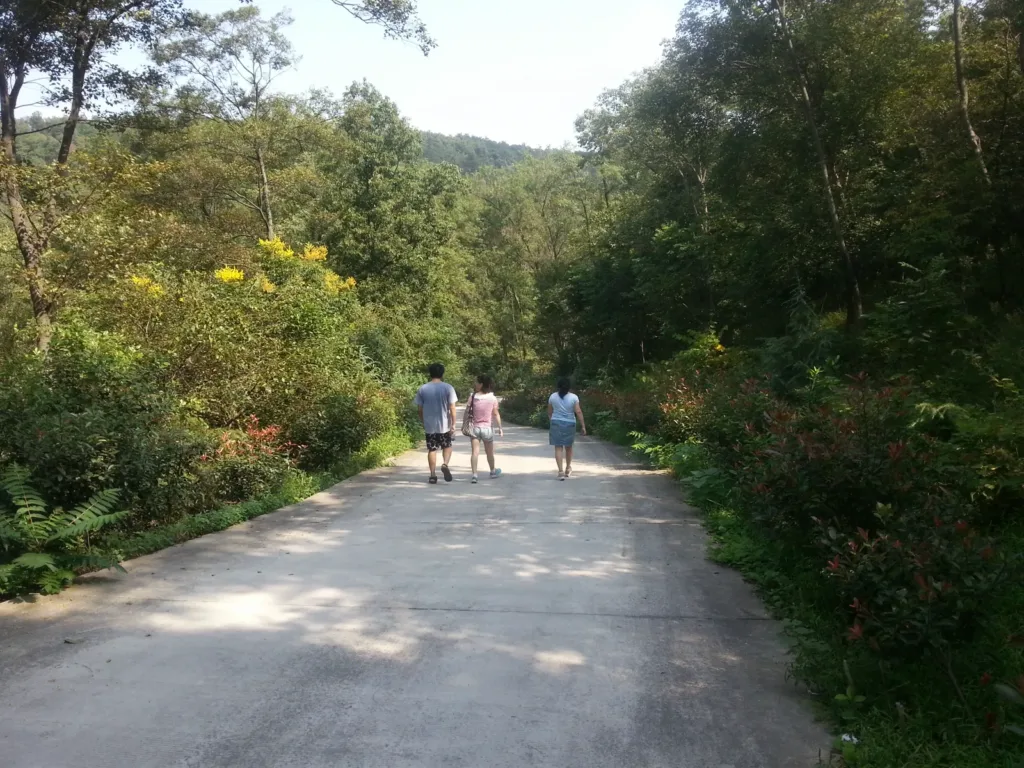 A forest road through the Laoshan woodland in Pukou District, on the north bank of the Yangtze. Photo: Weiping Yu (Panoramio) · CC BY 3.0
Plan your visit
Getting there
Pukou District is about 15 km (straight-line distance) from central Nanjing. Search for 浦口区 in a map app to find stations and your accommodation.
Where to stay →Build your route
Start with Laoshan National Forest Park. The linked place guides have entrance and visit details.
Continue with Nanjing →More in Nanjing
Sources & geographic information
Administrative names and parent areas: Official geographic directory (dmfw.mca.gov.cn) · Reference date 2026-09-06.
Background text adapted from Pukou, Nanjing — Wikipedia contributors, under CC BY-SA 4.0. Text has been shortened and reorganized; source revision 1353411038.
Map data © OpenStreetMap contributors. Pins mark approximate centres, not entrances or boundaries.
Image credits & notes (1)
- Bamboo rafting at Pearl Spring (Zhenzhuquan) in Pukou District, Nanjing. Photograph date recorded by the source: 2006-04-20 12:45:31.Photo: Jack No1 · CC BY-SA 3.0Resized for the web; the photo itself has not been edited. Thumbnails may show a cropped view.
