

Explore the region
Lingering Garden is a historic private garden in Suzhou’s Gusu District, at 338 Liuyuan Road (留园路338号). It is managed by the Suzhou Lingering Garden Management Office. The garden began in 1593 as Dongyuan, the estate of Xu Taishi. After later rebuilding and a succession of owners, Sheng Kang restored and enlarged it in the 1870s and gave it the name Liuyuan, or Lingering Garden. The municipal garden authority describes its present character as representative of Qing garden design; UNESCO includes it among the Classical Gardens of Suzhou, a World Heritage property.
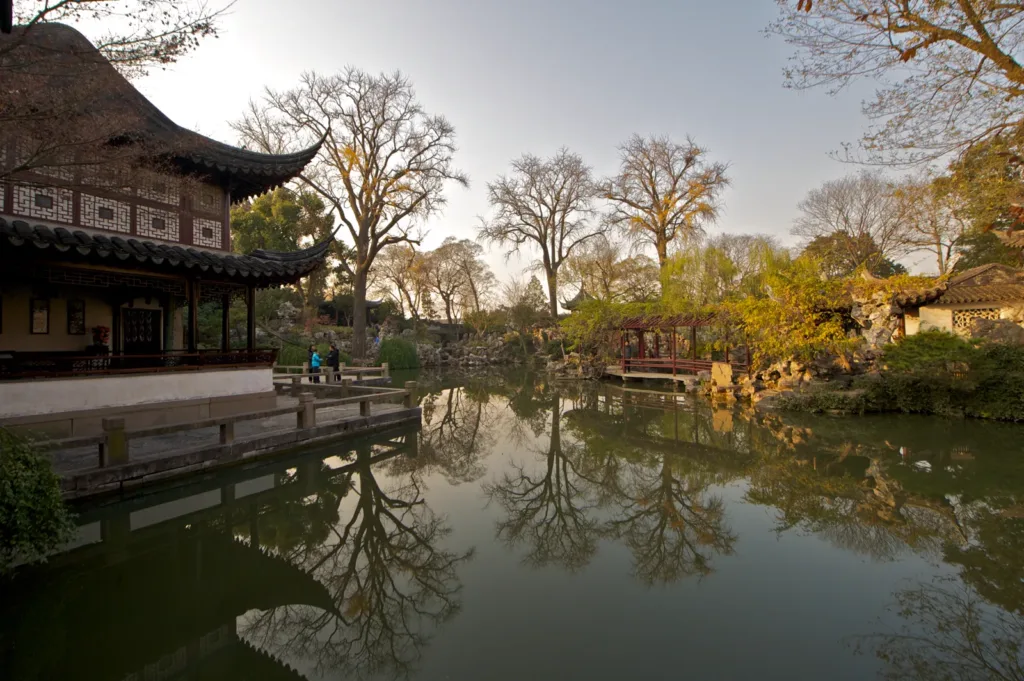
The garden is best understood as a walk through changing compositions, not as a checklist of pavilions. Walls and buildings divide it into central, eastern, northern and western areas, joined by winding covered corridors. In the central area, pause beside the pond and notice how halls, a small island, trees and yellow-stone rockwork make a compact landscape feel larger than its footprint. The waterside Hanhui Shanfang (涵碧山房) and Mingse Lou (明瑟楼) frame the view; from the corridor, openings reveal and conceal the water in turn.
Continue east into a tighter sequence of courtyards. Doorways, lattice windows and corridors set up one view after another, ending at the celebrated Guanyun Peak (冠云峰), a tall Taihu limestone whose cavities and contours invite changing silhouettes as you circle the viewing courts. Ruiyun Peak (瑞云峰) and Xiuyun Peak (岫云峰) stand alongside it. Five-Peak Immortal Hall (五峰仙馆), known locally as the Nanmu Hall (楠木厅), is a large, richly finished reception hall. Look from the hall-and-courtyard scale back to the singular stone: the contrast is part of the garden’s design.
The northern area has a more open, horticultural character, including a bonsai garden and planted paths. The western area turns toward a hill, trees and winding water, with a less architectural, more wooded feel. A useful unhurried sequence is pond and central halls, eastern courtyards and the three peaks, then the north and west before following the covered galleries back toward the exit. The route is a way to compare the garden’s scenes, not a timed or one-way circuit.
The UNESCO listing places gardens like this in a wider Suzhou tradition: limited residential space is shaped into a miniature natural world through water, stones, plants and buildings with literary associations. At Lingering Garden, notice how the route alternates between enclosed thresholds and open views, and how a single rock can be framed like a mountain.
Visiting and getting there
The garden authority’s published schedule lists 07:30–17:30 from March through October, with last entry at 17:00; from November through February it lists 07:30–17:00, with last entry at 16:30. On 22 October 2026, the published seasonal schedule therefore indicates 07:30–17:30 and a 17:00 last entry. Check the authority’s current notice before setting out, because holiday arrangements and temporary changes can differ. The same authority’s rate page lists seasonal prices but does not show a clear update date, so confirm the applicable ticket and entry slot through the official Suzhou Garden Tourism booking channel before purchase.
For the metro, take Suzhou Rail Transit Line 2 to Shilu (石路) station. A local directions listing identifies Exit 1: walk north along Guangji South Road (广济南路) to Liuyuan Road, then turn west and follow the garden signs to the public entrance. The listed directions do not provide a current walking-time guarantee.
Buses listed close to the garden include routes 85, 317 and 933; alight at Liuyuan (留园) stop and follow signs to the visitor entrance. Bus services and stop-side details can change, so check the live route display before boarding.
For a taxi or ride-hail, enter 留园游客入口,苏州市姑苏区留园路338号. The authority confirms the garden’s address; use a signed legal passenger drop-off serving the public entrance and do not stop in a traffic lane. A dedicated curbside lay-by was not confirmed in the sources reviewed.
Combine your visit
A suggested sequence linking the specific features of this visit.
-
Central pond and grotto
Begin with the oldest garden’s main water-and-rock scene.
-
Eastern scholar-stone courts
Compare the display of individual stones with the larger grotto.
-
Western garden
Finish with the more open hill and planted setting.
This order is editorial. Confirm access and any transfers between stops; it does not establish a walking route, same-day connection or common admission ticket.
Find Lingering Garden
留园 · 苏州市
The pin marks the area, not the entrance.
More places nearby
Approximate straight-line distances between map pins, not travel distances.
The Garden of Cultivation 艺圃
2 km awayThe Garden of Cultivation, or Yipu, places a central pond between northern buildings and a southern rock-and-tree landscape. Its relatively direct composition preserves the character of a scholar’s residential garden.
View guide →Mountain Villa with Embracing Beauty 环秀山庄
2 km awayHuanxiu Shanzhuang is a compact Suzhou garden centred on an elaborate rockery associated with the Qing garden designer Ge Yuliang. Its peaks, narrow passages and surrounding pond create a miniature mountain landscape.
View guide →Hanshan Temple 寒山寺
2 km awayHanshan Temple stands at Fengqiao west of Suzhou’s old city. Its association with Zhang Ji’s poem about a night mooring has made the temple bell and canal-side setting central to its identity.
View guide →Sources & visit information
Sources checked on 22 October 2026. Hours, tickets, reservations and transport can change; confirm with the operator before you go.
- Lingering Garden, Suzhou Municipal Garden and Landscape Administration ↗
- Classical Gardens of Suzhou, UNESCO World Heritage Centre ↗
- Opening Hours, Suzhou Municipal Garden and Landscape Administration ↗
- Ticket Prices, Suzhou Municipal Garden and Landscape Administration ↗
- Visitor Instructions, Suzhou Lingering Garden Management Office ↗
- Metro directions to Lingering Garden, Suzhou BendiBao ↗
- Public transit directions to Liuyuan Southeast Gate 1, Moovit ↗
Image credits & notes (1)
- The central water garden, with halls and rockwork reflected in the pond. Photo: Kevin A. McGill (Commons: kevinmcgill from Den Bosch, Netherlands)Photo: CC BY-SA 2.0