

Photo adjustments
Full frame retained; proportionally resized and converted to WebP. No retouching or changes to the photographed subject. Card displays may crop the view.
Explore the region
About The Garden of Cultivation
Its relatively direct composition preserves the character of a scholar’s residential garden.
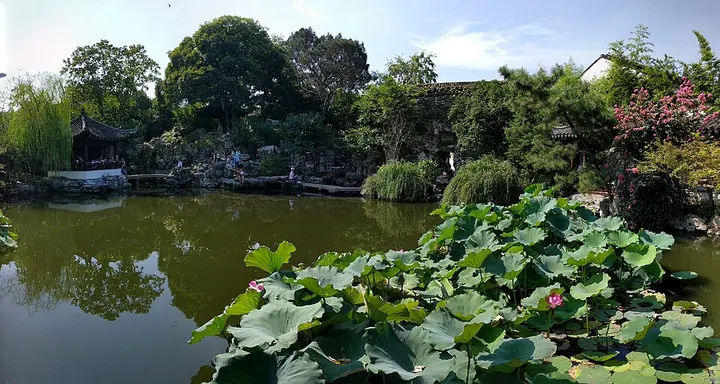
Boya Hall leads toward Yanguang Pavilion, a waterside structure facing the rockery. Ruyu Pavilion is a smaller Ming-period survivor beside the pond. Compare these buildings from the water’s edge to see how the garden creates a broad landscape impression within a compact urban plot.
The garden originated in the Ming Jiajing era (1541) as Zuiying Tang (醉颖堂), built by Yuan Zugeng (袁祖庚). It was later bought by Wen Zhenmeng (文震孟), grandson of Wen Zhengming, who renamed it Yao Pu (药圃). In 1660, Jiang Cai (姜埰) of Laiyang renovated the garden and renamed it Yi Pu (颐圃), also called Jingting Shanfang; his son Jiang Shijie (姜实节) later changed the name to Yipu (艺圃), the present name.
After 1950 the garden served in turn as offices, a theatre troupe's premises and a nursery, and its residential portions were subdivided into housing, shrinking its extent. The Suzhou municipal government relocated the occupying factory and restored the garden between 1982 and 1984, at a cost of 500,000 yuan.
Yipu was listed as a municipal-level protected site in 1963, a Jiangsu provincial-level site in 1995, added to the UNESCO World Heritage list as part of the Classical Gardens of Suzhou in 2000, and listed as a Major Historical and Cultural Site Protected at the National Level (全国重点文物保护单位) in 2006.
What to look for
- Yanguang Pavilion faces the southern rockery across the central pond.
- Ruyu Pavilion preserves a smaller Ming-period waterside structure.
The surrounding area
A provincial city base for classical gardens, canals and soup-noodle breakfasts; do not confuse its old city with the distant North railway station.
Location & getting there
Getting to The Garden of Cultivation
Approach 5 Wenya Lane in Gusu, within the old-city lanes near Changmen.
Combine your visit
A suggested sequence linking the specific features of this visit.
-
Boya Hall
Begin with the garden’s principal hall.
-
Yanguang Pavilion
Read the main pond-and-rockery composition from the waterside building.
-
Ruyu Pavilion
Compare the smaller historic pavilion with the broader water frontage.
This order is editorial. Confirm access and any transfers between stops; it does not establish a walking route, same-day connection or common admission ticket.
Find The Garden of Cultivation
艺圃 · 苏州市
The pin marks the area, not the entrance.
More places nearby
Approximate straight-line distances between map pins, not travel distances.
Mountain Villa with Embracing Beauty 环秀山庄
Less than 1 km awayHuanxiu Shanzhuang is a compact Suzhou garden centred on an elaborate rockery associated with the Qing garden designer Ge Yuliang. Its peaks, narrow passages and surrounding pond create a miniature mountain landscape.
View guide →Lingering Garden 留园
2 km awayThe Lingering Garden is divided into four themed sections linked by covered walkways. Its central garden gathers buildings around a pond and a yellow-stone grotto, while the eastern section focuses attention on a major viewing…
View guide →Temple of Mystery 玄妙观
2 km awayXuanmiao Temple stands on Guanqian Street in Suzhou and is dedicated to the Taoist Three Pure Ones. Its Sanqing Hall preserves a substantial Southern Song timber building with a broad, double-eaved roof.
View guide →Sources & visit information
The sources below support the place-specific description and arrival information. Suggested combinations are editorial planning ideas; confirm current opening, entry arrangements and transport services for your date.
Visitor information adapted and edited from Wikipedia contributors, “艺圃” · CC BY-SA 4.0. Source revision 91611426.
Visitor information adapted and edited from Wikivoyage contributors, listing “The Garden of Cultivation” · CC BY-SA 4.0.
Background paragraphs translated and condensed from Wikipedia contributors, "艺圃", Chinese Wikipedia · CC BY-SA 4.0. Source revision 91611426.